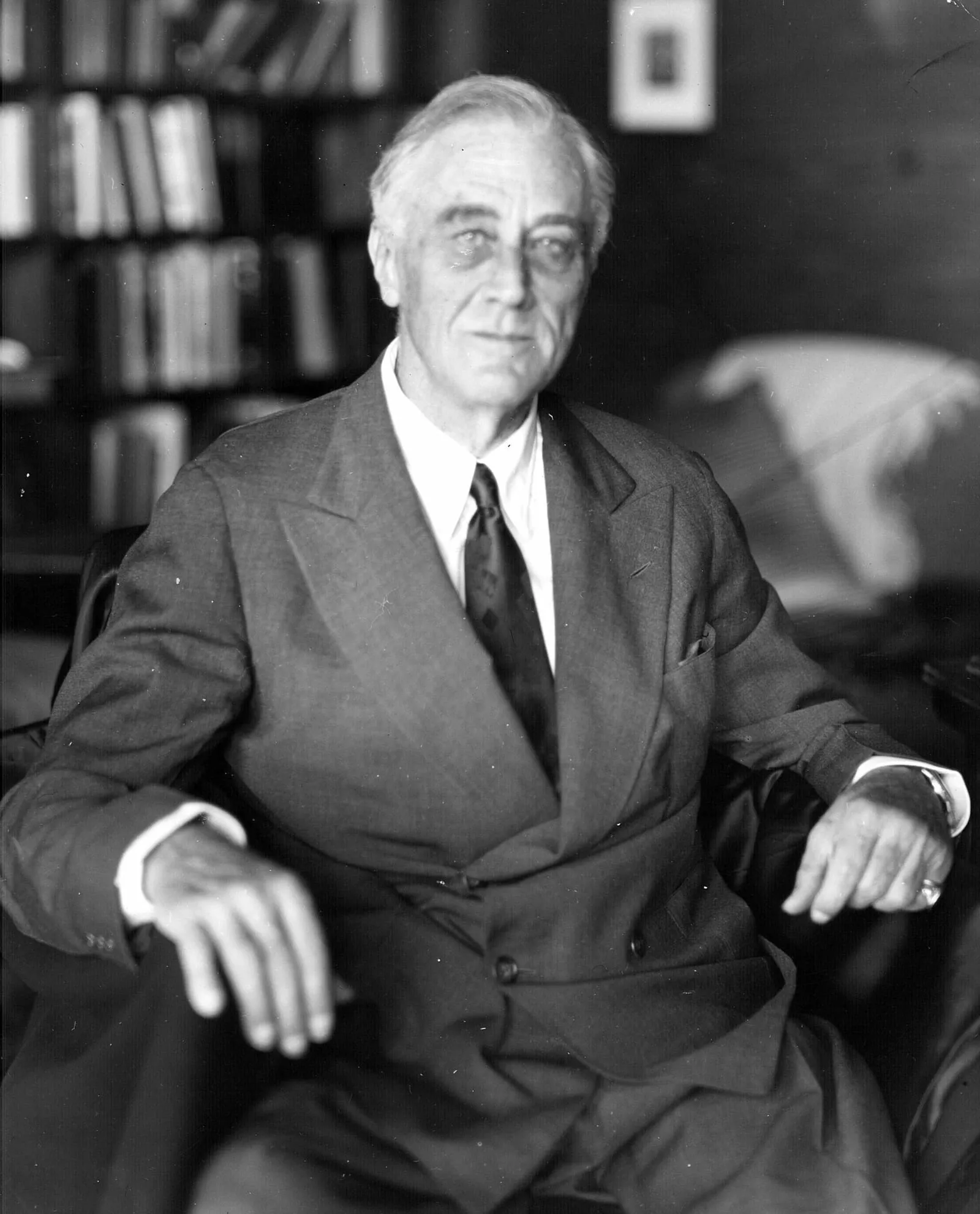
In the early afternoon of 12 April 1945, in a small house at Warm Springs, Georgia, the President of the United States, Franklin Delano Roosevelt, lost consciousness while sitting for a portrait. He died at 3.35 p.m. local time; the doctor diagnosed a massive cerebral haemorrhage. He was 63 and had been in office for his fourth term for less than three months. That same evening, at 7.09 p.m., in the Cabinet Room of the White House, the Vice President, Harry Truman, took the presidential oath.
The news took the world by surprise, although those around the President had seen for months that he was gravely ill. Roosevelt had led the country since March 1933 – through the economic depression, through the years of neutrality and through a war in which the United States had become the principal Allied power. He died less than four weeks before Germany’s surrender and less than two weeks before the opening in San Francisco of the conference that was to bring the United Nations Organisation into being – his most important project for the post-war world.
The last months of a sick president
Roosevelt’s health had been deteriorating since at least 1944. In March of that year the cardiologist Howard Bruenn, who examined him at the naval hospital in Bethesda, diagnosed hypertension, hypertensive heart disease and cardiac failure. The President’s personal physician, Admiral Ross McIntire, advised him to cut back his work and rest daily, while during the 1944 election campaign he publicly assured the country that the President was in good shape. Neither the voters nor – fully – his closest associates knew the truth about his illness. In his book The Dying President (1998) the historian Robert Ferrell argued that by then Roosevelt was too ill to hold office and that his frailty affected his decisions in 1944–1945; other scholars take a more cautious view.
On 20 January 1945 Roosevelt was sworn in for his fourth term at a modest ceremony on the White House portico, and two days later he set off on a long journey: aboard the cruiser USS Quincy to Malta, and from there by air to the Crimea for the Yalta Conference with Stalin and Churchill. He came back exhausted. On 1 March, reporting to Congress on Yalta, he spoke seated for the first time and referred publicly to the weight of the steel braces on his legs, which he had worn since his illness in 1921. Observers were struck by how much he had aged and lost weight, and how often he lost the thread.
On 29 March the President went to Warm Springs to rest. He had been coming there since the 1920s, when he sought relief for his paralysis in the warm springs; he had founded a rehabilitation centre there for polio patients, and in 1932 he had built a modest house known as the Little White House. He was to recover his strength before travelling to San Francisco, where the founding conference of the UN was to open on 25 April. He was accompanied by two cousins, Laura Delano and Margaret “Daisy” Suckley, his secretary Grace Tully, his aide William Hassett and Dr Bruenn. The First Lady, Eleanor Roosevelt, had stayed in Washington.
Even in his last days the President was occupied with the war and with politics. From Warm Springs he corresponded with Churchill and Stalin over the tense matter of the talks in Bern on the surrender of the German forces in Italy, which Moscow regarded as an attempt at a separate deal behind its back. In a cable to Churchill sent on 12 April he advised him to “minimize the general Soviet problem” as far as possible, since such disputes arose every day and most of them were straightened out. He was also preparing a radio address for Jefferson Day, 13 April. The text, whose closing line he is traditionally said to have added in his own hand, ended with the words “The only limit to our realization of tomorrow will be our doubts of today,” followed by a call to move forward with strong and active faith. The address was never delivered.
The afternoon of 12 April
On the morning of 12 April Roosevelt felt, according to those around him, reasonably well, though he complained of a slight headache and a stiff neck. Around noon he was sitting in an armchair by the fireplace in the living room, going through documents and mail sent down from Washington while sitting for a watercolour. The portrait was being painted by the Russian-born American portraitist Elizabeth Shoumatoff, who had been brought to Warm Springs by her friend Lucy Mercer Rutherfurd. Mrs Rutherfurd had been Eleanor Roosevelt’s social secretary in 1914–1918 and – as biographers have established – Franklin’s lover; after the affair was discovered in 1918 he promised his wife to end the relationship, but in the last years of his life he saw her again, sometimes with the help of his daughter Anna. In April 1945 she had come over from Aiken, South Carolina, and was in the living room while the President sat for his portrait.
At about 1.15 p.m. Roosevelt raised his hand to his temple and said: “I have a terrific headache.” A moment later he slumped in his chair and lost consciousness. He was carried to his bedroom. Dr Bruenn diagnosed a cerebral haemorrhage; his blood pressure, according to Bruenn’s later account, was extremely high. Another doctor was summoned by telephone from Atlanta, but there was nothing left to be done. At 3.35 p.m. Bruenn pronounced him dead. Shoumatoff’s unfinished picture – the so-called “Unfinished Portrait” – hangs today at Warm Springs; the painter later made a completed copy for the White House.
Elizabeth Shoumatoff and Lucy Rutherfurd left Warm Springs before the family arrived. The painter’s presence became known and she had to answer journalists’ questions, but the President’s entourage kept quiet about Lucy Rutherfurd’s part in his last day. Eleanor Roosevelt learned of it at Warm Springs from Laura Delano. The wider public learned the story only in 1966, from the memoirs of the President’s former aide Jonathan Daniels. All this is of secondary importance beside the significance of the day, but it belongs to the history of his death, and over the decades a great deal of gossip grew up around it.
“The President is dead”
In Washington Eleanor Roosevelt was at a charity event at the Sulgrave Club when she was urgently summoned to the White House; there the President’s press secretary, Stephen Early, and Dr McIntire told her that her husband was dead. At about five in the afternoon Early telephoned the Vice President and asked him to come to the White House. Truman, who in accordance with his duties had presided over the Senate that day, had just adjourned the session and dropped into the office of the Speaker of the House of Representatives, Sam Rayburn, for an afternoon drink. He drove to the White House thinking – as he later recalled – that the President had unexpectedly returned from Georgia and wanted to see him.
Upstairs, in the private quarters, Eleanor Roosevelt put her hand on his shoulder and said: “Harry, the President is dead.” When Truman asked whether there was anything he could do for her, she answered with a question that has gone down in history: “Is there anything we can do for you? For you are the one in trouble now.” Shortly before six in the evening, Washington time, Early gave the news to the press agencies. Radio programmes were interrupted, and within the hour the news had spread across the country and the world.
Members of the Cabinet, congressional leaders and the Chief Justice, Harlan Fiske Stone, were called in. A Bible took a long time to find. At 7.09 p.m. in the Cabinet Room, beneath a portrait of Woodrow Wilson, Truman took the oath, with his wife Bess and daughter Margaret beside him. The ceremony lasted about a minute. Immediately afterwards the new President convened the Cabinet and took his first decision: asked by the Secretary of State, Edward Stettinius, he replied that the San Francisco conference would go ahead as planned on 25 April. After the meeting the Secretary of War, Henry Stimson, stayed behind for a moment and told him that work was under way on a new explosive of almost unbelievable destructive power. Truman learned the details of the Manhattan Project only at a meeting with Stimson and General Leslie Groves on 25 April.
Truman had been Vice President for 82 days. According to his own account and the findings of his biographers, he had met Roosevelt alone only twice in that time and had not been let into the most important matters of the war and diplomacy. The next day, 13 April, he told reporters at the Capitol: “I don’t know if you fellas ever had a load of hay fall on you, but when they told me yesterday what had happened, I felt like the moon, the stars, and all the planets had fallen on me.” He asked them to pray for him.
The funeral train and the burial
Because of the war, a full state funeral with the coffin lying in state at the Capitol was dispensed with. On the morning of 13 April the flag-draped coffin was taken to the station at Warm Springs along a road lined by soldiers from nearby Fort Benning and by patients from the rehabilitation centre. A photograph of a Black Navy petty officer, Graham Jackson, playing “Goin’ Home” on the accordion with tears in his eyes, published by Life magazine, became one of the best-known images of those days. The train carrying the coffin, the family and the President’s staff set off for Washington. Along the route through Georgia, both Carolinas and Virginia, even at night, hundreds of thousands of people – according to the press – stood beside the tracks.
On the morning of 14 April the train arrived at Union Station in Washington. The cortège, with the coffin on an artillery caisson, passed through the streets to the White House, watched by crowds while aircraft flew overhead. In the afternoon a simple service was held in the East Room, attended by the family, President Truman, members of the government and Congress, diplomats and military officers. In the evening the train set off north to Hyde Park on the Hudson. On Sunday 15 April Franklin Delano Roosevelt was buried, according to his wishes, in the rose garden of the family estate at Springwood, to volleys fired by West Point cadets. Thirty days of mourning were declared across the United States; they coincided with the end of the war in Europe, and Truman dedicated Victory Day to the memory of the late President.
Reactions around the world
The news reached Britain during the night of 12/13 April. Winston Churchill, who had met Roosevelt several times during the war and exchanged almost two thousand letters and messages with him, later wrote that he felt as if he had been struck a physical blow. He considered flying to the funeral but in the end stayed at home; the Foreign Secretary, Anthony Eden, flew to Washington and then went on to San Francisco. On 17 April a memorial service was held at St Paul’s Cathedral, and Churchill delivered a farewell tribute in the House of Commons, in which he called the late President the greatest American friend the British had ever known and the greatest champion of freedom ever to have brought help and comfort from the New World to the Old.
In Moscow flags were lowered to half-mast, and Pravda appeared with Roosevelt’s portrait in a black frame. The US ambassador, Averell Harriman, who called on Joseph Stalin on the evening of 13 April, reported that the Soviet leader held his hand for a long time in silence and questioned him about the circumstances of the death. At Harriman’s request Stalin agreed – as a gesture towards the new President – to send the Foreign Minister, Vyacheslav Molotov, to the San Francisco conference, which he had previously refused to do.
In Berlin the news was greeted with hope divorced from reality. The Propaganda Minister, Joseph Goebbels, who had returned late in the evening from a visit to the headquarters of the 9th Army on the Oder, is said – according to the diary of the Finance Minister, Johann Ludwig Schwerin von Krosigk, quoted by the historian Hugh Trevor-Roper – to have telephoned Hitler with the words: “My Führer, I congratulate you! Roosevelt is dead. It is written in the stars that the second half of April will be the turning point for us. Today is Friday, 13 April. This is the turning point!” In the bunker beneath the Reich Chancellery an analogy from the Seven Years’ War came back to life: the death of the Empress Elizabeth of Russia in 1762, which had saved Frederick the Great from defeat (the “Miracle of the House of Brandenburg”). In an order of the day to the soldiers of the Eastern Front on 16 April, Adolf Hitler called the late President “the greatest war criminal of all time”. The euphoria was short-lived – Roosevelt’s death changed nothing in the military situation or in Allied policy.
Tokyo reacted differently. The Prime Minister, Kantarō Suzuki, who had taken office on 7 April, expressed in a statement to the Dōmei agency – as foreign news agencies reported – his “profound sympathy” to the American people on the loss of the leader to whom he attributed their present advantage. His words contrasted both with Goebbels’s tone and with Japanese propaganda.
Among Poles in exile the news aroused mixed feelings. Roosevelt had been the leader of a great power from which the Polish government in London expected support, but he was also one of the authors of the Yalta decisions on Poland’s eastern border and government, which the government of Tomasz Arciszewski had declared contrary to law and to Poland’s interests. At the time of the President’s death, sixteen leaders of the Polish Underground State, treacherously arrested on 27–28 March and taken to Moscow, had been in the hands of the NKVD for two weeks.
At the fronts the news arrived at different moments. Generals Dwight Eisenhower, Omar Bradley and George Patton, who had visited the liberated camp at Ohrdruf that day, heard it on the radio at night in Patton’s quarters. The soldiers on Okinawa learned of it on the morning of 13 April, in the midst of heavy fighting; memorial services were held aboard the ships.
The legacy of twelve years
Roosevelt held office longer than any other President of the United States – 12 years and 39 days – and was the only one to win four elections. This experience led to the ratification in 1951 of the 22nd Amendment to the Constitution, limiting the presidency to two terms. He took office in March 1933, at the lowest point of the Great Depression, and responded with the New Deal: banking reform, public works, social security and labour legislation that permanently changed the role of the federal government in American life.
In foreign policy he travelled the road from the Neutrality Acts of the 1930s to the leadership of the anti-Hitler coalition. After the fall of France in 1940 he urged Americans that their country must become the “arsenal of democracy”, and the Lend-Lease Act of March 1941 opened the way to supplies of weapons and materials for Britain, the USSR, China and other states fighting the Axis. In August 1941, together with Churchill, he proclaimed the Atlantic Charter, and after the attack on Pearl Harbor he led the country into a two-ocean war, adopting the “Germany first” principle. It was on his initiative that the Declaration by United Nations was issued on 1 January 1942, and in 1944 the plan for a new international organisation was drawn up at Dumbarton Oaks. The San Francisco Conference, opened on 25 April 1945, adopted the Charter of the United Nations on 26 June. Thanks to Einstein’s letter and Roosevelt’s decisions, the programme to build the atomic bomb was also set in motion.
His record also has dark sides, which historians list alongside his achievements: the incarceration of more than a hundred thousand Americans and US residents of Japanese descent under the executive order of February 1942; caution towards Jewish refugees and the news of the Holocaust (the War Refugee Board was set up only in January 1944); and, finally, the concessions to Stalin at Tehran and Yalta, including over Poland’s border and government. In Poland it is with Yalta that his name is most often associated. The debate over whether the Western Allies could have achieved more – with the Red Army standing in the middle of Europe – and whether the President’s illness affected his decisions continues to this day.
What the change in the White House brought
Roosevelt’s death did not alter the course of the fighting. That same week the Red Army took Königsberg and was finishing the battle for Vienna, American troops were reaching the Elbe, and on Okinawa heavy fighting against the Japanese continued. German hopes that the coalition would fall apart proved illusory: from his first day the new President insisted that he would continue his predecessor’s policy and carry the war through to the unconditional surrender of Germany and Japan.
Much changed, however, in the style and substance of American policy. Truman, a Missouri politician with no experience of international affairs, had to familiarise himself within weeks with arrangements that Roosevelt had handled personally and often without putting them on paper. As early as 23 April, in a conversation with Molotov in Washington, he sharply accused the Soviet Union of breaking the Yalta agreements on Poland. It was he who announced the victory in Europe to the American people, took part in the Potsdam Conference in the summer of 1945 and decided to use the atomic bomb against Japan. In the years that followed it was his administration – not Roosevelt’s – that faced the break-up of the wartime coalition and the beginning of the Cold War.
For many contemporaries 12 April 1945 marked the end of an era. Of the three leaders of the Big Three who had discussed the post-war world at Yalta in February, only Stalin remained in power at the end of the war with Japan: Roosevelt died in April, and Churchill lost the election in July. The order that Roosevelt had wanted to build on the cooperation of the great powers within the UN did come into being – but in an atmosphere quite different from the one he had envisaged.
Sources
Meanwhile
(04)Elsewhere, within a week.
- 11 April 1945 · Western FrontThe liberation of BuchenwaldOn 11 April 1945 the US 6th Armored Division reached Buchenwald near Weimar. The camp, taken over by the prisoners' underground, held some 21,000 inmates.
- 11 April 1945 · PacificKamikaze over OkinawaOn 11 April 1945 a kamikaze hit the battleship Missouri and the carrier Enterprise was damaged. The attacks off Okinawa killed nearly 4,900 sailors.
- 13 April 1945 · Western FrontThe Gardelegen massacreOn 13 April 1945, near Gardelegen in the Altmark, Germans burned and shot 1,016 concentration camp prisoners evacuated ahead of the front in a barn.
- 14 April 1945 · PacificThe Tokyo raid of 13–14 AprilOn the night of 13/14 April 1945 over 300 B-29s burned some 30 km² of northern Tokyo, killing about 2,500. On 15/16 April Kawasaki and Yokohama burned.
Related events
(04)The same battle, people or subject.
- 4 April 1945 · Western FrontThe liberation of OhrdrufOn 4 April 1945 soldiers of the US Third Army entered Ohrdruf, a Buchenwald subcamp in Thuringia – the first Nazi camp liberated by the Americans.
- 25 April 1945 · Western FrontThe meeting on the ElbeOn 25 April 1945 patrols of the US 69th Infantry Division met Red Army soldiers on the Elbe near Strehla and at Torgau. The Reich was cut in two.
- 27 March 1945 · Western FrontEisenhower gives up BerlinAt the end of March 1945 Eisenhower decided that the Allies' main objective was not Berlin but Leipzig and Dresden. He left the Reich's capital to the Red Army.
- 9 May 1945 · Central and Eastern EuropeThe Red Army in PragueOn the morning of 9 May 1945 Konev's tanks entered Prague. By 11 May Army Group Centre had surrendered, while the Americans halted on a line near Plzeň.