Equipment
Supermarine Spitfire
The British fighter that came out of the Battle of Britain as a symbol of resistance and, constantly improved, fought in the front line until 1945.
- Role:
- fighter
- State:
- United Kingdom
- Maker:
- Supermarine (Vickers-Armstrongs)
- First flight:
- 5 March 1936
- Built:
- over 20,300 (not counting the Seafire naval version)
- Author:
- Natalia
- Updated:
- 1 November 2026
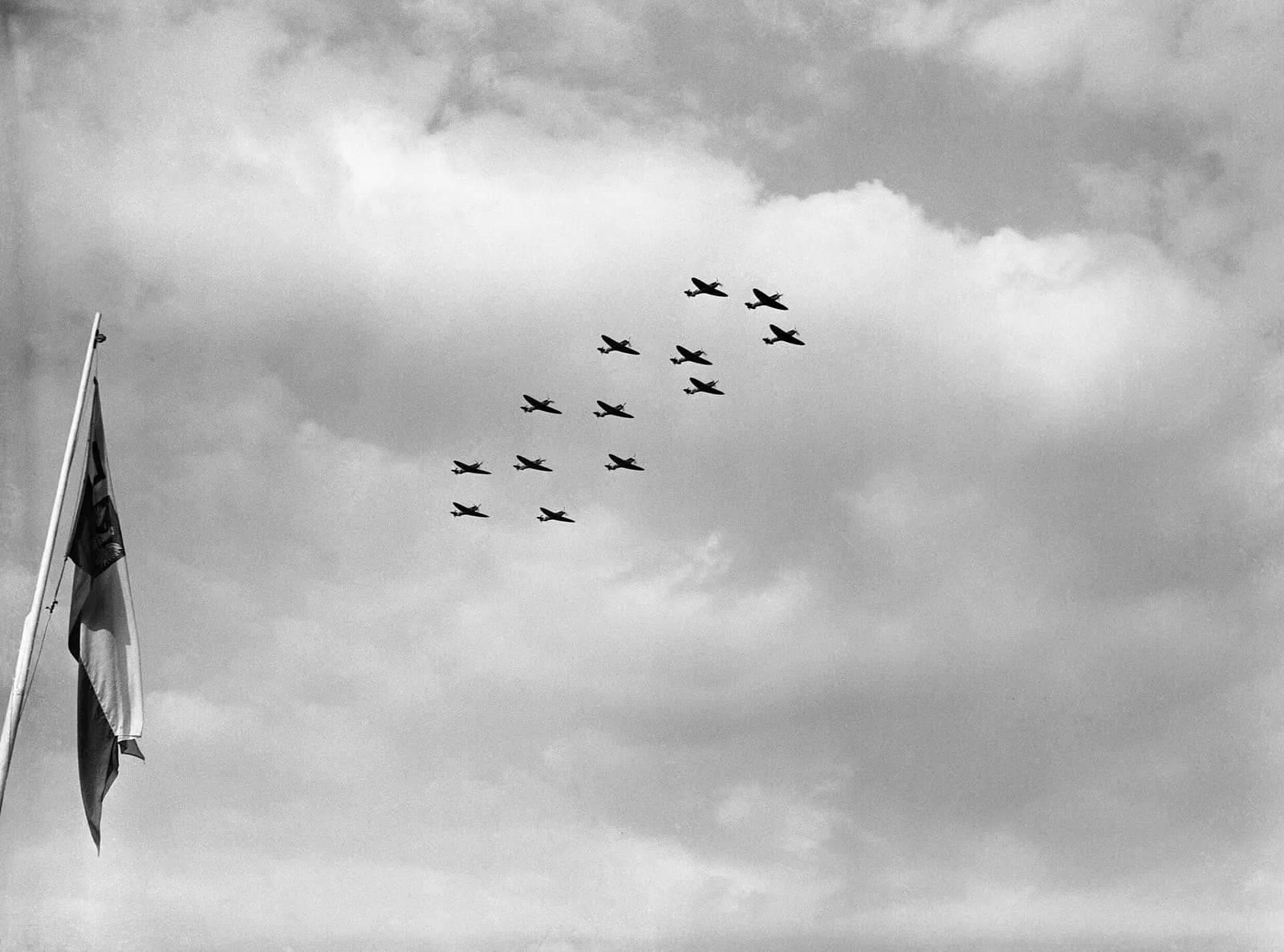
The Supermarine Spitfire was the only British fighter built without a break throughout the war, from its first day to its last. It did not win the Battle of Britain on its own – most of the work was done by the more numerous Hurricanes – but it became the face of that battle and the symbol of British resistance in 1940. Its real strength lay in a design that could absorb ever more powerful engines: successive versions kept up with new German fighters until the end of the war. It fought over the English Channel, over Malta, in Africa, in Italy, in Burma and over northern Australia.
From racing seaplanes to a fighter
The chief designer of Supermarine (PL) of Southampton, Reginald Joseph Mitchell, had made his name with racing seaplanes such as the Supermarine S.6 (PL), which won the Schneider Trophy for Britain at the start of the 1930s. His first attempt at a fighter to the ministry’s F.7/30 specification of 1930 was a failure. So Mitchell started again: a small low-wing monoplane with a thin, elliptical wing that held eight machine guns, powered by the new Rolls-Royce Merlin.
The prototype, K5054, was first flown on 5 March 1936 at Eastleigh by Vickers’ chief test pilot, Joseph “Mutt” Summers. In May it reached about 560 km/h (some 348 mph) in level flight, and on 3 June 1936 the Air Ministry ordered 310 aircraft. Mitchell, ill with cancer, died on 11 June 1937, before the first production Spitfire reached a unit; his work was taken over by Joseph Smith, who went on developing the aircraft throughout the war. Production was slow, because the complicated wing was too much for a small firm. The first aircraft went to No. 19 Squadron at Duxford on 4 August 1938.
The Battle of Britain
Spitfires scored their first victories as early as 16 October 1939, when they shot down two German bombers over the Firth of Forth. The head of Fighter Command, Hugh Dowding, who had ordered the type as a member of the Air Council, guarded it jealously and would not send it to France. Spitfires first met Messerschmitts on a large scale in May 1940 over the beaches of Dunkirk, flying from airfields in England.
In the summer of 1940 RAF Fighter Command had far more squadrons of Hurricanes than of Spitfires, and it was the Hurricanes that shot down the most German aircraft. The Spitfire, however, was faster and better at height, so commanders liked to send it against the escorting fighters while the Hurricanes went for the bombers. Against the Messerschmitt Bf 109 it fought as an equal: the German climbed and dived better, the Briton turned more tightly. In Keith Park’s No. 11 Group, which bore the brunt of the fighting, squadrons of both types fought side by side. Production at the new factory at Castle Bromwich only got going under the Minister of Aircraft Production, Lord Beaverbrook, and collections “for a Spitfire” in towns across the Empire turned the aircraft into a propaganda hero.
The enemy himself added to the legend. According to the memoirs of Adolf Galland, when an angry Hermann Göring asked in the summer of 1940 what his fighter pilots needed, Galland replied that he would like Spitfires for his wing. It was more a jibe at a command that tied the fighters to the bombers than an honest verdict on the aircraft: Galland believed in his Messerschmitt.
From Merlin to Griffon
In 1941 the RAF went over to the offensive above France, and the Spitfire Mk V, with a more powerful Merlin and often with 20 mm cannon, became the most numerous version. From January 1941 the Polish fighter squadrons (PL) began converting to Spitfires, starting with No. 303 Squadron. In the autumn of 1941, however, the Focke-Wulf Fw 190 appeared over the Channel, clearly better than the Mk V. The answer was the Mk IX with a two-stage supercharger, introduced from the summer of 1942. On 19 August 1942, during the Dieppe raid, the two types clashed in the biggest air battle of the year, and the whole Polish wing, flying Spitfire Mk Vs, achieved, according to Polish tallies, the best result of any RAF wing. Two days earlier Spitfires had escorted the first American B-17 raid on France. Their short range, though, limited them to escort work over France and the Low Countries.
Unarmed reconnaissance Spitfires, light and fast, photographed the ports, airfields and factories of the Reich from 1939. It was on their photographs from 1943 that analysts spotted rockets at Peenemünde, which led to Operation Hydra.
From 1943 units began to receive versions with the larger Rolls-Royce Griffon (PL) engine, first the low-level Mk XII, then the Mk XIV. In the summer of 1944 Griffon Spitfires were among the few fighters that could catch the V-1 flying bombs over southern England. After the Normandy landings the Mk IX and XVI also served as fighter-bombers.
Malta and distant fronts
The Spitfire’s most dramatic chapter came over Malta in 1942. On 7 March the first fifteen aircraft reached the island from the carrier Eagle, the first fighter Spitfires to serve outside the British Isles. In April the Germans destroyed most of the next delivery on the ground, but on 9 May Operation Bowery brought more than sixty aircraft, which went straight into action. By the autumn carriers had delivered some 275 Spitfires to the island, and Malta’s defence, under Park’s command, turned to intercepting the enemy over the sea.
The Spitfire also fought far from Europe. In 1943 a Spitfire wing defended northern Australia, but in the fight over Darwin on 2 May the tropical version, whose filter robbed it of some of its performance, lost many aircraft to fuel shortage and mechanical failure. Spitfires were supplied to the Soviet air force, which used them over the Kuban in 1943, and flown by American squadrons in Britain and the Mediterranean. From 1942 the Fleet Air Arm used the naval Seafire, fast but too delicate for landing on carrier decks.
The legend
By February 1948 more than 20,300 Spitfires had been built, and with the Seafires over 22,000; no other British fighter was built in such numbers. The engines of the 1945 versions had more than twice the power of the prototype’s Merlin, and the Spitfire flew its last RAF operational sortie in 1954. Historians point out that in 1940 the Hurricane brought more victories, and that in the last years of the war American long-range fighters did what the Spitfire could not. Yet it was the Spitfire, elegant and constantly improved, that remained in British memory as the aircraft that saved the island.
Sources
Battles
(06)- 26 May – 4 June 1940Battle of DunkirkFrom 26 May to 4 June 1940 the Allies held a perimeter around Dunkirk while a fleet of over 800 vessels evacuated 338,000 troops to England.
- 11 June 1940 – 20 November 1942Siege of MaltaFrom June 1940 to November 1942 Italy and Germany bombed and blockaded Malta. The island held out and became a base for attacks on Axis convoys to Africa.
- 10 July – 31 October 1940Battle of BritainFrom 10 July to 31 October 1940 the Luftwaffe tried to destroy the RAF ahead of an invasion of Britain. It failed, and Hitler postponed the landing.
- 10–15 August 1942Operation PedestalOn 10–15 August 1942 the Pedestal convoy fought its way to Malta. Five of 14 ships arrived, including the tanker Ohio, and their cargo saved the island.
- 20–28 March 1943Battle of the Mareth LineOn 20–28 March 1943 Eighth Army attacked the Mareth Line. The frontal assault failed, but an outflanking move through the Tebaga Gap forced Messe to retreat.
- 8 September – 22 November 1943Dodecanese campaignBetween 8 September and 22 November 1943 the Germans took Rhodes, Kos, Leros and Samos from the British and Italians. Luftwaffe air supremacy decided it.
In the chronicle
(34)1940
- 24 May 1940The halt order before Dunkirk
- 26 May 1940Operation Dynamo
- 4 June 1940“We shall fight on the beaches”
- 10 July 1940The Battle of Britain begins
- 12 July 1940Air raids on Wales and Scotland
- 1 August 1940Operation Hurry
- 13 August 1940Adlertag
- 15 August 1940Black Thursday
- 29 November 1940Raids on Liverpool and Southampton
1942
- 7 January 1942Malta under air attack in January 1942
- 7 March 1942The first Spitfires over Malta
- 20 April 1942Operation Calendar
- 9 May 1942Operation Bowery
- 11 June 1942Operation Harpoon
- 11 August 1942The sinking of HMS Eagle
- 15 August 1942The Ohio reaches Malta
- 17 August 1942The first B-17 raid on Rouen
- 19 August 1942The Dieppe Raid
- 29 September 1942The Eagle Squadrons join the USAAF