United Kingdom
Frank Messervy
Commander of Gazelle Force (1940–1941), the 4th Indian Division (1941), the 1st and 7th Armoured Divisions (1942), the 7th Indian Division (1943–1944) and IV Corps (1944–1945)
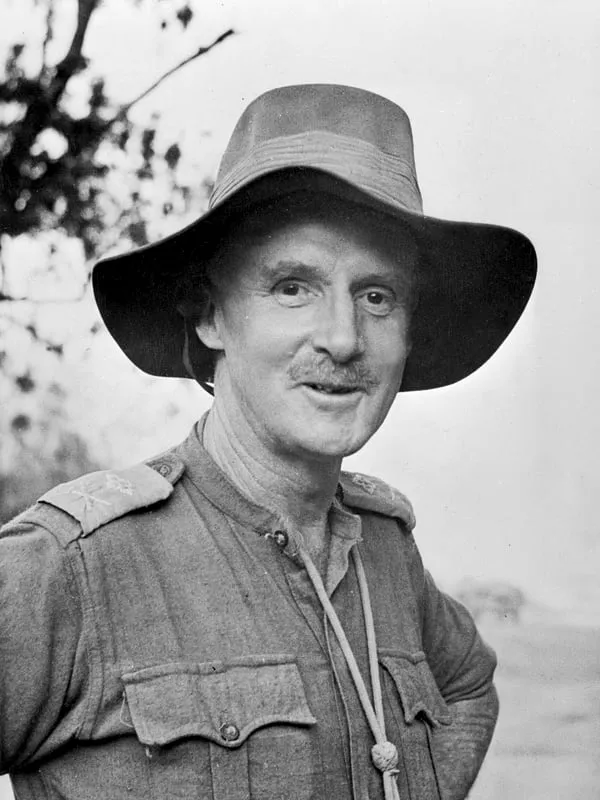
- Born:
- 9 December 1893, Trinidad (Trinidad and Tobago)
- Died:
- 2 February 1974, Heyshott (United Kingdom)
- Author:
- Natalia
- Photo:
- No 9 Army Film & Photographic Unit, domena publiczna, Wikimedia Commons

Frank Messervy went through the Second World War as few British generals did: he fought the Italians in Eritrea, the Afrika Korps in the Libyan desert and the Japanese in Burma. In the desert he was sometimes beaten, and once he was even taken prisoner by the Germans, escaping by sheer cunning. In Burma he was one of the best commanders in General William Slim’s Fourteenth Army: his division withstood encirclement in the Arakan, and in 1945 his corps dealt the Japanese the decisive blow at Meiktila and led the drive on Rangoon. After the war he became the first commander-in-chief of the Pakistan Army, during the first war over Kashmir.
A cavalryman of the Indian Army
Frank Walter Messervy was born on 9 December 1893 in Trinidad, where his father, who came from Jersey, managed a bank; his mother came from the local de Boissière family. He was educated at Eton College and at the Royal Military College, Sandhurst. He was commissioned as a second lieutenant in January 1913 for service with the Indian Army. He served in the cavalry, in Hodson’s Horse. In the First World War he fought in France and then in Palestine and Syria, and in 1919 also in Kurdistan.
Between the wars
Messervy attended the Staff College at Camberley in 1925–1926, was a brigade major on India’s North-West Frontier, and in 1932–1936 was an instructor at the Staff College at Quetta (PL). One of his fellow instructors there was Bernard Montgomery. In 1927 he married Patricia Courtney, a colonel’s daughter; they had a daughter and two sons. In 1938–1939 he commanded the 13th Duke of Connaught’s Own Lancers.
Gazelle Force and Keren
In September 1939 Messervy, by then a colonel, became chief staff officer of the newly forming 5th Indian Division, which in 1940 was sent to the Sudan against the Italians in East Africa. In October 1940 he was given Gazelle Force – a mobile reconnaissance and strike group made up of Indian troops, units of the Sudan Defence Force and artillery. When the British offensive in East Africa began in January 1941 (see the East African campaign), Gazelle Force led the way: after the capture of Kassala it pursued the Italians towards Agordat, where at Keru it was briefly held up by mounted askaris, and on to the foot of the rock wall at Keren. In March Messervy, as an acting brigadier, commanded the 9th Indian Brigade in the decisive phase of the Battle of Keren.
In the Libyan desert
As early as April 1941, after only six weeks as a brigadier, Messervy took over the 4th Indian Division as an acting major-general. In June the division fought for the Halfaya Pass in the failed Operation Battleaxe. In November, in Operation Crusader, the Indian brigades dug in on the Egyptian frontier beat off Rommel’s tanks during his dash to the Egyptian frontier, and in December the division took part in the pursuit that ended at Benghazi.
In January 1942 Messervy was due to return to India, but instead he took over the 1st Armoured Division in place of the wounded General Herbert Lumsden. The division, newly arrived in the desert and weaker than the German panzer divisions, was routed in Rommel’s second offensive. In March Messervy took over the famous 7th Armoured Division from General Jock Campbell, who had been killed in a car accident; he was the only Indian Army officer to command a British division in this war.
On the morning of 27 May, at the start of the Battle of Gazala, German tanks overran the divisional headquarters and Messervy was taken prisoner. He tore off his badges of rank, convinced the Germans that he was a mere batman, and escaped at the first opportunity; he was back with his own side the next day. For two days, however, the division had no effective command. In the following weeks Messervy was again unlucky: on “Black Saturday” he drove off to confer with his corps commander, ran into the Germans near El Adem and for several hours had no contact with his brigades, which were waiting for orders. It was also he who passed on to General Marie-Pierre Kœnig the decision to withdraw the French from Bir Hakeim. His superiors concluded that Messervy, a cavalryman with no experience of armour, was not suited to commanding an armoured division, and in mid-June General Neil Ritchie took the 7th Division away from him.
Tanks for Burma
For a few weeks Messervy was Deputy Chief of the General Staff in Cairo; he then returned to India to raise the 43rd Armoured Division, intended for the defence of Persia. When after Stalingrad the threat to Persia had passed, the division was disbanded, and in 1943 Messervy became Director of Armoured Fighting Vehicles at General Headquarters in India. He regarded the post as a punishment but put it to good use: he persuaded the staff that, contrary to the prevailing opinion, not only light tanks but medium ones too could be used in the jungles of Burma. In 1944–1945 medium tanks proved one of the most effective weapons against the Japanese.
The Admin Box and Kohima
In mid-1943 Messervy took over the 7th Indian Division and in the autumn led it to the Arakan, where in the winter XV Corps advanced on Maungdaw. At the beginning of February 1944 the Japanese, in Operation Ha-Go, infiltrated the division’s scattered lines, outflanked them and on 6 February fell on its headquarters. Messervy and part of his staff fought their way through to the supply base at Sinzweya, known as the “Admin Box”, and directed the defence from there. In line with General William Slim’s new rules, the encircled units did not fall back, and transport aircraft dropped them ammunition and food. The Japanese, who had counted on captured supplies, began to starve themselves and at the end of February broke off the operation. It was the first clear victory of British and Indian troops over the Japanese in Burma, and in April 1944 Messervy received a second Distinguished Service Order for the fighting in Burma.
In the spring two of his brigades were flown to besieged Imphal and Kohima, and in May the whole division fought in the Battle of Imphal and Kohima: it attacked along the Kohima ridge, fought hard for the Naga Village, and then pursued the Japanese towards the Chindwin.
Meiktila and Rangoon
In December 1944 Messervy took over IV Corps as a lieutenant-general, when the Fourteenth Army was already advancing towards the Irrawaddy. Slim gave him the key role in his new plan. The corps moved in secret from the left flank of the army to the right, southwards down the Gangaw valley, while a dummy headquarters sent out signals as if it were still heading for Mandalay. In mid-February 1945 its 7th Division crossed the Irrawaddy at Nyaung-U, and General David Cowan’s 17th Division with an armoured brigade struck at Meiktila, the main Japanese communications centre and base. The town fell at the beginning of March, and the cut-off Japanese armies tried in vain to retake it (see the Battle of Meiktila and Mandalay).
In April IV Corps, with tanks in the lead, raced along the railway and road in the Sittang valley, covering more than 300 kilometres in a month, to reach Rangoon before the monsoon. The rains, however, stopped it some tens of kilometres short of the city, which was taken by a seaborne landing. In July 1945 Messervy was knighted. By the time he returned from leave in England, the war was over. He took over Malaya Command and in February 1946 at Kuala Lumpur received the sword of the surrendering General Seishirō Itagaki.
Pakistan and Kashmir
In 1946 Messervy took over Northern Command in India, and when Pakistan came into being on 14 August 1947 he became the first commander-in-chief of its army. A few weeks later the war over Kashmir began: in October armed tribal volunteers from the Pashtun tribes invaded the princely state, followed in 1948 by regular Pakistani units as well. Messervy’s role remains disputed. According to Indian authors and some accounts by Pakistani officers, the Pakistan Army under his command helped to arm and direct the invaders; he himself, abroad at the time of the invasion, publicly denied that Pakistani officers were directing the fighting. In February 1948 he gave up his post, and in August he left the army with the honorary rank of general. Later, in a widely noticed article, he claimed that India had been preparing an intervention in Kashmir several weeks before the events.
In retirement he was, among other things, Deputy Chief Scout and a Berkshire county councillor. He died on 2 February 1974 at his home in the village of Heyshott (PL) in the south of England. In 1961 a biography of him, “Spearhead General”, was published. Messervy was no great strategist and as an armoured commander in the desert he failed, but he was a brave, energetic commander who learned well from his own mistakes. In Burma, in a fast war of movement that relied on air supply and on the tanks he himself had helped bring there, he found his place.
Sources
Commanded in battles
(01)Mentioned in battles
(06)Often appears with
People who appear in the same events.