United Kingdom
Neil Ritchie
Commander of the Eighth Army (1941–1942), the 52nd Infantry Division (1942–1943) and XII Corps (1943–1945)
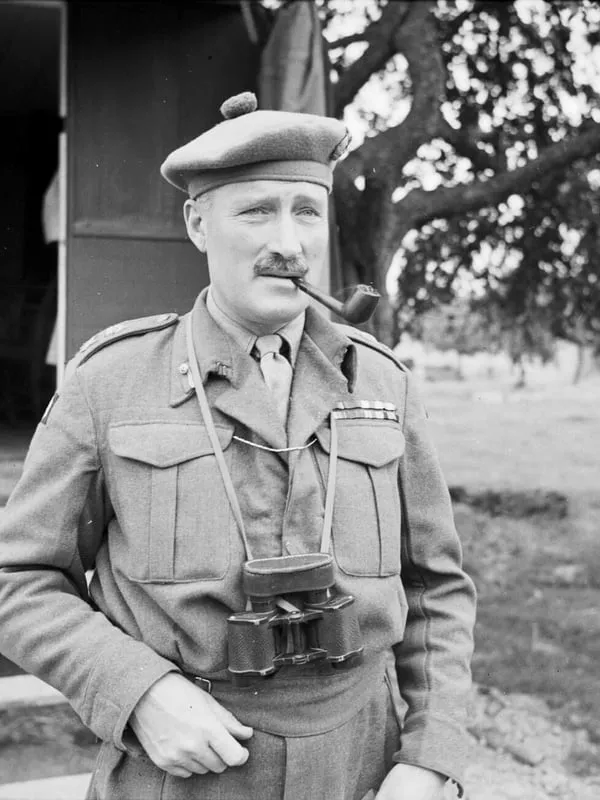
- Born:
- 29 July 1897, Essequibo (British Guiana, today Guyana)
- Died:
- 11 December 1983, Toronto (Canada)
- Author:
- Łukasz
- Photo:
- Mapham, J (Sgt), No 5 Army Film & Photographic Unit, domena publiczna, Wikimedia Commons

Neil Ritchie is a tragic figure in the history of the desert war. In November 1941, aged forty-four and never having commanded even a division in battle, he suddenly took over the Eighth Army in the middle of a great battle, because his superior, General Claude Auchinleck, needed someone who would carry out his will. He won the battle. Six months later, at Gazala, the same army under his command suffered one of the heaviest defeats in the history of the British Army and gave up Tobruk. Unlike many dismissed generals, Ritchie was given a second chance and made good use of it: in 1944 and 1945 he commanded a corps well from Normandy to northern Germany.
From Guiana to the Black Watch
Neil Methuen Ritchie was born on 29 July 1897 on the Essequibo river in British Guiana, the son of a Scottish sugar planter. When disease ruined his father’s crops, the family moved to Malaya, where it set up a rubber plantation. Neil was sent to school in England. In December 1914, aged seventeen, he passed out of Sandhurst and was commissioned as a second lieutenant in the Scottish regiment, the Black Watch (PL).
He went to the Western Front in May 1915 and in September was wounded at the Battle of Loos. After recovering he joined the regiment’s 2nd Battalion, which was fighting the Turks in Mesopotamia. As battalion adjutant he was present at the capture of Baghdad in March 1917 and received the Distinguished Service Order. At the end of 1917 the battalion was moved to Palestine. In September 1918, in the offensive that shattered the Turkish armies (the Battle of Megiddo), Ritchie earned the Military Cross: when the soldier carrying a machine gun collapsed from exhaustion, he carried the gun up the hill himself and helped drive off a Turkish picket.
Between the wars
After the war he served with his battalion in the occupied Rhineland. One of the company commanders there was Major Archibald Wavell, who talked him out of leaving the army and later took him to work at the War Office. Ritchie attended the Staff College at Camberley and in 1933–1937 served on the staff of Northern Command in India, where he got to know Brigadier Claude Auchinleck. In December 1937 he married a Canadian, Catherine Minnes of Kingston; they had a son and a daughter. In 1938 he transferred to another regiment to take over the 2nd Battalion of the King’s Own Royal Regiment, which he commanded in Palestine during the Arab revolt.
At Brooke’s side
In December 1939 Ritchie, by then a brigadier, became chief of staff of II Corps of the British Expeditionary Force, commanded by General Alan Brooke. Brooke praised him in his diary from the first weeks, and in May 1940, during the retreat to Dunkirk, Ritchie ran the corps headquarters calmly, which allowed his commander to concentrate on the battle itself. In June he went to France with Brooke a second time, but on 16 June Brooke sent him home, having concluded that there was no longer any point in keeping him there.
In October 1940, as a forty-three-year-old acting major-general, Ritchie took over the 51st (Highland) Division, which was being re-formed after the capitulation at Saint-Valery. In mid-1941 he was moved to Cairo as Deputy Chief of the General Staff of Middle East Command, first under Wavell and then under Auchinleck.
Commander of the Eighth Army
At the end of November 1941, at the most difficult moment of Operation Crusader, the commander of the Eighth Army, General Alan Cunningham, wanted to break off the offensive after Rommel’s dash to the Egyptian frontier. Auchinleck dismissed him and appointed Ritchie in his place, passing over both corps commanders, who were busy fighting the battle. Ritchie was meant to be a temporary solution and in practice the executor of the plans of the commander-in-chief, who spent the first ten days of December at his headquarters himself. The offensive went on, Tobruk was relieved and Rommel withdrew all the way to El Agheila. The Polish Independent Carpathian Rifle Brigade took part in the fighting at Tobruk and Gazala, and in May 1942 Ritchie received the Polish Virtuti Militari, 5th class. Auchinleck judged that another change of commander, and a victorious one at that, would harm morale, and left Ritchie in post.
The victory was short-lived. On 21 January 1942 Rommel struck from El Agheila (Rommel’s second offensive). Ritchie and Auchinleck were slow to believe that this was a serious offensive. Ritchie cancelled the retreat ordered by the commander of XIII Corps, General Reade Godwin-Austen, and gave orders directly to his divisional commander. Benghazi fell all the same, Godwin-Austen resigned, and by 6 February the army had fallen back to the Gazala line.
Gazala and Tobruk
On the Gazala line at the end of May 1942 Ritchie’s Eighth Army had more than 100,000 men and about 850 tanks in the front line. The infantry brigades sat in fortified “boxes” scattered across the desert, with the armoured divisions behind them. On 26 May Rommel opened the Battle of Gazala by swinging round the southern end of the line, past the French position at Bir Hakeim. When his divisions dug in in the Cauldron behind the British minefields, Auchinleck urged Ritchie to strike boldly to the west, but Ritchie preferred first to destroy the enemy in the Cauldron. The British armoured brigades attacked separately and suffered heavy losses to anti-tank fire, and on 1 June Rommel destroyed the isolated 150th Brigade. Operation Aberdeen, the attack on the Cauldron on 5 June, ended in defeat.
Ritchie was in a difficult position. His corps commanders, Willoughby Norrie and William Gott, had more desert fighting experience than he did and often undermined his decisions, seeing him as no more than Auchinleck’s mouthpiece. Auchinleck, for his part, kept him on a short leash: he sent long instructions, visited his headquarters and left his own adviser, Brigadier Eric Dorman-Smith, there. Ritchie had no experience of handling large armoured formations, and the reports on the state of his own tanks on which he relied were too optimistic. After “Black Saturday”, 13 June, when about 70 tanks were left of his armour, he had to order the retreat from the Gazala line.
The gravest consequence was the fall of Tobruk. Auchinleck told Ritchie to defend the fortress but not to let himself be shut up in it; the orders were unclear, and Ritchie understood them to mean that the garrison should hold out for as long as the rest of the army covered it from outside. Meanwhile the army fell back towards the Egyptian frontier, and on 21 June, after a single day’s assault, General Hendrik Klopper’s garrison surrendered. According to various tallies some 32,000–33,000 soldiers were taken prisoner. Ritchie decided to fall back further, to Mersa Matruh, and on 25 June Auchinleck dismissed him and took command of the army himself.
A second chance
In July 1942 Ritchie returned to England as a colonel. On 15 July Brooke, by then Chief of the Imperial General Staff, received him and decided to give him one more chance. In September Ritchie took over the 52nd (Lowland) Division, which was training for mountain warfare in case of operations in Norway, and in November 1943 XII Corps. His corps became part of General Miles Dempsey’s Second Army in the 21st Army Group of Bernard Montgomery, who had no intention of replacing him, even though Ritchie was not one of his men.
XII Corps fought throughout the Battle of Normandy. At the end of August 1944 its 15th (Scottish) Division seized a bridgehead across the Seine, and in early September the 7th Armoured Division reached Ghent. In January 1945 the corps cleared the Germans out of the “Roer Triangle” in Operation Blackcock, and in March it crossed the Rhine between Xanten and Wesel in Operation Plunder. Ritchie now commanded with confidence, speed and firmness; he did not hesitate to sack a divisional commander he judged weak, and he drove hard those who in his view were advancing too slowly. For the campaign in Europe he was knighted.
After the war
After the war Ritchie commanded the troops in Scotland and was Governor of Edinburgh Castle, and in 1947–1949 he commanded the British land forces in the Far East, when a communist insurgency broke out in Malaya. In 1947 he became a full general. His last post was head of the British military mission in Washington. In August 1951 he retired and moved to Canada, his wife’s country, where he went into business: among other things he was chairman of a reinsurance company. He died on 11 December 1983 in Toronto (PL); the generals.dk website gives the year as 1985, but the other sources agree on 1983.
How Ritchie is judged depends on whom one blames for Gazala. The historian Correlli Barnett, in his book “The Desert Generals”, portrayed him as a man who was not up to the task. Among his defenders was Field Marshal Michael Carver, who served under him in 1944. Ritchie’s defenders point out that he commanded the army according to Auchinleck’s plans and under his constant supervision, with subordinates who did not obey him and with equipment inferior to the German. Many historians believe that the real mistake was giving him an army without experience, and his later service showed that as a corps commander he was fully competent.
Sources
Commanded in battles
(03)Mentioned in battles
(01)Often appears with
People who appear in the same events.