- Category:
- Military operations
- Front:
- Mediterranean
- Date:
- 7 February 1941
- Author:
- Łukasz
- Battle:
- Operation Compass
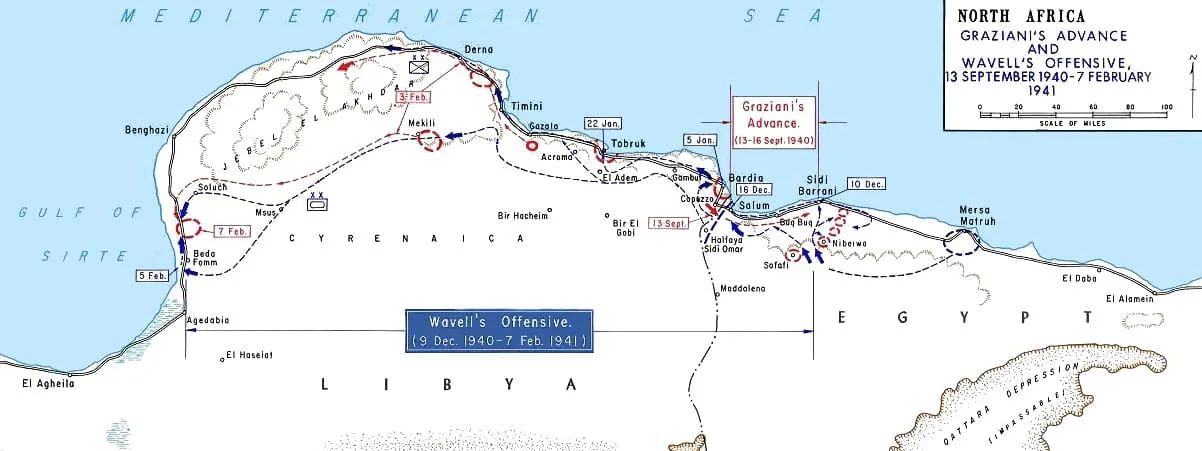
On 7 February 1941, shortly after dawn, on the coast road between Benghazi and Ajdabiya in Cyrenaica, the last tanks of the Italian 10th Army charged a British roadblock. They broke through the forward infantry positions but were knocked out one after another by anti-tank guns. The last tank was stopped a few dozen metres from the tent that housed a rifle battalion’s officers’ mess. Soon white flags began to appear above a column of vehicles more than twenty kilometres long. By about nine in the morning resistance had ceased along the whole road. The commander of the 10th Army, General Giuseppe Tellera, was dying of wounds received the previous day, and General Annibale Bergonzoli, who had slipped through British hands at Bardia and at Derna, was taken prisoner. So ended the three-day Battle of Beda Fomm, the final act of Operation Compass.
The battle was made possible by one of the boldest manoeuvres of the desert war. As the Italians fled Cyrenaica along the coast road, the British 7th Armoured Division took a short cut across the desert south of the hills and closed the road in front of them. A flying column on wheels, Combe Force, some two thousand men strong, blocked the highway, while the division’s tanks spent two days attacking the flank of an army crammed onto the road.
Flight from Cyrenaica
After the capture of Tobruk on 22 January, General Richard O’Connor’s XIII Corps pushed on westwards. At Mechili the tanks of General Valentino Babini’s Italian Special Armoured Brigade escaped from the trap set for them, and on the Wadi Derna the Italian infantry held off the Australians for a week before abandoning Derna.
Marshal Rodolfo Graziani, Governor of Libya and commander-in-chief of the Italian forces in North Africa, concluded that Cyrenaica could not be held. On 1 February he reported to Benito Mussolini that he intended to pull his forces back to the Gulf of Sidra, to the area of Sirte, where the commander of the 5th Army in Tripolitania, General Italo Gariboldi, was to prepare a defence. The next day he ordered Tellera to take command of all forces in eastern Libya from 3 February and to conduct the retreat, while he himself left Cyrenaica and moved his headquarters westwards. Tellera, formerly chief of staff to Marshal Italo Balbo, had commanded the 10th Army since 22–23 December 1940, when Graziani dismissed General Mario Berti. According to an Italian account, on accepting the post he told a fellow officer that he knew he was going to his death.
The retreat followed the only asphalt road, known as the Via Balbia (Litoranea Balbo), which ran south from Benghazi along the coast, through Ghemines and Beda Fomm to Ajdabiya, and then turned west towards El Agheila and Tripolitania. It was not only soldiers who took to the road. According to the Italian official history, the columns were joined by a disorderly mass of soldiers from various units and services, as well as men, women and children fleeing Benghazi in buses and lorries of every kind.
A short cut across the desert
For a long time O’Connor intended to wait. General Michael O’Moore Creagh’s 7th Armoured Division had covered more than fifteen hundred kilometres since December, and most of its roughly fifty surviving cruiser tanks needed overhaul. Two fresh tank regiments from the 2nd Armoured Division were due at the beginning of February, supplies were being stockpiled in depots near Mechili, and a new offensive was planned for 10–12 February.
The Italian retreat changed these plans. On 2 February airmen and patrols reported movement westwards on a large scale, and by 3 February there was no longer any doubt that the 10th Army was abandoning Cyrenaica. O’Connor decided to wait neither for the new tanks nor for supplies. At dawn on 4 February the division set out from Mechili to the south-west, across desert never reconnoitred on the ground, towards Msus and Antelat, with supplies for only a few days. The pursuit had to be decided within three days, or it would grind to a halt for lack of fuel, water and ammunition. General Archibald Wavell, who flew in to Tmimi that day, approved the plan. Meanwhile, through the hills along the coast, General Iven Mackay’s 6th Australian Division pressed on the Italian rearguard.
The first eighty kilometres proved to be the worst ground the British had yet met in the desert, and every vehicle that broke down was left where it stood. Even so, at 3 p.m. the armoured cars of the 11th Hussars reached the fort of Msus, whose small Italian garrison fled at the sight of them. Creagh, knowing that the tracked tanks would not get there in time, then took the decision that settled the battle. He sent ahead a column made up entirely of wheeled vehicles and directed it not west towards Soluch but south-west through Antelat, so as to cut the road as far south as possible. Only the 7th Armoured Brigade, with one tank regiment, and the 7th Support Group went west, towards the fort of Sceleidima.
5 February: the roadblock at Sidi Saleh
The column, which Lieutenant Colonel John Combe of the 11th Hussars took over at Antelat on the morning of 5 February, consisted of a squadron of armoured cars each from the 11th Hussars and the 1st King’s Dragoon Guards, an RAF armoured car squadron, Lieutenant Colonel James Renton’s motorised 2nd Battalion, the Rifle Brigade, six 25-pounder field guns of C Battery, Royal Horse Artillery, and nine Swedish 37 mm Bofors anti-tank guns carried on lorries. At around 12.30 p.m. Hussar patrols reached the Via Balbia between Beda Fomm and Sidi Saleh, about 30 kilometres north of Ajdabiya. Since leaving Mechili they had covered some 270 kilometres in a day and a half.
The rest of the column was still arriving when, about half an hour later, the first Italian column came down from the north. It drove onto hastily laid mines and came under fire from the artillery, the anti-tank guns and the armoured cars. The Italians were thrown into confusion and many surrendered. Bersaglieri of the 10th Regiment tried to force their way along the road and probed for gaps on the flanks, but without the support of their artillery, which was travelling at the rear with the rest of the army, they could achieve little. In the afternoon the Rifle Brigade crossed the road and occupied the dunes between the highway and the sea, so as to close the route along the beach as well. At the head of the retreat came mainly rear echelons and services, without tanks. Behind them, on the road from Ghemines, a jam of hundreds of vehicles was building up.
While waiting for the tanks, Combe searched the ground north of the roadblock. Near a small white mosque he found long, low ridges behind which tanks could hide from observation from the road, drive up onto the crest, fire at close range and drop back out of sight again. A small round hillock crossed by the road west of the settlement of Beda Fomm gave a view in both directions along the highway. The British called it “the Pimple”.
Brigadier John Caunter’s 4th Armoured Brigade, made up to strength with the best tanks of the 7th Brigade, left Msus at 7.30 a.m. Crossing a field of “thermos bombs”, Italian mines dropped from aircraft, forced it to move in single file, and it reached Antelat only at around 4 p.m. Combe advised it by radio to attack the column level with the mosque. The first regiment, the 7th Hussars, set off at full speed and, although some of its tanks ran out of fuel, struck the stationary column at two points less than five kilometres apart, then drove along it in both directions, firing at everything on the road. Resistance was weak; many drivers tried to escape into the dunes and got stuck in the sand. Blazing tankers lit up the dusk. By the light of the fires, seven cruiser tanks of the 2nd Royal Tank Regiment destroyed an anti-aircraft battery from Benina airfield. By nightfall, according to the British official history, some thousand more prisoners had been taken. For the night the tanks withdrew from the road to refuel, often with petrol from captured Italian lorries.
Tellera, who was bringing up the rear of the retreat, left Benghazi, according to Italian accounts, only at 5.30 p.m., when the roadblock had already been in place for several hours. In the north, in the hills, the Australians entered Barce (Al Marj) that day, just after the Italians had blown up an ammunition dump there.
6 February: the fight for the Pimple
During the night Bergonzoli, who was directing the attempts to break through, prepared an attack along the road and an outflanking move through the desert east of the Pimple, by which Babini’s tanks were to reach the rear of Combe Force. He still had about a hundred M13/40 medium tanks, most of them new, freshly shipped from Italy. The British had 32 cruiser tanks and 42 light tanks near the road. Some of the Italian tanks, however, had to remain in the north, near the fort of Sceleidima, where Colonel Riccardo Bignami’s group was covering the rear of the column against the 7th Support Group.
From early morning and throughout the day the M13s attacked in groups of a few or a dozen or so, as they arrived from the north. The first wave of ten tanks drove into the guns of British A13 cruisers, which edged out from behind a ridge at a range of about 550 metres, knocked out eight of them according to British accounts, and slipped back again; they repeated the same manoeuvre near the mosque. The British had the advantage in communications: their tanks had wireless sets, whereas most of the Italian ones did not, so commanders had to stop their vehicles and climb out to pass on orders. The Italian attacks, launched without reconnaissance and often without artillery support, broke down one after another.
In rain and squalls the light tanks of the 7th and 3rd Hussars harried the column further north, where it was not covered by the M13s. By midday the British had put about forty Italian medium tanks out of action, but fifty or more were still in the fight, and the 4th Armoured Brigade had only fifteen serviceable cruisers left. In the afternoon the Italian rearguard arrived with artillery and the Italians took the Pimple, opening the way south. The situation was saved by a counter-attack of the 2nd Royal Tank Regiment, supported by F Battery of the Royal Horse Artillery, which retook the hillock, and by the arrival of the 1st Royal Tank Regiment, the division’s last reserve, delayed by a lack of petrol. It turned up just in time to turn back thirty tanks trying to break out to the south-east. Nevertheless, at least thirty Italian tanks with some of the lorries managed to get through south of the Pimple.
Somewhere in this fighting Tellera was severely wounded. According to the report of an Italian military chaplain, cited by the historian Angelo Del Boca, the general left his shelter in a roadman’s house at the 39th kilometre before Ajdabiya, a spot the Italians called Bottega Araba, climbed into one of the surviving tanks and tried to make his way along the column to Bergonzoli’s tanks, in order to join them in a final attempt to break the encirclement. He ran into British tanks; a shell splinter pierced his lung.
According to the Australian official history, the brigade’s three regiments destroyed 51 M13 tanks that day, and other units another 33. The brigade lost only three cruisers and seven men in the fighting, and about 10,000 Italians were taken prisoner that day. All day long Combe Force, supported by C Battery and the nine Bofors guns, beat off successive attacks on the roadblock. After dark the tanks that had got past the Pimple appeared. Four ran onto mines or were hit, four slipped through to the south with a few dozen lorries, and the rest gave up.
That evening an Australian patrol drove into Benghazi under a white flag, where the mayor and the bishop were waiting in the town hall, and on the morning of 7 February Australian infantry entered the city. O’Connor ordered Mackay to send infantry south in lorries, without stopping in Benghazi, to fall on the tail of the Italian column.
7 February: the surrender
At 6.30 a.m. some thirty tanks, leading a column of lorries nearly twenty kilometres long according to the Australian official history, charged straight down the road at Combe Force’s roadblock. They drove through the forward companies of the Rifle Brigade, who sat it out in their trenches, and concentrated their fire on the anti-tank guns. The commander of C Battery asked for permission to shell ground held by his own infantry and received it. The guns knocked out the tanks one by one, and the last was stopped just short of the officers’ mess tent. The Italian infantry following the tanks was pinned down by the riflemen’s fire. At around seven the whole column surrendered – 5,000 to 6,000 men, according to the Australian official history. Further north the 4th Armoured Brigade surrounded another mass of troops, and the 7th Support Group, advancing from Soluch, struck at the tail of the column. Between 8.55 and 9.00 a.m. resistance ceased everywhere. The Australian infantry, carried by lorry through Benghazi, had already reached El Magrun, halfway from Ghemines.
Bergonzoli surrendered to men of the Rifle Brigade. The British found Tellera among the prisoners, mortally wounded. According to a letter from an Italian army doctor, Lieutenant Mauro Sabiani, the general died in his arms at two o’clock in the morning of 7 February near Suluq; British accounts say he died in hospital after the battle. The British allowed the doctor to escort the body to Benghazi and buried the general with full military honours.
For more than ten kilometres the road was choked with wrecked and abandoned lorries, tanks with their dead crews still inside, and guns. O’Connor sent Wavell a message – transmitted in clear, according to an account repeated in the literature – that opened with words from the jargon of fox-hunting: “Fox killed in the open”.
Prisoners and losses
Many chronologies state that at Beda Fomm, “after several days of desperate fighting”, the British accepted the surrender of some 130,000 Italians. This is a simplification: that figure refers to the whole of Operation Compass, from Sidi Barrani to Beda Fomm. At Beda Fomm itself, after less than three days of fighting, about 25,000 prisoners were taken according to the British official history, and about 20,000 according to the Australian one. Depending on the tally, between 100 and 112 medium tanks were captured or destroyed, along with more than a hundred guns – 216 according to Australian figures – and about 1,500 wheeled vehicles. British losses were very light; there are no precise figures for the battle alone, and the whole of XIII Corps lost about 500 killed, 1,373 wounded and 55 missing in two months. How many troops managed to escape is not known precisely. The Italian official history states that of the entire 10th Army only about 7,000 Italians and 1,300 Libyans escaped captivity; the Australian historian Gavin Long estimated that considerably more had withdrawn to Tripolitania before and during the final battle.
El Agheila and the halt
On 8 February the armoured cars of the 11th Hussars, collecting prisoners and abandoned equipment along the way, moved on westwards. They met no organised resistance and reached El Agheila on the border between Cyrenaica and Tripolitania; according to the British official history the settlement was occupied as early as 8 February, while war chronologies usually give 9 February. There the advance stopped. The vehicles were worn out, and the supply lines from Tobruk to El Agheila ran for more than 700 kilometres along the coast road. O’Connor was nonetheless convinced that he could reach Tripoli before the Germans arrived there.
The decision was taken in London. On 8 February the new Prime Minister of Greece, Alexandros Koryzis, successor to the late Ioannis Metaxas, confirmed that Greece would resist Germany and asked about the scale of British aid. On 10 February the Defence Committee decided that no major operations should be undertaken beyond Benghazi and that Cyrenaica should be held with the minimum of forces. On 12 February Winston Churchill congratulated Wavell on taking Benghazi “three weeks ahead of expectation”, but at the same time ruled out “any serious effort against Tripoli”: the main forces were to be concentrated in the Nile Delta and made ready for transfer to Europe. The Foreign Secretary, Anthony Eden, and the Chief of the Imperial General Staff, General John Dill, set off for Cairo and then Athens.
Place in the war
Beda Fomm ended the existence of the Italian 10th Army and the whole of Operation Compass. The battle became a textbook example of pursuit and encirclement by fast-moving forces. The British official history notes that at Beda Fomm the Italians had roughly a fourfold superiority in medium tanks. What decided the outcome was the speed of the march across the desert, which the Italians had not expected although they knew it was possible; wireless communications; and the fact that the Italian tanks and guns entered the fight piecemeal, as they reached the traffic jam. The British also drew misleading lessons from this victory: a faith in tanks acting alone and in small mobile columns, which cost them dearly against the Germans.
For Mussolini it was a political disaster. After the defeats in Greece and the losses of the fleet at Taranto, Italy had lost an entire army in Africa, and the “parallel war” waged independently of Germany was over. On 5 February, the first day of the battle, Adolf Hitler wrote Mussolini a reproachful letter and announced that he would send an armoured division to Libya, provided the Italians did not withdraw to Tripoli. On 10 February the Duce ordered Tripolitania to be defended as far east as possible. Graziani, who had telegraphed Mussolini that recent events had “severely strained his nerves and strength”, left Libya on 11 February and was succeeded by Gariboldi. On the same day General Erwin Rommel reported in Rome; on 12 February he flew to Tripoli and took command of the German corps, the future Afrika Korps.
The debate over whether in February 1941 the British could have taken Tripoli and ended the war in North Africa continues to this day. O’Connor believed they could; in a report written in captivity he cited conversations with German and Italian officers who wondered why he had stopped. Other historians point to the worn-out vehicles, the long supply lines and the superiority of the German air force, which as early as February began attacking Benghazi and the troops at the front. The best units, including the 6th Australian Division, sailed for Greece, where they were defeated in April in the Balkans campaign. Weak, inexperienced units were left in Cyrenaica. On 24 March Rommel took El Agheila, and on 31 March he attacked and within a few weeks recovered almost everything the British had won in Operation Compass, with the exception of besieged Tobruk. During the retreat, on the night of 6–7 April, O’Connor and Combe were taken prisoner.
Sources
Meanwhile
(02)Elsewhere, within a week.
- 10 February 1941 · PoliticsDarlan named Pétain’s successorOn 10 February 1941 Admiral Darlan became Vichy's deputy premier and Pétain's successor. Laval, ousted in December, did not return despite German pressure.
- 31 January 1941 · AfricaThe Battle of AgordatOn 31 January 1941 the 4th Indian Infantry Division, backed by Matilda tanks, broke the Italian defences at Agordat in Eritrea. It took the town next morning.
Related events
(04)The same battle, people or subject.
- 21 January 1941 · MediterraneanThe capture of TobrukOn 21 January 1941 the 6th Australian Division attacked Tobruk. Next day the fortress capitulated and some 25,000 Italians were taken prisoner.
- 5 January 1941 · MediterraneanThe capture of BardiaOn 5 January 1941 General Mackay’s Australians broke the last resistance at Bardia. Some 36,000–40,000 Italians were captured, but Bergonzoli escaped to Tobruk.
- 14 February 1941 · MediterraneanRommel in TripoliHitler sent General Erwin Rommel to Libya. He flew into Tripoli on 12 February 1941, and on 14 February the first combat units of the Afrika Korps landed there.
- 30 January 1941 · MediterraneanThe British take DernaOn 30 January 1941 Australians entered Derna unopposed. After a week of stubborn defence on the Wadi Derna, the Italians withdrew to avoid encirclement.