Australia
John Curtin
Leader of the Labor Party and the Opposition (1935–1941), Prime Minister and Minister for Defence of Australia (1941–1945)
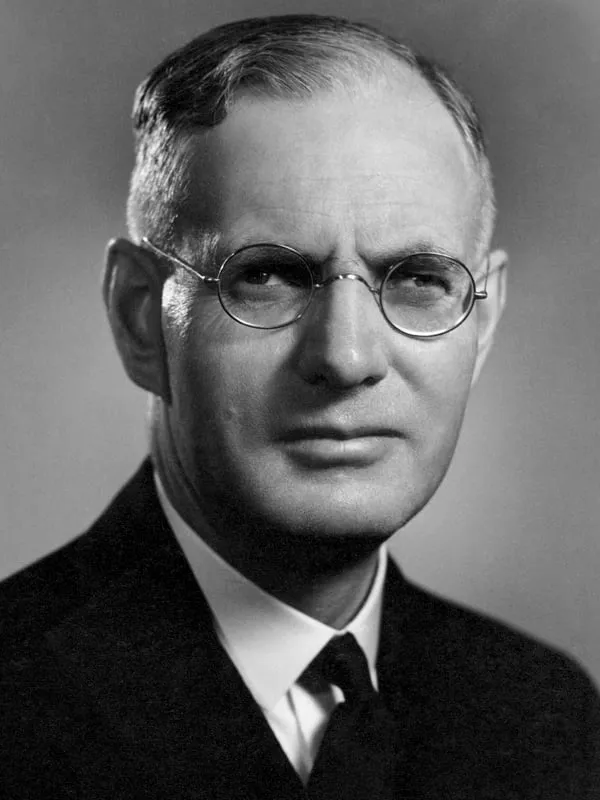
- Born:
- 8 January 1885, Creswick (Colony of Victoria, Australia)
- Died:
- 5 July 1945, Canberra (Australia)
- Author:
- Natalia
- Photo:
- National Library of Australia, domena publiczna, Wikimedia Commons

John Curtin was Prime Minister of Australia in the most dangerous years of its history. He took office two months before the Japanese attack on Pearl Harbor and died six weeks before the end of the war in the Pacific. A former socialist, trade unionist and opponent of conscription, who had briefly been jailed during the First World War, he led the country through its only war for its own territory. Along the way he did things no Australian politician before him would have dared: he declared publicly that Australia was looking to America rather than to Britain for support, he said no to Winston Churchill, and he placed his country’s forces under the orders of the American general Douglas MacArthur. In historians’ rankings he is today regarded as the greatest prime minister in Australia’s history.
Messenger boy, unionist, anti-conscriptionist
John Joseph Ambrose Curtin was born on 8 January 1885 in Creswick (PL), a mining town in the colony of Victoria, into a family of Irish Catholics from County Cork. His father had been a policeman and a prison warder, but fell ill and stopped working early, so the son had to help support the household while still a teenager. He left school at around thirteen. He was an office boy at a magazine, a copy boy at the Melbourne daily The Age and a potter’s apprentice, and only in 1903 did he find a permanent job, as a clerk with the Titan Manufacturing Company in South Melbourne. In his spare time he played Australian football and cricket, and he remained a keen follower of both for the rest of his life.
The young Curtin was drawn into the world of the left: he belonged both to the Labor Party and to the Marxist Victorian Socialist Party, wrote for radical newspapers and denounced imperialism and militarism. From 1911 to 1915 he was secretary of the Victorian branch of the timber workers’ union, and in 1914 he became the first president of its federal body. When, during the First World War, Prime Minister Billy Hughes sought to introduce conscription for service overseas, Curtin led the anti-conscription league in Victoria. In December 1916 he spent a few days behind bars for refusing to attend a compulsory medical examination, even though his very poor eyesight would have made him unfit for service anyway. He is the only Australian prime minister to have been in prison. The strain of those years drove him to drink, and alcohol held back his career for many years.
Journalist and parliamentarian
In 1917 Curtin moved to Perth to edit the union weekly Westralian Worker. In April that year he married Elsie Needham. In Western Australia his views mellowed, and the agitator became a capable journalist and organiser. He entered federal Parliament in 1928 as the member for the port of Fremantle. His reputation as a drinker kept him out of James Scullin’s cabinet, and in 1931, when Labor collapsed in the Depression, he lost his seat. He won it back in 1934.
In October 1935 the parliamentary Labor Party elected him leader by a single vote over Frank Forde. The left wing and the unionists who backed him set one condition: no more drinking. Curtin kept his word. He rebuilt the shattered party, and in the September 1940 election Labor won so many seats that the House of Representatives was deadlocked; Curtin himself held his seat by only a few hundred votes. When war broke out he assured Robert Menzies’s government of his support for Australia’s part in it, but he turned down the offer to join a government of national unity, fearing a split in his own party. He did agree, however, to sit on the all-party Advisory War Council.
War leader
In August 1941 Menzies resigned, and his successor Arthur Fadden lasted only forty days. In early October two independent members, Arthur Coles and Alexander Wilson, voted with Labor against the budget and brought the government down. The Governor-General did not want to call an election in the middle of a war and made both men promise to support a new ministry. On 7 October 1941 Curtin, then aged 56, was sworn in as Prime Minister; he also took the defence portfolio. He inherited a country whose best divisions were fighting far away: the 9th Division was holding besieged Tobruk, the others were in the Middle East, and most of the 8th Division was in Malaya. As Prime Minister he backed General Thomas Blamey, who was demanding that the exhausted Australians be withdrawn from Tobruk.
On 8 December 1941, after the attack on Pearl Harbor, Curtin announced by radio that Australia was at war with Japan. This time the country declared war itself, rather than by accepting a British declaration as in 1939. At the end of December, in an article for the Melbourne Herald, he wrote the sentence that went down in history: Australia looked to America, “without any inhibitions of any kind”, free of any pangs as to its traditional links with the United Kingdom. Churchill was indignant, and President Roosevelt felt that the piece smacked of panic. For many Australians it came as a shock, but for Curtin himself it was a sober admission that Britain, fighting for survival in Europe, could not at the same time defend the Antipodes.
The battle for Australia
On 15 February 1942 Singapore surrendered, and most of the Australian 8th Division went into captivity. The next day Curtin said on the radio that the fall of the fortress was for Australia what Dunkirk had been for Britain, and that the battle for Australia was beginning. Three days later Japanese aircraft bombed Darwin. In the same days came the sharpest dispute in history between Canberra and London. The Australian I Corps, returning from the Middle East, was meant to defend Java; when that became impossible, Churchill wanted at least the 7th Division sent to Burma and, without Australian consent, tried to turn a convoy in that direction. Roosevelt backed him. Curtin, supported by his Chief of the General Staff, who threatened to resign, refused and in one cable after another demanded that the troops come home. He got his way; he only agreed that part of the 6th Division should garrison Ceylon for a few months. Historians still argue whether the Australian brigades could have saved Rangoon, but their return proved invaluable for the campaign in New Guinea.
On 17 March 1942 Curtin announced that MacArthur had arrived in Australia and that the government had nominated him as supreme commander of the Allied forces in the region. He built a close partnership with the general, in which MacArthur was responsible for the front and the Prime Minister for the home front. On 17 April he instructed Australian commanders to treat the American general’s orders as though they came from the government. Curtin’s biographer John Edwards regards this as the cleverest of his military decisions: the Prime Minister understood that a small country’s voice would be heard in Washington only through MacArthur. The price, however, was handing Australian strategy to a man who usually put his ally’s interests behind his own plans.
At the same time the Curtin government completed the country’s legal independence: in 1942 Parliament at last adopted the Statute of Westminster, with effect backdated to 3 September 1939. Meanwhile the war reached the Australian coast: in May Japanese midget submarines broke into Sydney Harbour. When in the summer the Japanese advanced over the mountains towards Port Moresby and MacArthur began to doubt the Australian soldiers, Curtin, under his pressure, sent Blamey to New Guinea to take personal command on the Kokoda Track. Years later he admitted that, in his ignorance of military matters, this had seemed to him the obvious thing to do.
Conscription and electoral triumph
Curtin’s hardest political decision concerned the very issue that had defined his youth. Australia had two armies: a volunteer one that could be sent anywhere, and a militia of conscripts who by law served only in Australia and its territories. The Americans fighting alongside the Australians in New Guinea could not understand why some of their ally’s soldiers were not allowed to cross a border, and the government was constantly having to explain itself. In November 1942 Curtin raised the matter at a special party conference, and in January 1943 he won its approval. The act passed in 1943 allowed the militia to be sent to a designated zone of the South West Pacific, but not north of the equator. For the party’s left wing it was a blow to its oldest principles: in March 1943 Arthur Calwell (PL) accused the Prime Minister in Parliament of betrayal, and Curtin threatened to resign before Calwell apologised.
The threat of invasion receded after the battles of the Coral Sea and Midway and the victories in New Guinea, and in August 1943 Labor won the greatest victory in its history: two-thirds of the seats in the House of Representatives and every Senate seat up for election. In the spring of 1944 Curtin travelled by ship (he was afraid of flying) to the United States and Britain; in London he proposed, without success, a permanent imperial council in which the dominions would have a say on war and peace. In 1944 he lost a referendum in which the government sought broad economic and social powers for five years after the war.
Towards the end of the war his policy towards MacArthur began to bear bitter fruit. The Americans kept the main line of advance, towards the Philippines, for themselves, and the Australians were left fighting the cut-off Japanese garrisons in New Guinea, Bougainville and New Britain and the campaign in Borneo. Some historians regard these operations as unnecessary and costly and hold the Curtin government partly responsible for agreeing to them.
Death and assessment
Curtin was never a picture of health: he smoked heavily and suffered from depression and stress-related illnesses, and the war and the quarrels in his own party wore him out completely. In November 1944 he had a heart attack and spent several weeks in hospital. He returned to work at the beginning of 1945, but from the end of April he never appeared in Parliament again. He died in the early hours of 5 July 1945 at the Prime Minister’s residence in Canberra, aged 60, a few days after the Australian 7th Division landed at Balikpapan. He was buried in Karrakatta Cemetery in Perth. After a short period in which Forde acted as Prime Minister, Curtin was succeeded by his closest colleague, Ben Chifley, who carried out many of the plans for post-war reconstruction drawn up under his government.
Australians remember Curtin as the leader who, at the moment of danger, was able to stand up to Churchill and mobilise the whole country; in surveys of historians and political scientists in 2010 and 2020 he was ranked first among prime ministers. He is also valued as a founder of the Australian welfare state: his government introduced, among other things, widows’ pensions, extended benefits to families and to Indigenous Australians, and in 1945 committed the state to securing full employment. Critics point out that he was no strategist, that he trusted MacArthur too readily, and that his talk of a “battle for Australia” exaggerated the threat of an invasion which, as some historians argue, the Japanese did not intend to carry out. Yet no one denies him the merit his contemporaries already stressed: this pacifist by conviction, who loathed war, gave it the last of his strength and health.
Sources
Mentioned in battles
(05)Often appears with
People who appear in the same events.