The Prague offensive
- Dates:
- 6–11 May 1945
- Front:
- Eastern Front
- Location:
- Bohemia and Moravia and eastern Saxony: the area of Riesa, Meissen and Dresden on the Elbe, Lusatia between Bautzen and Bischofswerda, the passes of the Ore Mountains (Krušné hory) and Saxon Switzerland, Moravia from Brno and Olomouc to Jihlava, and finally Prague and central Bohemia up to the demarcation line Chemnitz – Karlovy Vary – Pilsen – České BudějoviceOn the battle map →
- Sides:
- Soviet Union (with the Romanian 1st and 4th Armies and the 1st Czechoslovak Army Corps)Ivan Konev, Rodion Malinovsky, Andrei YeremenkoPoland (Polish 2nd Army)Karol ŚwierczewskiNazi GermanyFerdinand Schörner
- Result:
- Soviet victory. Tanks of the 1st Ukrainian Front entered Prague on the morning of 9 May 1945, and Army Group Centre, deprived of its commander, disintegrated and for the most part surrendered on 10–11 May; the last fighting, at Slivice, went on until the night of 11–12 May. According to Soviet figures some 860,000 German soldiers were taken prisoner. Soviet and allied forces lost, according to Grigori Krivosheev's tabulation, 11,997 killed and missing and 40,501 wounded and sick, including 887 men of the Polish 2nd Army.
- Author:
- Natalia
Name and dates
The Prague operation (Russian: Пражская стратегическая наступательная операция – the Prague Strategic Offensive Operation) is the name Soviet historiography gives to the Red Army’s last great offensive in Europe, conducted from 6 to 11 May 1945 across Bohemia, Moravia and eastern Saxony. Three fronts took part – the 1st Ukrainian Front under Marshal Ivan Konev, the 2nd Ukrainian Front under Marshal Rodion Malinovsky and the 4th Ukrainian Front under General of the Army Andrei Yeremenko – together with the Polish 2nd Army of General Karol Świerczewski, two Romanian armies and a Czechoslovak army corps. Their opponent was Field Marshal Ferdinand Schörner’s Army Group Centre – the last large and still cohesive grouping of the Wehrmacht – along with part of Army Group Ostmark.
The starting date is set by the attack of Konev’s main grouping from around Riesa and Meissen on the afternoon of 6 May – a day earlier than the orders from Moscow had envisaged. The acceleration was forced by events in Prague itself, where an uprising had broken out on 5 May. Soviet historiography takes 11 May as the end of the operation, when Soviet troops reached the demarcation line with the Americans and the bulk of Army Group Centre laid down its arms. The last major engagement on Czech soil, at Slivice near Příbram, did not end, however, until the early hours of 12 May.
The operation therefore continued after the Third Reich’s instruments of surrender had been signed at Reims (7 May) and in Berlin-Karlshorst (late in the evening of 8 May). That is why the war in Europe ended last of all in Bohemia, and why 9 May – the day the Red Army entered Prague – was also the day celebrated in the USSR as Victory Day, since the Karlshorst instrument was signed when it was already past midnight in Moscow. Because the war was drawing to a close and Prague was taken almost without a fight, the offensive is sometimes portrayed as a march against no opponent. The figures say otherwise: according to Soviet tabulations the allied forces lost more than 52,000 killed, wounded and sick in six days, and most of these losses were suffered in the fighting in the Ore Mountains, in Saxony and in Moravia, far from Prague.
Background
Bohemia had been under German occupation since March 1939, when, after the Munich Agreement and the severance of the Sudetenland, Hitler seized the rest of the country and created the Protectorate of Bohemia and Moravia. Occupation rule, made harsher after the assassination of Heydrich and the destruction of Lidice, was personified in 1945 by Karl Hermann Frank, first State Secretary and then Minister of State for the Protectorate. In the last year of the war the fighting returned to Czechoslovak territory from the east: in the autumn of 1944 the Red Army and the 1st Czechoslovak Army Corps fought their way through the Dukla Pass to aid the Slovak National Uprising, and in the spring of 1945 the 2nd Ukrainian Front took Bratislava (4 April) and Brno (26 April). The 4th Ukrainian Front, in the hard-fought Moravian–Ostrava offensive, captured Moravská Ostrava on 30 April.
Even so, at the beginning of May Bohemia and much of Moravia were still in German hands. Army Group Centre, which Schörner had commanded since January 1945, had come out of the spring campaign less battered than the forces defending Berlin; as late as the second half of April its units had inflicted heavy losses on the Polish 2nd Army at the Battle of Bautzen, part of the Berlin offensive. Schörner, fanatically devoted to Hitler and notorious for his ruthlessness towards his own soldiers, had received his field marshal’s baton at the beginning of April, and in his political testament Hitler named him Commander-in-Chief of the Army. After the fall of Berlin on 2 May his forces were the last serious Wehrmacht force on the Continent.
The government of Admiral Karl Dönitz at Flensburg wanted to gain time so that as many soldiers as possible from the east could reach the west and surrender to the Americans and British. The chief of the OKW operations staff, Alfred Jodl, accordingly ordered that Soviet captivity be avoided and resistance to the Red Army continued, while a ceasefire was sought in the west. Schörner drew up a plan for a gradual, staged withdrawal westwards, with lines of resistance named after flowers; the 4th Panzer Army in the north was to hold Konev off for as long as possible so that the rest of the army group could pull back.
The race for Bohemia also had a political dimension. Winston Churchill urged the Americans to take Prague before the Russians, but Dwight D. Eisenhower adhered to the military arrangements. American troops, which after the link-up on the Elbe had turned towards Bavaria and Austria, crossed the Czech border in the last days of April. On 4 May Eisenhower proposed to the Soviet General Staff that his forces might advance as far as the Vltava and the Elbe. The next day the Chief of the General Staff, General Aleksei Antonov, asked that the Americans not cross the agreed line, and Eisenhower consented. In the end the demarcation line ran through Karlovy Vary, Pilsen (Plzeň) and České Budějovice. Joseph Stalin wanted the Red Army to be standing in western Bohemia, and above all in Prague, at the moment of surrender.
Forces and plans
Army Group Centre was deployed in a great horseshoe enclosing Bohemia and Moravia. In the north, between Dresden and Görlitz, stood the 4th Panzer Army; in the east, from Silesia to the Ostrava area, the 17th Army; around Olomouc, the strong 1st Panzer Army; and in the west, facing the Americans, the weakened 7th Army. In southern Moravia and Lower Austria stood the 8th Army of General Lothar Rendulic’s Army Group Ostmark. Soviet studies put the enemy’s strength at some 900,000 men, 9,700 guns and mortars and 1,900 tanks and assault guns; many divisions, however, were mere remnants, fuel was short and the air force barely flew.
According to Soviet figures, around 2,028,000 men, more than 30,000 guns and mortars, nearly 2,000 tanks and self-propelled guns and some 3,000 aircraft were committed to the operation. This total included about 139,000 Romanians of the Romanian 1st and 4th Armies, about 69,000 Poles of the Polish 2nd Army and about 48,000 soldiers of the 1st Czechoslovak Army Corps.
On 1 May Stalin ordered the 1st Belorussian Front to take over the Berlin sector from Konev so that he could turn south; on 2 May Malinovsky, too, received the order to attack towards Prague. Within a few days the 1st Ukrainian Front had to shift several combined-arms armies, two tank armies and several independent corps 100–200 kilometres south from around Berlin. Under Konev’s directive of 4 May the main blow was to go from the Riesa and Meissen area along the Elbe valley and across the Ore Mountains straight to Prague: the 3rd and 5th Guards Armies, the 13th Army and the 3rd and 4th Guards Tank Armies (under General Pavel Rybalko and General Dmitry Lelyushenko), supported by five artillery divisions. The 5th Guards Army was to take Dresden. A second blow, by the 28th and 52nd Armies, was to come from the Zittau area, while the Polish 2nd Army was to cut Dresden off from the south-east.
The 2nd Ukrainian Front was to attack from the Brno area and north of Vienna, with the 6th Guards Tank Army in the lead, while the 4th Ukrainian Front was to take Olomouc and send a fast mobile group towards Prague. The three fronts were to meet in Prague and so trap Schörner’s main forces east of the capital before they could escape to the Americans. The attack had originally been planned to begin on 7 May, with Prague to be taken no earlier than the middle of the month.
In the west, General George S. Patton’s US Third Army had crossed the Czechoslovak border. On the morning of 6 May units of the 16th Armored Division of General Clarence Huebner’s V Corps entered Pilsen, welcomed by the inhabitants. Patton was ready to push on to Prague, less than 90 kilometres away, but Eisenhower, bound by his understanding with Moscow, refused to let American troops cross the demarcation line. According to Konev’s memoirs, General Omar Bradley made him a similar offer, which the marshal declined.
Konev’s attack (6–8 May)
The Prague uprising broke out on 5 May. The insurgents seized the radio building and broadcast appeals for help in Czech, Russian and English, while the Germans began bringing troops into the city, including Waffen-SS units. In this situation the Stavka brought the offensive forward. On the morning of 6 May reconnaissance in force showed that on many sectors in front of Konev the Germans had begun to withdraw. Konev therefore did not wait for the regrouping to be completed: after a short but heavy artillery preparation the 13th Army, the 3rd Guards Army and both tank armies moved off in the afternoon, joined in the evening by the 5th Guards Army attacking towards Dresden. By the end of the day the 13th Army and the 4th Guards Tank Army had advanced more than 20 kilometres. That same day besieged Breslau capitulated, and the 4th Ukrainian Front set off towards Olomouc.
On 7 May the 3rd Guards Army took Meissen, while the leading units of Lelyushenko’s army and the 13th Army covered another 45 kilometres and reached the northern slopes of the Ore Mountains. Rybalko’s army and the 5th Guards Army began the fight for Dresden, already devastated by the February bombing. On the eastern wing of the front the 28th and 52nd Armies and the Polish 2nd Army went over to the attack. That day at Reims Jodl signed the instrument of unconditional surrender, which was to come into force on 8 May at 11.01 p.m. Central European Time. On the Czech front it changed nothing: most of Schörner’s troops kept fighting in order to gain time for the retreat westwards.
On 8 May Soviet troops broke through the defences in the Ore Mountains and crossed the passes into Bohemia; the armoured spearheads were 70–80 kilometres from Prague. In the evening the 3rd Guards Tank Army and the 5th Guards Army occupied the ruins of Dresden. Lelyushenko’s tanks came upon the headquarters of Army Group Centre and destroyed it. Schörner himself was not there. That day he had still received an emissary from the OKW, Colonel Wilhelm Meyer-Detring, who brought news of the surrender and an instruction that the troops should try to make their own way west. Schörner reportedly issued an order to observe the surrender, with the caveat that it would not be carried out everywhere. He then abandoned his troops: in civilian clothes he flew in a light aircraft from near Podbořany to the Austrian Alps. There he was detained on 18 May and handed to the Americans, who soon turned him over to the Soviets. On the evening of 8 May the Soviet command called by radio on the German forces to lay down their arms by 11 p.m. There was no reply.
Deprived of command and communications, the armies of Army Group Centre now acted each on its own. Instead of surrendering, most units marched hastily west towards the American lines, while Soviet armoured columns cut across their lines of retreat.
In Moravia (6–9 May)
On the southern wing the 2nd Ukrainian Front went over to the attack on 7 May. After a half-hour artillery preparation the 7th Guards Army broke through the defences of the German 8th Army on a frontage of some 25 kilometres and to a depth of 12 kilometres, and the 6th Guards Tank Army was committed into the breach. On the left wing, north of Vienna, the 9th Guards Army and the 46th Army attacked. By 8 May the tanks had reached the Bohemian-Moravian Highlands near Jihlava, and during the night of 8–9 May they set off along the highway to Prague.
The 4th Ukrainian Front, attacking from 6 May across hilly country with no good roads to the west, had the hardest task. Facing it was the 1st Panzer Army, Schörner’s strongest army. Olomouc fell on 8 May; only then could a fast group detached from the front set off towards Prague. In its ranks and alongside the Soviet armies fought units of the 1st Czechoslovak Army Corps, whose tank brigade reached the capital on 10 May. The Romanian armies, attacking as part of Malinovsky’s front, advanced through southern Moravia.
The Polish 2nd Army
The Polish army, bled white at Bautzen, entered the Prague operation on the left wing of Konev’s thrust. Its task was to destroy the German grouping east of Dresden, reach the Elbe and advance further towards Prague. The Polish 1st Armoured Corps was to set off in pursuit once the infantry divisions had broken through the first line of defence.
On 7 May the Polish armoured brigades attacked in the Burkau and Bischofswerda area, and the next day, together with the 1st Motorised Infantry Brigade, they took Bischofswerda. The corps was ordered to reach the Elbe as quickly as possible and seize the bridge at Bad Schandau. First, however, it had to take Neustadt in Sachsen, whose garrison beat off a frontal attack; the town was outflanked and taken after a short fight. On 9 May the Poles captured Bad Schandau together with its bridge over the Elbe.
Meanwhile the infantry divisions – the 7th and 8th Infantry Divisions – were crossing the mountainous Sudeten border. As late as 8 May, 19 soldiers of the 34th Infantry Regiment of the 8th Division were killed in the fight for the village of Lobendava. After 8 May, with Germany having already surrendered, several dozen more Polish soldiers were killed on Czech territory. On 10 May the leading units of the 1st Armoured Corps reached Mělník on the Elbe, some 30 kilometres north of Prague, where Polish operations came to an end. According to Polish studies, the 2nd Army took more than 3,000 German soldiers prisoner between 7 and 10 May.
Świerczewski’s role remains the subject of criticism: military historians hold him responsible for the heavy losses at Bautzen. Nevertheless, on 11 May 1945 the State National Council (KRN), the communist-controlled quasi-parliament, promoted him to Lieutenant General, with seniority from 3 May.
Prague (5–9 May)
Fighting in Prague itself had been going on since 5 May. The insurgents, led by the Czech National Council, built more than 1,600 barricades in a single night, but they lacked heavy weapons. The Germans attacked with tanks and aircraft, shelled residential districts and shot prisoners and civilians. Unexpected help came from the 1st Division of the Russian Liberation Army (ROA) under General Sergei Bunyachenko, formed by the Germans from Soviet prisoners of war and subordinate to Andrei Vlasov. On 6 and 7 May Bunyachenko’s men, presumably hoping for more lenient treatment from the Allies, turned their weapons against the Germans and fought for Ruzyně airfield and the western districts of the city. The Czech National Council, however, in which the communists had strong influence and which was waiting for the Red Army, disowned them, and on 8 May the division left Prague and headed west towards the Americans.
On the afternoon of 8 May the National Council, faced with the enemy’s superiority and the threat that the city would be destroyed, reached an agreement with the Wehrmacht’s plenipotentiary in Prague, General Rudolf Toussaint. The German troops were to leave the city with their light weapons and withdraw westwards, leaving their heavy equipment at the city limits. Some SS units refused to recognise the agreement and fought on into the night.
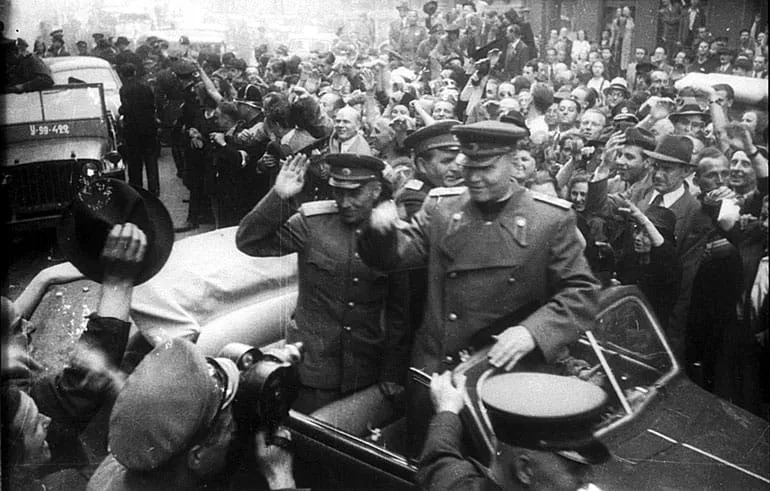
During the night of 8–9 May the tanks of Rybalko and Lelyushenko covered the last 80 kilometres through the Ore Mountains and the Vltava valley. At around 4 a.m. on 9 May the first tanks of the 4th Guards Tank Army drove into Prague from the north-west, soon followed by units of Rybalko’s army. According to Soviet accounts the first to reach the city centre was the 63rd Guards Tank Brigade, and the commander of one of its tanks, Lieutenant Ivan Goncharenko, was killed in action by the Mánes Bridge. Together with the insurgents, the tank crews cleared the city of scattered German groups by about 10 a.m. Later that day and during the night units of the 2nd and 4th Ukrainian Fronts reached Prague, followed on 10 May by the Czechoslovak tank brigade.
According to older Czech estimates the uprising cost the lives of some 1,700 Czechs – insurgents and civilians (newer research, carried out since 2016, speaks of at least around 2,900 victims); between 150 and more than 300 ROA soldiers were also killed, and the Red Army lost several dozen men in the city itself. From the very first days of freedom there were acts of revenge in Prague against German prisoners and the civilian population, including women and children: lynchings, executions and mass internment. These events, long passed over in silence in post-war Czechoslovakia, opened the period of forced expulsions of Germans from the Czech lands.
The end of Army Group Centre (9–12 May)
The capture of Prague by the troops of three fronts closed the road west to Schörner’s main forces, which were still east, north-east and south of the city – above all the 1st Panzer Army and the 17th Army. Columns of German soldiers, joined by fleeing civilians, marched towards the American lines, pursued by Soviet tanks and attacked by Czech partisans. Many units fought to the end out of fear of Soviet captivity and Czech retribution. After 8 May the Americans took in some of the fugitives, but in line with the arrangements made with the Russians they began turning back soldiers trying to cross the demarcation line to the Soviet side, and later handed some of those who had already surrendered over to the Soviets.
On 10 and 11 May one corps and division after another capitulated. On 11 May troops of the 1st and 2nd Ukrainian Fronts met the Americans on the line Chemnitz – Karlovy Vary – Pilsen, and Malinovsky’s left wing made contact with Patton’s Third Army in the area of České Budějovice and Písek. Soviet historiography regards this day as the end of the operation. According to Soviet figures some 860,000 German soldiers were taken prisoner, and 9,500 guns and mortars, 1,800 tanks and assault guns and 1,100 aircraft were captured. These figures, given jointly for both army groups, are estimates.
The last major battle on Czech soil was fought at Slivice near Příbram, right by the demarcation line. Around 9 May a strong German grouping, mainly of Waffen-SS units, had gathered there under SS-Gruppenführer Carl Friedrich von Pückler-Burghauss, accompanied by fleeing Sudeten Germans. The road west was blocked by partisans. On 11 May a partisan detachment led by a Soviet officer tried to attack the Germans but was beaten back; in the afternoon units of the 104th Guards Rifle Division arrived. After fighting all night, at around 3 a.m. on 12 May, Pückler-Burghauss signed a surrender, witnessed by Soviet and American officers, and then took his own life. According to Czech studies, some 6,000 men were taken prisoner. Isolated groups remained in hiding in the forests for many days afterwards.
Losses
According to the tabulation compiled under Grigori Krivosheev, Soviet and allied forces lost 52,498 men in the Prague operation: 11,997 killed and missing and 40,501 wounded and sick. Of these, 49,348 were Red Army soldiers (11,265 killed and missing), 887 belonged to the Polish 2nd Army (300 killed and missing), 1,730 to the Romanian forces (320) and 533 to the 1st Czechoslovak Army Corps (112). Equipment losses amounted to 373 tanks and self-propelled guns, more than 1,000 guns and mortars and 80 aircraft.
German losses in killed cannot be established precisely; Soviet data speak above all of prisoners, and much of Army Group Centre’s documentation from the last days of the war was lost. The victims of the operation also include Czech insurgents and civilians killed in Prague and in other towns, the inhabitants of villages on which retreating German units took revenge for partisan attacks, and Germans – soldiers and civilians – killed in the first weeks after the liberation.
Significance
The Prague operation was the Red Army’s last great operation in Europe and the last battle of the war on the Continent. It destroyed Army Group Centre and part of Army Group Ostmark – the last large Wehrmacht groupings still capable of fighting – and dashed the Dönitz government’s hopes of bringing armies a million strong from the east into Western captivity. Hundreds of thousands of prisoners from Bohemia ended up in camps in the USSR. In 1952 a Soviet court sentenced Schörner to 25 years’ imprisonment; after his return to Germany in 1957 a court in Munich sentenced him to a further four and a half years for the unlawful execution of his own soldiers. The soldiers of the Russian Liberation Army, including those who had fought in Prague, were handed over to the Soviets; Vlasov and Bunyachenko were executed in Moscow on 1 August 1946.
For Czechoslovakia the offensive meant the end of an occupation that had lasted since the autumn of 1938 in parts of the country and since March 1939 in Bohemia. On 16 May President Edvard Beneš returned to Prague. The liberation of the capital by the Red Army, while the Americans were halted at Pilsen, strengthened the position of the communists, even though both Soviet and American troops left the country at the end of 1945. In June 1945 Czechoslovakia ceded Carpathian Ruthenia to the USSR, and in February 1948 the communists seized full power. Throughout the communist period only the Red Army’s contribution was emphasised; the ROA’s role in the uprising and the liberation of western Bohemia by the Americans were passed over in silence.
The revenge against the Germans that began in the first days of May turned, through the Beneš decrees and the decisions taken at Potsdam, into the organised expulsion of some 3 million Sudeten Germans. Emil Hácha, the President of the Protectorate, was arrested on 14 May and died in prison on 27 June 1945. Karl Hermann Frank, captured by the Americans and handed over to Czechoslovakia, was sentenced to death and hanged in Prague on 22 May 1946.
The day on which Konev’s tanks drove into Prague, 9 May, was celebrated in the USSR and the Eastern Bloc countries as Victory Day. The monument to the Soviet tank crews in Prague’s Smíchov district, with a tank on its plinth, became after 1989 one of the symbols of the dispute over the memory of those days.