Austria
Lothar Rendulic
Commander of the 52nd Infantry Division (1940–1942), XXXV Corps (1942–1943), 2nd Panzer Army in Yugoslavia (1943–1944), 20th Mountain Army (1944–1945), Army Groups Courland, North and South/Ostmark (1945)
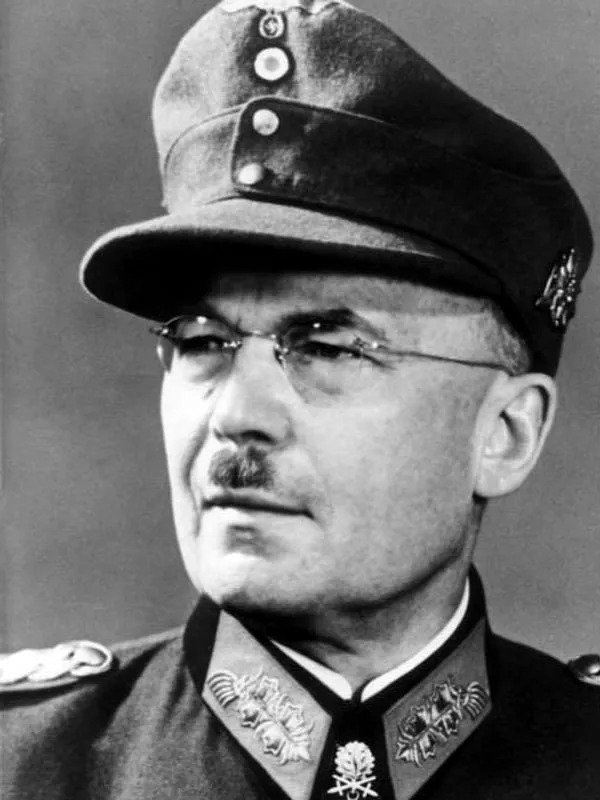
- Born:
- 23 October 1887, Wiener Neustadt (Austria-Hungary)
- Died:
- 17 January 1971, Fraham near Eferding (Austria)
- Author:
- Łukasz
- Photo:
- Krucker, CC BY-SA 3.0 DE, Wikimedia Commons

Lothar Rendulic was one of the few Austrians to rise to the rank of colonel general in the Wehrmacht, and one of Hitler’s favourite “firemen” in the last years of the war. A doctor of law and an early member of the illegal Austrian Nazi Party, in 1943–1944 he commanded in Yugoslavia an army that waged a ruthless war against the partisans of Josip Broz Tito. In the autumn of 1944 he led the retreat from Finland to Norway, leaving behind him a burned Lapland and a depopulated Finnmark. In 1945 Hitler sent him in turn to Courland, East Prussia, Courland again and Austria, always where the front was collapsing. An American tribunal at Nuremberg sentenced him to twenty years’ imprisonment for crimes against the civilian population of Yugoslavia, but acquitted him of the charge of devastating Finnmark, and the reasoning behind that verdict is still cited in the law of war.
A Croat from Wiener Neustadt
He was born on 23 October 1887 in Wiener Neustadt in Lower Austria, into a military family of Croatian origin; his father, Lukas Rendulić, was a colonel in the Austro-Hungarian army. He studied law in Vienna and Lausanne, and in 1907 entered the Theresian Military Academy in his home town. In 1910 he was commissioned as a lieutenant. In the First World War he fought in Galicia, on the Eastern Front and in Italy, and ended it as a captain and general staff officer of XXI Corps.
A Nazi in Austrian uniform
After the collapse of Austria-Hungary (PL) Rendulic returned to the University of Vienna, took his doctorate in law in 1920 and joined the new army of the republic, the Bundesheer (PL). He worked in the Ministry of Military Affairs. On 12 May 1932 he joined the Nazi Party, which was soon banned in Austria. Even so, in 1933–1934 he was Austrian military attaché in Paris, also accredited in London. When his party membership came to light, he was placed on the inactive list in 1936. The Anschluss rehabilitated him: in April 1938 he transferred to the Wehrmacht as a general staff colonel.
From Poland to Kursk
In September 1939 Rendulic was chief of staff of XVII Army Corps in the September campaign, and on 1 December he was promoted to major general. In June 1940 he briefly commanded the 14th Infantry Division, and from October 1940 the 52nd Infantry Division (PL), with which in June 1941 he entered the USSR as part of Operation Barbarossa. The division fought in the Battle of Moscow and in the winter defensive battles, for which Rendulic received the Knight’s Cross in March 1942. In November 1942 he took over XXXV Army Corps (PL) in the Orel salient, and on 1 December became General of Infantry. In the summer of 1943 his corps defended the northern flank of the Battle of Kursk when the Red Army went over to the counter-offensive towards Orel; in August Rendulic received the Oak Leaves for this fighting.
War against the partisans
In August 1943 Hitler gave him the 2nd Panzer Army, which despite its name was above all an occupation army spread across the western Balkans. Rendulic took it over on the eve of Italy’s capitulation, when the Germans had to disarm the Italian divisions in the Balkans and take over their occupation zones, while Tito’s partisans seized Italian weapons and gained growing Allied support. In December 1943 his army carried out Operation Kugelblitz in eastern Bosnia and the Sandžak; the Germans took a number of towns and inflicted heavy losses on the partisans, but the main forces of two corps of the National Liberation Army of Yugoslavia slipped out of the encirclement. At the beginning of 1944 Hitler ordered Rendulic to prepare the capture of Tito himself. The result was the SS paratroop landing at Drvar on 25 May 1944, in Operation Rösselsprung, which smashed the partisan headquarters, but Tito managed to escape.
In Yugoslavia the war against the partisans was a war against the civilian population. German orders required dozens of hostages to be shot for every soldier killed, villages suspected of helping the partisans to be burned and men to be deported for labour. Rendulic did not invent this system, but he applied it and put his name to it in his own orders, as he later found out at Nuremberg. On 1 April 1944 he was promoted to colonel general.
Fire in Lapland
On 23 June 1944 Colonel General Eduard Dietl, commander of the 20th Mountain Army in northern Finland, was killed in an air crash, and Rendulic took over his army of more than 200,000 men. Within a few weeks the situation changed radically: the armistice of 19 September obliged the Finns to remove the Germans from their territory. The Germans began to withdraw northwards under Plan Birke, and for several days the two armies only pretended to fight. The illusion ended on 1 October, when the Finns landed at the port of Tornio. From then on it was a real Lapland War.
Rendulic replied with scorched-earth tactics. In mid-October German sappers blew up the public buildings in Rovaniemi, the capital of Lapland, and a fire, helped along by the explosion of an ammunition train, consumed most of the town. According to Finnish calculations the retreat destroyed some 40–46 per cent of the province’s buildings, hundreds of bridges and thousands of kilometres of roads; the civilian population had been evacuated beforehand to Sweden and southern Finland. When in October a Soviet offensive in the Arctic drove his troops out of the area of Petsamo and Kirkenes, Hitler ordered that Norway’s Finnmark be laid waste as well, so that the Red Army would find no shelter there. The population was driven south by force, and houses, harbours and boats were burned. Only in January 1945 did Rendulic hand over the 20th Mountain Army to General Franz Böhme, and on 18 January he received the Swords to the Knight’s Cross. The end of the Lapland War came in April 1945.
A fireman on a collapsing front
On 15 January 1945 Rendulic took command of Army Group Courland, cut off in Latvia. After less than two weeks Hitler moved him to East Prussia, where during the East Prussian operation he replaced the dismissed General Georg-Hans Reinhardt. On 27 January Rendulic took over the remnants of Army Group Centre, renamed Army Group North, pushed back to Königsberg and the Vistula Lagoon. He carried out Hitler’s order not to give ground and fought demoralisation with draconian methods: according to accounts cited by historians, he ordered unwounded soldiers found away from their units to be shot on the spot. On 12 March he was moved back to Courland, where he stayed for a few weeks.
His last task was Austria. On 7 April 1945, with Soviet troops already outside Vienna, Hitler dismissed General Otto Wöhler and gave Rendulic Army Group South. Wiener Neustadt, his home town, was already in Red Army hands. Rendulic, who was regarded as a specialist in defence to the last, could not save Vienna, which fell on 13 April during the Vienna offensive, but he stopped the front on a line through the Vienna Woods and eastern Styria, where it held until the capitulation. On 30 April his army group was renamed Army Group Ostmark; its Eighth Army was still fighting in Moravia during the Prague offensive. On 7 May 1945 he surrendered to American forces at the Rothschild castle in Waidhofen an der Ybbs (PL).
The Hostages Trial
Rendulic stood before the American Military Tribunal V at Nuremberg in the trial of the commanders in the Balkans, known as the Hostages Trial, alongside Field Marshal Wilhelm List and other generals who had fought in the Balkans. The indictment charged them with the murder of hostages and civilians, plunder and destruction, denying prisoners their rights, and deportations. On 19 February 1948 the tribunal found Rendulic guilty of war crimes and crimes against humanity in Yugoslavia, above all the execution of hostages and reprisals against the population, and sentenced him to twenty years’ imprisonment.
It acquitted him, however, of the charge of unlawfully devastating Finnmark. The judges accepted that Rendulic, with scant information about the enemy, could in good faith have regarded a Soviet pursuit as a real threat, and that military necessity must be judged by how the situation appeared to the commander at the moment of decision, not by knowledge gained later. This principle, known in legal literature as the “Rendulic rule”, entered the canon of the law of armed conflict. For the people of Finnmark who had lost their homes, the verdict was bitter.
In 1951, in a wave of American clemency, the High Commissioner John McCloy reduced his sentence to ten years, and on 1 February 1951 Rendulic walked out of the war criminals’ prison at Landsberg.
Last years and assessment
After his release Rendulic settled in Austria and became a prolific author. He wrote memoirs, a book about his captivity, and works on atomic weapons, politics and command, and he was active in the local government of Seewalchen am Attersee (PL). In the late 1950s he was mentioned as a possible leader of the Freedom Party of Austria (PL). He died on 17 January 1971 (some sources give 18 January) at Fraham near Eferding (PL).
Rendulic was an able and energetic commander whom Hitler valued for his tenacity in defence and his political loyalty; he wore the Golden Party Badge, awarded in September 1944. His books, written from the standpoint of a professional soldier carrying out orders, helped to entrench in post-war Austria and Germany the myth of the “clean Wehrmacht”. Historians remember, however, that the army he commanded in Yugoslavia shot hostages on a mass scale, and that his retreat in the Arctic left behind it a burned Lapland and Finnmark.
Sources
Commanded in battles
(02)Mentioned in battles
(01)Often appears with
People who appear in the same events.