United Kingdom
Clement Attlee
Leader of the Labour Party (1935–1955), Lord Privy Seal (1940–1942), Deputy Prime Minister (1942–1945), Lord President of the Council (1943–1945), Prime Minister of the United Kingdom (1945–1951)
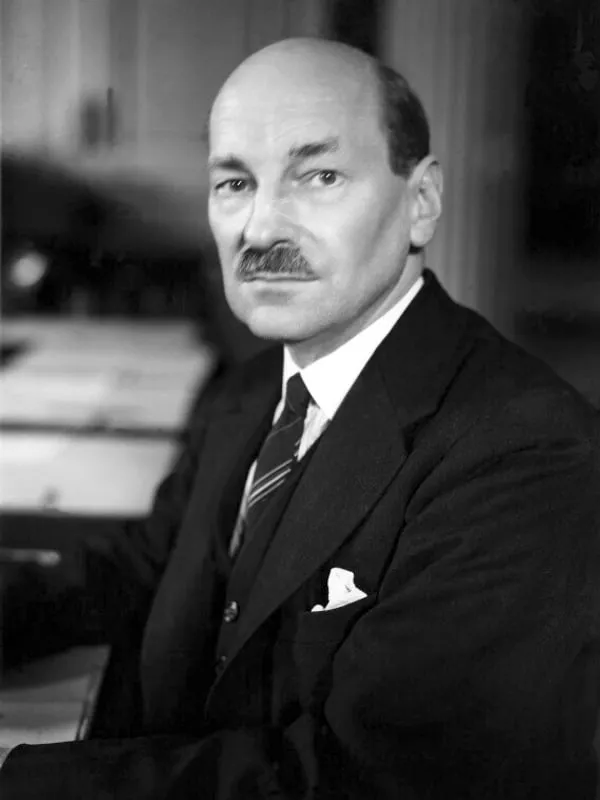
- Born:
- 3 January 1883, Putney (London, England)
- Died:
- 8 October 1967, London (England)
- Author:
- Natalia
- Photo:
- Howard Coster, domena publiczna, Wikimedia Commons

Clement Richard Attlee led the British Labour Party for twenty years and is remembered in British history above all as the Prime Minister who built the welfare state after 1945. For the history of the Second World War, however, what he did earlier mattered just as much. In May 1940 his decision that Labour would not join Neville Chamberlain’s government but would agree to serve under another Prime Minister sealed Chamberlain’s fall and opened the way for Churchill. For the five years of the war Attlee was Churchill’s closest colleague in the War Cabinet, ran the country’s domestic affairs and deputised for the Prime Minister when he was abroad. Quiet, sparing with words and devoid of charisma, he was Churchill’s opposite – and for that very reason complemented him well.
From a comfortable home to London’s East End
He was born on 3 January 1883 in Putney, then on the outskirts of London, the seventh of eight children of Henry Attlee, a prosperous solicitor. The family was religious and conservative. He was educated at Haileybury College, a boarding school, and in 1901–1904 read modern history at University College, Oxford. In 1906 he was called to the bar, but legal work in his father’s firm gave him no satisfaction. That same year he began helping at a club for working-class boys which his old school ran in Stepney, in London’s East End.
His encounter with the poverty of the slums changed his views. He came to believe that private charity could not abolish poverty and that only the state could. In 1908 he joined the Independent Labour Party, and after his father’s death he gave up the law. He was active among the Fabians, worked as secretary to Beatrice Webb, in 1911 toured the country explaining David Lloyd George’s National Insurance Act at public meetings, and in 1912 became a lecturer at the London School of Economics.
Gallipoli and Mesopotamia
When the First World War broke out, the 31-year-old Attlee volunteered for the army, although at first he was considered too old. As an officer of the 6th Battalion, South Lancashire Regiment, he fought on the Gallipoli peninsula in 1915, survived a severe bout of dysentery and was one of the last soldiers evacuated from Suvla Bay. He believed that the Dardanelles operation, for which Winston Churchill had been responsible, was a bold and sound idea ruined by its execution. This view later made it easier for him to work with Churchill. In April 1916, in Mesopotamia, he was badly wounded during the failed attempt to relieve besieged Kut. After convalescing he trained soldiers in England, served for a time in the armoured forces and in 1918 fought on the Western Front. He ended the war as a major, and between the wars many people called him “Major Attlee”.
Member of Parliament and minister
After the war he returned to Stepney. In 1919 he became mayor of the borough, and in 1922 Member of Parliament for Limehouse, which he represented until 1950. In January 1922 he married Violet Millar; they had a son and three daughters. In Ramsay MacDonald’s short-lived first government in 1924 he was Under-Secretary of State for War. In 1927–1930 he sat on John Simon’s commission examining India’s constitutional future, and from then on he was one of the best-informed experts on Indian affairs in Parliament. In MacDonald’s second government he was Chancellor of the Duchy of Lancaster and, in 1931, Postmaster General.
When MacDonald formed a National Government with the Conservatives and Liberals in August 1931, Attlee refused to join it and stayed with the Labour Party. He later called his former leader’s decision the greatest betrayal in the political history of the country. Labour was routed in the election of October 1931, and Attlee held his seat by a margin of only a few hundred votes. He was one of the few MPs with ministerial experience to survive and became deputy to the new leader, the elderly pacifist George Lansbury. For several years he carried a large share of the Opposition’s work in the House of Commons.
Leader of the Labour Party
In October 1935, when the party conference backed sanctions against Italy for its invasion of Ethiopia, Lansbury resigned, and Attlee, as his deputy, led Labour into the general election of November 1935. The party regained more than a hundred seats. In a ballot of MPs in late November and early December 1935 Attlee defeated Herbert Morrison and Arthur Greenwood and became party leader in his own right. He was regarded as a stopgap. He kept the post for twenty years.
His and his party’s position on German rearmament changed only slowly. In the first half of the 1930s Labour put its faith in the League of Nations and disarmament and opposed the National Government’s rearmament; Attlee called Chamberlain’s budget of 1936 a war budget. Under the influence of the Spanish Civil War and Germany’s growing power, from 1937 the party stopped voting against defence spending and criticised appeasement ever more sharply. At the end of 1937 Attlee visited British volunteers of the International Brigades in Spain, and one of their companies took his name. Of the Munich Agreement he told the House of Commons that it was a victory for brute force, that a gallant, civilised and democratic people had been betrayed and handed over to a ruthless despotism, and that Hitler had gained in Europe, without firing a shot, a position Germany had not won in four years of war. Even so, as late as April 1939 his party voted against the introduction of conscription.
From the Phoney War to May 1940
In the summer of 1939 Attlee underwent an operation, and in the first days of the war Greenwood stood in for him. The Labour Party supported the declaration of war on Germany but refused to join Chamberlain’s War Cabinet because it did not trust the Prime Minister. In October 1939 Attlee backed the rejection of Hitler’s peace offer in the House of Commons, saying that to accept the proposals of a man whose word was worthless would mean letting crime go unpunished.
After the defeat in Norway, Labour forced a division during the Norway Debate that became in effect a vote of no confidence. Although the government won it, its majority fell to 81. On 9 May 1940 Chamberlain asked Attlee and Greenwood whether they would join his government. Attlee replied that his party would not accept Chamberlain’s leadership but would probably agree to serve under another Prime Minister. The next day, as Germany attacked the Netherlands, Belgium and Luxembourg, the Labour Party’s National Executive Committee, meeting in Bournemouth, confirmed this position, and Attlee telephoned the decision through to Downing Street. A few hours later Churchill became Prime Minister. That same night Attlee and Greenwood agreed with him the make-up of the new government, in which Labour received more than a third of the posts, and on 13 May the party conference approved joining the coalition by an overwhelming majority.
In the War Cabinet
Attlee became Lord Privy Seal and one of the five members of the War Cabinet, alongside Churchill, Chamberlain, Lord Halifax and Greenwood. Apart from Churchill himself, he was the only one to sit in it continuously from May 1940 to May 1945. At the end of May 1940, during the War Cabinet crisis, when Halifax wanted to explore the possibility of negotiations with Germany through Italian mediation, Attlee and Greenwood backed Churchill, who wanted to fight on. Their votes gave the Prime Minister the upper hand in the cabinet.
In February 1942 Attlee became the first Deputy Prime Minister in British history, and until September 1943 he was also Secretary of State for Dominion Affairs. Then, as Lord President of the Council, he chaired the committee that coordinated the whole of domestic policy: the war economy, supply and social affairs. Churchill, absorbed in strategy and diplomacy, left the home front to him, and during his many journeys abroad also the chairmanship of the War Cabinet and answering for the government in the House of Commons. Attlee made the machinery of government more efficient, abolished many superfluous committees and smoothed over disputes between Conservative and Labour ministers. He also supported the plans for post-war social reform set out in the Beveridge Report of 1942. In the spring of 1945 he and Anthony Eden represented Britain at the San Francisco Conference, which founded the United Nations.
Prime Minister
After Germany’s surrender the Labour Party refused to extend the coalition until the end of the war with Japan and left the government in May 1945. In the election of 5 July, whose results were announced on 26 July, Labour won 393 seats and, for the first time in its history, an outright majority. That same day King George VI invited Attlee to form a government. The new Prime Minister returned to Potsdam, where he took Churchill’s place beside Stalin and President Harry Truman at the Potsdam Conference. The conference provisionally accepted Poland’s western border on the Oder and the Lusatian Neisse, pending a peace treaty, and the transfer of the German population.
Attlee’s government carried out the greatest social reforms in British history. It nationalised the Bank of England, coal mining, the railways, electricity, gas and the iron and steel industry, introduced universal national insurance and in July 1948 launched the National Health Service, a free public health service created by the minister Aneurin Bevan. All this took place in a country ruined by war, in debt and dependent on American loans, where food rationing lasted for several years after the war and in 1946–1948 even extended to bread, which had not been rationed during the war.
In foreign policy Attlee and his Foreign Secretary, Ernest Bevin, began by hoping for cooperation with the USSR but soon turned to building a Western bloc. Britain accepted Marshall Plan aid, took part in the Berlin Airlift, became a founding member of NATO in 1949 and in 1950 sent troops to the Korean War. Attlee’s government secretly decided to build a British atomic bomb. In August 1947 India and Pakistan gained independence, followed the next year by Burma and Ceylon, and in May 1948 Britain gave up the Palestine Mandate. The partition of India brought bloody fighting and mass population transfers in which several hundred thousand people died.
Attlee and the Poles
For Poles, Attlee’s government was the one that wound up the affairs of the Polish armed forces in the West. Britain had withdrawn recognition from the Polish government-in-exile as early as 5 July 1945, while Churchill was still in office, and recognised the Provisional Government of National Unity in Warsaw. Attlee’s cabinet pressed the soldiers of the Polish Armed Forces to return home, and allowed those who did not wish to go back to a Poland under communist rule to remain in Britain. In 1946 the Polish Resettlement Corps was set up, and the Polish Resettlement Act of 1947 allowed more than a hundred thousand soldiers and their families to settle in the British Isles. A bitter symbol of those years was the London Victory Parade of 8 June 1946, to which the Polish Armed Forces were not invited, even though they had fought alongside the British from the first day of the war to the last. A belated invitation sent to some of the Polish airmen was turned down by them in solidarity with their excluded comrades.
Later years
In the election of February 1950 Labour held on to power with a majority of only a few seats. The government was weakened by internal disputes, the cost of rearmament during the Korean War and ministers’ illnesses. In the election of October 1951 Labour won more votes than the Conservatives but fewer seats, and Churchill became Prime Minister again. Attlee remained Leader of the Opposition. After another electoral defeat in 1955 he stood down in December of that year and was succeeded by Hugh Gaitskell. He was created Earl Attlee and took his seat in the House of Lords. His wife died in 1964. He died of pneumonia in a London hospital on 8 October 1967. His ashes were laid in Westminster Abbey.
Significance
Attlee was underestimated all his life. The barbed remark that he was “a modest man who has much to be modest about” was attributed to Churchill, although Churchill denied having said it and thought highly of his wartime deputy. In May 1940 it was Attlee’s stance that ensured Chamberlain could not remain Prime Minister, and Labour’s support for Churchill at the end of that month made it possible to reject the idea of negotiating with Hitler. For five years of war Attlee kept the government running smoothly and the coalition united, without which Britain could not have endured a long total war. After the war he created a state whose foundations, above all the public health service, have lasted for decades. Historians and political scientists rank him among the greatest British Prime Ministers of the 20th century.
Sources
Often appears with
People who appear in the same events.