Battle of Smolensk (1941)
- Dates:
- 10 July – 10 September 1941
- Front:
- Eastern Front
- Location:
- The belt between the Dvina and the Dnieper on the road from Belarus to Moscow: Polotsk, Vitebsk, Orsha and Mogilev, Smolensk with Yartsevo and Dorogobuzh, Nevel and Velikiye Luki in the north, Rogachev, Zhlobin, Roslavl and Gomel in the south, and the Yelnya salient in the eastOn the battle map →
- Sides:
- Nazi GermanyFedor von Bock, Heinz Guderian, Hermann HothSoviet UnionSemyon Timoshenko, Georgy Zhukov, Andrei Yeremenko
- Result:
- A German operational victory that brought no decision. Army Group Centre took Smolensk, encircled the Soviet 16th, 19th and 20th Armies and, according to Bock's report of 5 August, took more than 300,000 prisoners, and then smashed Soviet groupings at Roslavl, Gomel and Velikiye Luki. According to Russian data the Red Army lost nearly 760,000 men, but its incessant counter-strikes forced the Germans to go over to the defensive on the Moscow axis on 30 July, and at the beginning of September they recaptured the Yelnya salient. Hitler sent the panzer groups to Ukraine and Leningrad, and the offensive against Moscow did not begin until October.
- Author:
- Natalia
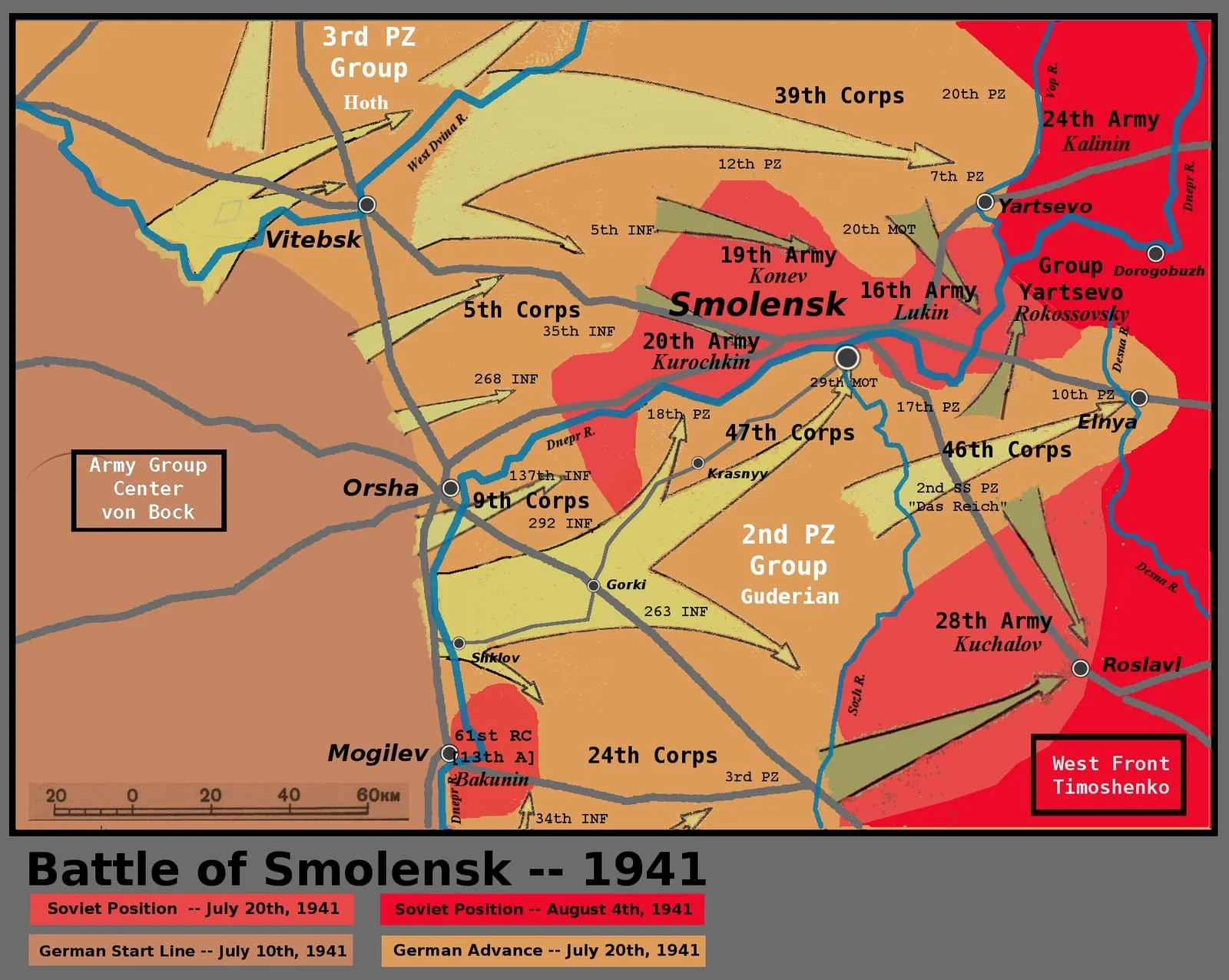
The Battle of Smolensk was Army Group Centre’s second great battle in the war against the Soviet Union, and the first in which the German plan for a lightning war began to grind audibly. At the beginning of July 1941, after the destruction of the Western Front at Białystok and Minsk, the German panzer divisions stood on the Dvina and the Dnieper. Between these rivers, in the belt known as the “Smolensk gate”, ran the shortest route to Moscow – the highway and the railway through Smolensk and Vyazma. On 10 July Field Marshal Fedor von Bock’s two panzer groups – Colonel General Heinz Guderian’s in the south and Colonel General Hermann Hoth’s in the north – set off to encircle the Soviet forces gathered around Smolensk and open the road to the capital.
Within a week the German tanks had burst into Smolensk, cut the Moscow highway at Yartsevo and trapped three Soviet armies in a pocket. This time, however, the Red Army did not let itself be broken as easily as in June. Marshal Semyon Timoshenko threw one new army after another from the interior against the armoured spearheads; their counter-attacks, chaotic and bloody, tied down and bled the German panzer divisions for two months. On 30 July Army Group Centre was ordered to go over to the defensive. In August Adolf Hitler, against the wishes of his generals, sent Guderian’s tanks to Ukraine, and at the beginning of September the troops of General of the Army Georgy Zhukov’s Reserve Front recaptured the exposed salient at Yelnya. Smolensk was a great victory for the Wehrmacht, but it cost two months and strength that would be lacking before Moscow in the autumn.
Name and dates
The Germans spoke of the battle of encirclement at Smolensk (Kesselschlacht bei Smolensk); Soviet and Russian historiography speaks of the Smolensk “srazheniye” (Smolenskoye srazheniye) – a battle in the broad sense, a complex of defensive and offensive operations on the Moscow axis. These approaches differ in their time span. The German side closed the battle of encirclement with Bock’s report of 5 August on the end of the fighting in the pocket, and some Western studies and other sources limit it to the period from 6 or 10 July to 5 August. Soviet historiography adopted a framework from 10 July to 10 September 1941 and divided it into four stages: the encirclement at Smolensk (10–20 July), the Soviet counter-strikes and the breakout of part of the forces from the pocket (21 July – 7 August), the German attacks on the flanks and the second wave of counter-attacks (8–21 August), and Guderian’s turn south together with the Yelnya operation (22 August – 10 September).
The broader period, from 10 July to 10 September, is the more useful frame for the battle, following Russian historiography and the most comprehensive modern study, the multi-volume monograph Barbarossa Derailed by the American historian David Glantz. Only within these limits does it become clear that this was not a single pocket but a two-month struggle. On 10 July both panzer groups began forcing the Dnieper and the Dvina across the whole width of the offensive (the Germans had already taken Vitebsk on 9 July), and 10 September is the day on which the Headquarters of the Soviet High Command (the Stavka) ordered the Western and Reserve Fronts to go over to the defensive. The battlefield stretched for 600–650 kilometres, from Velikiye Luki to Gomel.
The dates of individual episodes also vary: the Germans burst into Smolensk on the evening of 15 July and took most of the city on 16 July, while the northern part was fought over until 28–29 July. According to most studies the pocket was closed on 27 July, but a corridor across the Dnieper kept reopening until 4–5 August.
Background
After Minsk
At the beginning of July optimism reigned in the German command. On 3 July the Chief of the Army General Staff, Colonel General Franz Halder, noted that it would be no exaggeration to say that the campaign against Russia had been won within fourteen days. According to Wehrmacht intelligence the Red Army no longer had any significant reserves. From 3 July both panzer groups were subordinated to the headquarters of Field Marshal Günther von Kluge, redesignated the 4th Panzer Army, while the infantry of the 9th and 2nd Armies was still reducing the pockets near Minsk. The panzer commanders did not want to wait for it, so as not to give the Russians time to build a new defence.
The plan repeated the manoeuvre at Minsk. Hoth’s 3rd Panzer Group (XXXIX and LVII Motorised Corps) was to cross the Dvina at Vitebsk and Polotsk and bypass Smolensk from the north, with a subsidiary thrust towards Nevel. Guderian’s 2nd Panzer Group (XXIV, XLVI and XLVII Motorised Corps) was to force the Dnieper between Orsha and Rogachev and bypass the city from the south. The pincers were to close at Yartsevo, some 50 kilometres north-east of Smolensk, on the Moscow highway. According to Russian calculations 29 divisions with some thousand tanks were committed to the first blow, supported by Field Marshal Albert Kesselring’s Luftflotte 2.
The Red Army’s second echelon
German intelligence failed to notice that the armies of the second strategic echelon were moving west from the interior of the USSR. On 2 July they were placed under the Western Front, whose command was taken over by the People’s Commissar for Defence, Timoshenko, himself; his deputy was Lieutenant General Andrei Yeremenko, who had commanded the front for a few days after the recall of Dmitry Pavlov. On 10 July Timoshenko also became Commander-in-Chief of the Western Direction. Along the Dvina and the Dnieper, partly on the fortifications of the old Stalin Line, stood Lieutenant General Filipp Yershakov’s 22nd Army near Polotsk and Nevel; Lieutenant General Ivan Konev’s 19th Army, which was still detraining near Vitebsk; Lieutenant General Pavel Kurochkin’s 20th Army near Orsha; the 13th Army on the Dnieper near Mogilev; and Colonel General Fyodor Kuznetsov’s 21st Army near Rogachev and Zhlobin. In the second echelon, around Smolensk itself, Lieutenant General Mikhail Lukin (PL)’s 16th Army was assembling. By 10 July only 37 of the 48 planned divisions had managed to take up the line, and the defences had not been prepared by engineers.
Before the Germans moved, Timoshenko tried to strike first. On 6 July the 5th and 7th Mechanised Corps of the 20th Army – on paper more than 1,500 tanks, in practice, it is estimated, fewer than half that number – attacked towards Lepel between Vitebsk and Orsha. Launched without reconnaissance or air cover, the counter-strike was broken by 9–10 July against the German 7th and 17th Panzer Divisions and the Luftwaffe; both corps lost most of their tanks. Meanwhile the 3rd Panzer Group crossed the Dvina, and on 9 July the 20th Panzer Division took Vitebsk before the 19th Army had time to deploy there.
Course of the battle
Breakthrough on the Dnieper and the Dvina (10–16 July)
On 10 July Guderian began crossing the Dnieper. Attempts to seize the bridges at Rogachev and Mogilev on the move failed, so he chose weakly defended sectors away from the main roads: General Joachim Lemelsen’s XLVII Motorised Corps crossed the river at Kopys, south of Orsha; General Heinrich von Vietinghoff’s XLVI Corps at Shklov; and General Leo Geyr von Schweppenburg’s XXIV Corps in the Bykhov area. By 11 July all three corps had bridgeheads on the eastern bank. The shattered 13th Army, whose commander, Lieutenant General Pyotr Filatov, had been mortally wounded on 8 July, was unable to push the Germans back into the river. The Germans bypassed Mogilev, defended by several divisions of the 61st Rifle Corps, on both sides, and by 14 July the city lay in their rear.
In the north the 3rd Panzer Group moved out of Vitebsk to the east and north-east. It smashed the divisions of the 19th Army as they hurried into battle, on 13 July took Demidov and Velizh, and on the evening of 15 July General Hans von Funck’s 7th Panzer Division reached Yartsevo and cut the Smolensk–Moscow highway. On 16 July LVII Motorised Corps took Nevel, and the 22nd Army abandoned Polotsk and fell back, half-encircled. On 19 July the Germans took Velikiye Luki, but two days later they were driven out of it – the first sign that on the northern flank things were not going to plan.
The 16th, 19th and 20th Armies were caught between the two armoured wedges. On 11–13 July the Stavka ordered them to retake Vitebsk and restore the front on the Dnieper – tasks that historians describe as unrealistic. Konev’s divisions went into the attack straight from the railway wagons, without artillery or ammunition, and failed to stop Hoth. These battles saw the first use of the Soviet BM-13 rocket launchers, later known as “Katyushas”: according to most sources, on 14 July Captain Ivan Flyorov’s battery shelled the railway junction at Orsha; according to other accounts the first salvoes were fired a day later at Rudnya. On 14 July Timoshenko reported that the situation was “very difficult” and that armoured formations without tanks had turned into poorly armed infantry.
Things went better on the southern flank. On 13 July Kuznetsov’s 21st Army crossed the Dnieper and struck Guderian’s right flank. Its 63rd Rifle Corps under Lieutenant General Leonid Petrovsky recaptured Rogachev and Zhlobin, and individual divisions came close to Bobruisk. The offensive, supported by the boats of the Pinsk Military Flotilla (PL), stalled after a week, and both towns returned to German hands. It did, however, force Bock to send a reserve infantry corps south, which was then missing at Smolensk.
Smolensk and the pocket (15–28 July)
The fastest-moving unit was General Walter von Boltenstern’s 29th Motorised Division of Lemelsen’s corps. By 13 July it was only some 18 kilometres from Smolensk. The divisions of Lukin’s 16th Army, which had been entrusted with the defence, stood far to the north of the Dnieper; in Smolensk itself there were only a few regiments, NKVD units, the militia and destruction battalions made up of local inhabitants. On the evening of 15 July the vanguard of the 29th Division burst into the southern part of the city; the war diary of XLVII Corps recorded street fighting, fire from windows and cellars, and hand-to-hand combat. During the night the defenders withdrew across the Dnieper and blew up the bridges, and on 16 July the Germans took control of most of the city.
The loss of the city provoked fury in Moscow. An order of the State Defence Committee of 16 July called the “evacuation mood” of the front command a crime bordering on treason and forbade the surrender of Smolensk. Lukin threw everything he had to hand into counter-attacks, and for two weeks the northern part of the city changed hands again and again. Only on 28 July did the last Soviet divisions, threatened with encirclement in the city itself, abandon northern Smolensk – without the consent of Timoshenko, who the next day ordered them to be stopped and the city retaken.
The ring around the Soviet forces formed slowly. From the north it was closed by the 7th Panzer Division at Yartsevo, from the south by the 29th Motorised Division and the 17th Panzer Division, but between them, on the Dnieper near Solovyovo and Ratchino, there remained a gap more than ten kilometres wide. The panzer groups, stretched over hundreds of kilometres of front, lacked the strength to close it, and the infantry was only just arriving. Timoshenko entrusted the defence of the Yartsevo area to Major General Konstantin Rokossovsky, who had just arrived from Ukraine. From a hotchpotch of units and stragglers he cobbled together a grouping that held up the 7th Panzer Division, while the crossing at Solovyovo was defended by Colonel Alexander Lizyukov’s detachment. Supplies for the encircled forces passed through this corridor under fire and air attack.
Meanwhile part of Guderian’s forces pressed on eastwards. On 19–20 July the 10th Panzer Division of Vietinghoff’s corps took Yelnya on the Desna, some 80 kilometres south-east of Smolensk, and seized a bridgehead there – the point of the German front furthest advanced towards Moscow. Guderian regarded it as a springboard for a further advance, although Bock would have preferred the panzer group first to help close the pocket.
Counter-strikes by the operational groups (23 July – 7 August)
Behind the Western Front, meanwhile, further armies were being deployed: on 14 July they were formed into the Front of Reserve Armies, and on 18 July, on the approaches to the capital, the Mozhaysk Defence Line was created. On 20 July Joseph Stalin instructed Timoshenko to strike at Smolensk with these fresh forces and relieve the encircled armies. Five operational groups were formed, each of two or three divisions, named after their commanders: General Ivan Maslennikov, General Vasily Khomenko, General Stepan Kalinin, Rokossovsky and Lieutenant General Vladimir Kachalov. They were to strike concentrically from the north, the east and the Roslavl area. On 19 July Yeremenko took command of the Western Front, while Timoshenko directed the whole as Commander-in-Chief of the Direction.
The groups went into battle separately and at different times, without sufficient artillery or air cover. Kachalov attacked on 23 July and threw the Germans back more than ten kilometres; Khomenko and Kalinin attacked on 24–25 July towards Dukhovshchina; Rokossovsky first had to repel German attacks. None of the groups reached Smolensk. Glantz points out, however, that the mere appearance of five new armies where intelligence no longer saw any forces at all came as a shock to the German command. On 20 July Halder noted that the bitter fighting, the late arrival of the infantry and the exhaustion of the troops had caused a “collapse of morale” in the command.
On 26 July the German XXXIX Corps from the Yartsevo area and the 17th Panzer Division from the west attacked the crossing at Solovyovo and took it during the night of 26–27 July. The pocket was closed. The encircled divisions of the 16th and 20th Armies, under Kurochkin’s overall command, fell back towards the Dnieper. On 28 July Rokossovsky counter-attacked from the east and reopened a passage, through which the remnants of both armies – several tens of thousands of soldiers, without most of their heavy equipment – escaped by 4–5 August. The rest were killed or captured. On 5 August Bock announced the end of the battle of encirclement in an order of the day, stating that since 10 July 309,000 prisoners had been taken and 3,205 tanks and more than 3,000 guns captured or destroyed. The number of prisoners was later raised to some 350,000 by including the fighting at Mogilev and Rogachev.
Mogilev and Roslavl
The city that held out longest in the rear of the front was Mogilev, where Major General Fyodor Bakunin’s 61st Rifle Corps, with Major General Mikhail Romanov’s 172nd Rifle Division, repelled the assaults of the German VII Army Corps from 20 July. During the night of 25–26 July Bakunin ordered a breakout to the east, in which only a few succeeded, and the last groups laid down their arms on 27 July. The Germans reported taking some 35,000 prisoners at Mogilev. In Soviet memory the defence of the city became one of the symbols of the summer of 1941.
On 1 August Guderian, whose panzer group – made independent after the dissolution of the 4th Panzer Army headquarters – now operated as Army Group Guderian, attacked Kachalov’s group at Roslavl. On 3 August he took the town and encircled the grouping that had previously threatened his flank. The Germans reported taking more than 38,000 prisoners there. Kachalov was killed on 4 August trying to lead his soldiers out of the pocket. Order No. 270 of 16 August, which branded soldiers who surrendered as traitors, falsely accused him of going over to the enemy; he was rehabilitated in 1953.
Directives No. 33 and 34: Army Group Centre halts
The battle in the pocket was still going on when a dispute broke out in the German command over the future direction of the war. On 19 July Hitler issued Directive No. 33. It envisaged that once the fighting at Smolensk was over, Hoth’s panzer group would turn north to help Army Group North cut off Leningrad, and Guderian’s group south-east, into the rear of the Soviet forces defending Kiev. Army Group Centre was to advance on Moscow with infantry alone. Bock, Halder and the Commander-in-Chief of the Army, Field Marshal Walther von Brauchitsch, considered this a mistake: the main forces of the Red Army stood on the road to Moscow, and that was where they had to be destroyed. After the war Hoth wrote of a “complete departure” from the original plan.
For the time being the dispute was settled by the reality at the front. The panzer divisions were exhausted by six weeks of marching and fighting, and supplies had to travel hundreds of kilometres over bad roads and over railways that had to be converted to the European gauge. On 27 July, at a conference at Novy Borisov, Brauchitsch’s representative instructed the commanders to stick to Directive No. 33 and not to advance further east, and on 30 July Directive No. 34 ordered Army Group Centre to go over to the defensive and the panzer groups to replenish their equipment. Russian studies stress that for the first time since 22 June the Wehrmacht’s main grouping had come to a halt on the Moscow axis.
On the Soviet side commanders were being changed. On 29 July the Chief of the General Staff, Zhukov, proposed to Stalin that the Southwestern Front be withdrawn behind the Dnieper, giving up Kiev, and that the Yelnya salient be attacked. According to his memoirs Stalin called the proposal “nonsense”, and Zhukov asked to be relieved. The next day he took command of the new Reserve Front east of Smolensk, and Marshal Boris Shaposhnikov took over the General Staff. Timoshenko again assumed direct command of the Western Front. On 24 July Kuznetsov’s Central Front was split off from the southern wing, and in mid-August, for fear that Guderian would turn south, Yeremenko’s Bryansk Front was formed.
Fighting on the flanks and the Soviet offensive at Dukhovshchina (August)
Although the centre of Army Group Centre stood on the defensive, the Germans kept attacking on its flanks. After Roslavl Guderian struck south against the 13th Army: on 9 August he smashed it at Krichev and moved on towards Starodub. At the same time the infantry of Colonel General Maximilian von Weichs’s 2nd Army attacked the Central Front, in mid-August encircled five divisions east of Zhlobin, and on 19 August took Gomel. According to German figures, in the fighting at Zhlobin, Rogachev and Gomel the 2nd Army and Guderian’s group took some 78,000 prisoners. At the end of August the remnants of the Central Front were merged into the Bryansk Front, and the right wing of Army Group Centre now hung over the Southwestern Front from the north.
On the northern flank, General Georg Stumme’s group, with two panzer divisions detached from Hoth’s group, struck the 22nd Army on 22 August, encircled it and on 25–26 August retook Velikiye Luki. The Germans reported 34,000 prisoners, and half of the 22nd Army ceased to exist. On 29 August Toropets fell.
In the centre it was the Red Army that was attacking. From 8 August, and in full strength from 17 August, Konev’s 19th Army and Khomenko’s 30th Army attacked towards Dukhovshchina, north-east of Smolensk, against the positions of Colonel General Adolf Strauss’s German 9th Army. Konev’s divisions broke through the defences of the German 161st Infantry Division, which according to Bock was “bleeding to death”, and a counter-attack by the 7th Panzer Division on 20–21 August ran into dug-in tanks and anti-tank guns. There was not enough strength, however, to exploit into depth; the offensive cost both sides enormous losses but did not retake Smolensk.
Hitler sends Guderian south
A supplement to Directive No. 34 issued on 12 August postponed the march on Moscow until the flanks had been cleared. On 18 August Brauchitsch presented Hitler with a General Staff memorandum recommending that all forces be concentrated on Moscow before the autumn. Hitler rejected it in an order of 21 August: the most important objective before winter was to be not the capture of Moscow but the seizure of the Crimea and of the industrial and coal-mining region of the Donbas, cutting the USSR off from Caucasian oil, and the encirclement of Leningrad. On 23 August Guderian flew to the Wolf’s Lair, sent by Bock and Halder to argue for the advance on Moscow. After talking to Hitler he agreed to lead his group south. From 25 August the 2nd Panzer Group and the 2nd Army advanced on Konotop, into the rear of the Soviet forces on the Dnieper. The Bryansk Front was unable to stop them.
Yelnya (30 August – 8 September)
The Yelnya salient, driven into the Soviet defences and threatening a thrust towards Vyazma, had been one of the bloodiest sectors of the front since July. Throughout August Major General Konstantin Rakutin’s 24th Army attacked it without success, while the Germans, who had withdrawn their panzer divisions from there, held on with infantry under constant artillery fire. Halder called this fighting a typical example of positional warfare.
On 21 August Zhukov called off the failed attacks and ordered a new offensive to be prepared. The Reserve Front’s chief of artillery, Major General Leonid Govorov, assembled some 800 guns, mortars and rocket launchers. The plan envisaged two thrusts from the north and the south against the base of the salient and the encirclement of the divisions defending it. The offensive began on 30 August. In the first days it advanced a kilometre or two, but on 3 September the neck of the salient narrowed to 6–8 kilometres and the Germans, with the consent of Halder and Brauchitsch, began to abandon it. They withdrew efficiently, and the encirclement failed. On 6 September Soviet units entered the ruins of Yelnya, and by 8 September they had cleared the whole salient, after which the offensive came to a halt on a prepared German defensive line. The neighbouring 43rd Army, attacking towards Roslavl, suffered a defeat.
In the USSR the Yelnya operation was hailed as the Red Army’s first victory in the war: for the first time the Wehrmacht had been forced to retreat on a significant sector of the front and a town had been recaptured. Propaganda turned it into a great triumph and one of the pillars of the Zhukov legend; historians stress that it was a limited success, bought, according to Russian data, with losses of the order of 30,000 killed, missing and wounded. On 18 September the 100th and 127th Rifle Divisions from Yelnya, together with the 153rd and 161st Divisions of the Western Front, became the first to receive the title of Guards divisions, reviving the tradition of the Guards in the Red Army.
Apart from Yelnya, the general offensive of the three fronts, launched at the turn of August and September, brought no success. On 10 September the Stavka ordered the fronts of the Western Direction to go over to the defensive. The Battle of Smolensk was over.
Losses
The Russian tally of losses edited by Grigoriy Krivosheev, based on the archives and published in 1993, states that the troops of the Western, Reserve, Central and Bryansk Fronts and the Pinsk Military Flotilla, numbering some 580,000 men at the start of the battle and constantly reinforced, lost 759,974 men between 10 July and 10 September: 486,171 killed, died, missing and captured, and 273,803 wounded and sick. These figures do not distinguish between the dead and prisoners, and some researchers consider them too low – some authors’ estimates go as high as a million men. The same studies put the losses of equipment at some 1,350 tanks, nearly 9,300 guns and mortars and more than 900 aircraft.
German communiqués gave a total of more than half a million prisoners for the whole period of the battle (309,000–350,000 at Smolensk and Mogilev, more than 38,000 at Roslavl, some 78,000 at Gomel and 34,000 at Velikiye Luki). As after the battle at Minsk, these figures may have been inflated, among other things by counting detained civilians.
German losses were many times smaller, but painful for the Wehrmacht. On the basis of German documents, Glantz estimates the personnel losses of Army Group Centre from 10 July to 10 September at some 115,000 killed, wounded and missing; other tallies speak of about 100,000. The panzer divisions, which held the encirclement front for weeks, suffered most: at the end of August, according to Glantz, the panzer divisions of the two groups had on average about 45 per cent of their establishment strength in tanks, and the 7th Panzer Division a mere quarter.
Occupation and crimes
Behind the front, what had happened in Belarus a few weeks earlier was repeated. Prisoners were driven to makeshift camps in the open air, among them ones near Smolensk and Mogilev, where water and food were lacking. Political commissars and Jewish prisoners were shot. Most of the Soviet prisoners of war taken in the summer of 1941 did not survive until the following spring.
In Smolensk and the towns in the rear of the front operated units of Arthur Nebe’s Einsatzgruppe B, whose headquarters was moved to Smolensk in the summer. The Jews who had not managed to flee were shut in a ghetto and most of them were murdered in 1942. In Smolensk the Germans captured the archive of the regional party committee, took it to the Reich and used it for propaganda; after the war much of it was taken over by the Americans, and historians gained one of the first sources on how Soviet power functioned in the provinces. Near Smolensk also lay the Katyn Forest, where in the spring of 1940 the NKVD had shot thousands of Polish officers taken prisoner in 1939 (the Katyn massacre). In 1943 the Germans revealed the victims’ graves there.
Significance
On paper the Battle of Smolensk was another great victory for the Wehrmacht: three Soviet armies had been encircled and destroyed, and the communiqués spoke of hundreds of thousands of prisoners. At the same time, for the first time, the German plan did not work as intended. The Red Army was not destroyed west of the Dvina and the Dnieper, as Directive No. 21 had assumed, but fielded new armies every time. Timoshenko’s counter-attacks, though costly and badly organised, robbed the panzer groups of their freedom of manoeuvre and drew them into positional fighting for which they had not been designed. The Russians used the two months the Germans spent between Smolensk and Yelnya to build further lines of defence in front of Moscow.
The battle also settled the summer dispute in the German command: Hitler, for whom raw materials mattered more than the enemy’s capital, sent Guderian to Ukraine. This brought the Germans a great victory: in September, in the Kiev pocket, the Wehrmacht destroyed the Southwestern Front, and its commander, Colonel General Mikhail Kirponos, was killed trying to break out of the encirclement. The offensive against Moscow – Operation Typhoon – did not begin, however, until 30 September and 2 October, just before the autumn thaw, with divisions weakened at Smolensk. Historians argue over whether an attack on Moscow in August could have succeeded; many point out that the exhaustion of the troops and the supply difficulties revealed precisely at Smolensk limited the capabilities of Army Group Centre regardless of Hitler’s decision.
On the Soviet side the battle brought new names to the fore: Konev, Rokossovsky, Govorov and, above all, Zhukov, whom Yelnya established in Stalin’s eyes as the commander for the hardest tasks. A few days after its recapture Stalin sent him to Leningrad, and in October to the defence of Moscow. Smolensk remained in German hands until 25 September 1943.