Equipment
The M4 Sherman tank
The American medium tank built in nearly 50,000 examples: from El Alamein to Okinawa, in the US, British, Soviet, French and Polish armies.
- Role:
- medium tank
- State:
- United States
- Maker:
- Lima Locomotive Works, Detroit Tank Arsenal i inne zakłady
- In service from:
- 2 September 1941
- Built:
- about 49,000
- Author:
- Natalia
- Updated:
- 1 November 2026
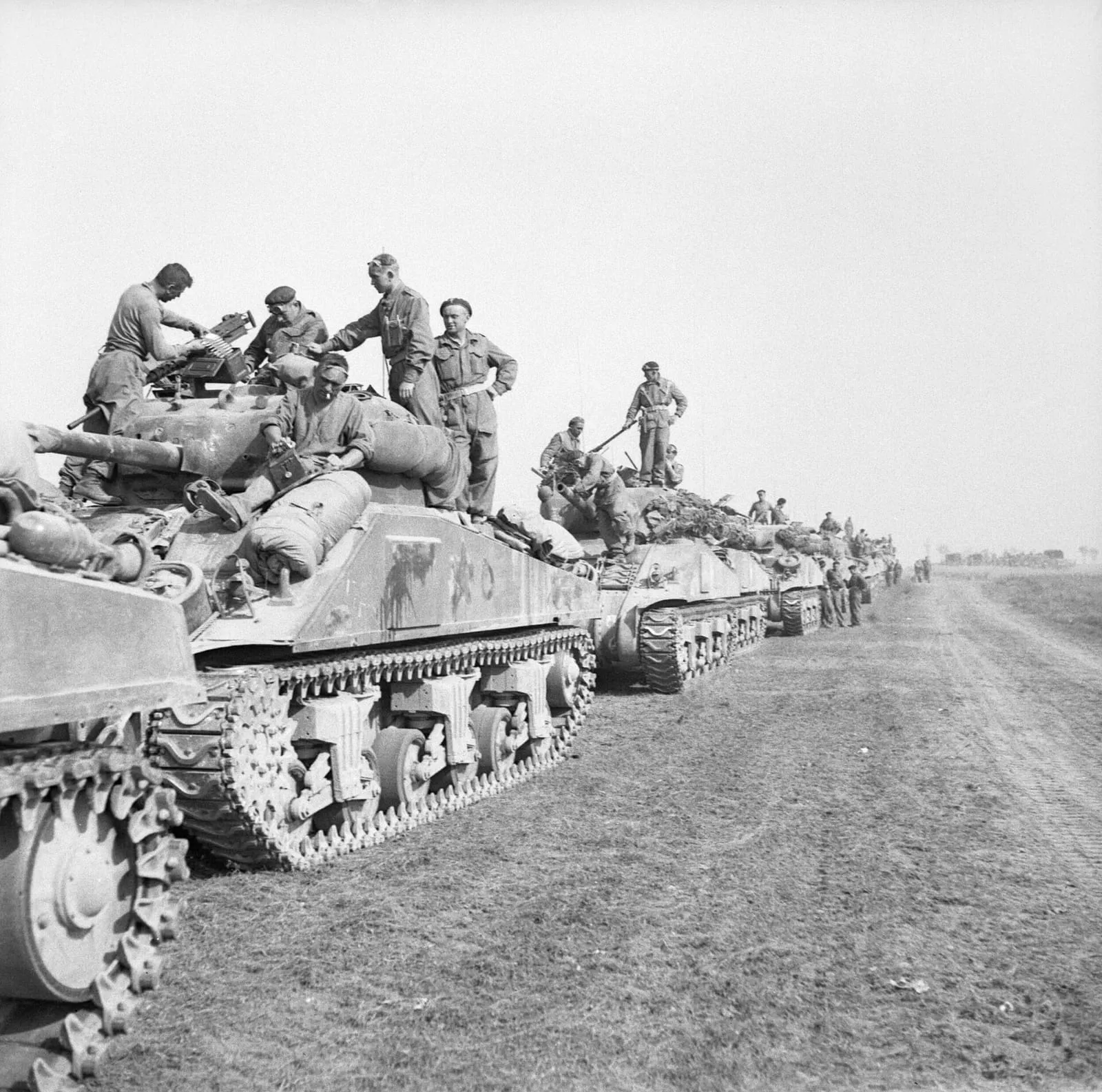
The M4 Sherman was the main tank of the Western Allies in the second half of the war. It was not the best tank of its time, and its crews knew it from 1943 on, but it was simple to build, reliable, easy to repair and easy to ship across the ocean, and American factories built it in numbers no enemy could match. It fought in the desert, in the hedgerows of Normandy, in the mountains of Italy, on the coral atolls of the Pacific and on the Eastern Front. Americans, Britons, Canadians, New Zealanders, Frenchmen, Red Army soldiers and Poles all rode in it.
A tank built for the factories
In 1940 the US Army had no modern medium tank. The fall of France showed that a 75 mm gun in a rotating turret was needed, and the Americans could not yet build such a turret. For the time being, therefore, came the M3 Lee, a tank with its gun in the hull, and in parallel the work on its successor. General Jacob Devers, chief of the Armored Force from August 1941, pressed industry for more powerful engines and for the quickest possible switch to the new vehicle. The T6 prototype, an M3 hull with a new turret, was ready on 2 September 1941, and in February 1942 the locomotive works at Lima, Ohio, turned out the first production vehicle, designated M4A1.
Ease of production was the key to its success. Shermans were built by locomotive works, car plants and new tank arsenals, about ten firms in all. The variants differed mainly in engine and hull: cast or welded, a radial aero engine, a General Motors diesel, a Ford V8 or five Chrysler engines coupled together. The British, who received them under Lend-Lease, named the tank after the Civil War general William Tecumseh Sherman, and the name caught on in the US Army as well. It had a crew of five, weighed from 30 to over 35 tonnes depending on the variant, and ran on roads at 35–45 kilometres an hour.
The desert and Tunisia
Shermans went into action with the British before the Americans. After the fall of Tobruk in June 1942 Roosevelt and Marshall took several hundred new vehicles away from American armoured divisions and sent them to Egypt. In the Second Battle of El Alamein, from 23 October 1942, General Bernard Montgomery’s Eighth Army had about 250 of them. The 75 mm gun fired both armour-piercing and high-explosive rounds to good effect, and the armour protected against many German guns; in Rommel’s two panzer divisions only about thirty tanks could match it.
The Americans first used their own Shermans in November 1942 in Operation Torch. Tunisia brought the first lesson: in February 1943, in the first days of the Battle of the Kasserine Pass, an armoured battalion counter-attacking at Sidi Bou Zid lost 46 of its 52 Shermans. The fault lay less with the machine than with inexperienced command and German 88 mm guns set up in ambush.
Normandy and the Panthers
By 1944 the Sherman was a tank of an earlier era. German Panthers and Tigers had thicker armour and guns that pierced it at long range, while its own 75 mm could not penetrate the front of a Panther. In the Battle of Normandy American and British armoured divisions lost hundreds of vehicles, and in the hedgerow fighting the Americans welded steel teeth to the Shermans to cut through the earth banks. Early vehicles caught fire easily when penetrated, because the ammunition lay in dry bins in the hull; after containers surrounded by liquid were introduced, the rate of fires fell, according to American studies of 1945, from 60–80 to 10–15 per cent. The popular story that soldiers called it the “Ronson” because it lit first time, like the lighter, is a later invention: the advertising slogan dates from after the war.
The answer was a series of changes. From 1944 new Shermans received a 76 mm gun, and 254 M4A3E2 “Jumbo” vehicles had armour up to 178 mm thick. The most effective idea was British: the Sherman Firefly with the 17-pounder, the only British tank gun that gave a real chance against Panthers and Tigers. More than two thousand vehicles were converted; the British tried to have one in every troop, and the Canadian and Polish divisions received them too. Something else decided the outcome, though: every Sherman destroyed was replaced by a new one, while the Germans had nothing with which to replace their Panthers.
Poles, the Pacific and the Eastern Front
The Polish 1st Armoured Division of General Stanisław Maczek received Shermans and Cromwells at the turn of 1943 and 1944. In Shermans its armoured regiments closed the Falaise pocket in August 1944 on the Mont-Ormel heights and at Chambois, and then went on through Belgium and the Netherlands all the way to Wilhelmshaven. In Italy the 2nd Armoured Brigade of the II Corps of the Polish Armed Forces under General Władysław Anders fought in Shermans, supporting the infantry at Monte Cassino and later at Ancona and Bologna; in 1945 it was expanded into an armoured division.
In the Pacific the Marines’ Shermans first went ashore on Tarawa in November 1943. Japanese tanks had thin armour and could not take them on, so the Shermans were used mainly to destroy bunkers and caves, often with flamethrowers. The Soviet Union received under Lend-Lease, depending on the tally, between about 3,700 and 4,100 Shermans, mostly with diesel engines. Red Army tank crews called them “Emchas”, from the designation M4, and used them until the end of the war.
Production ended with the war. Depending on whether prototypes and special vehicles are counted, about 49,000 were built: the British Army alone received more than 17,000, the US Army more than 19,000. Shermans fought on in Korea, and in Israel, rearmed with new guns, until the 1973 war.
Sources
Battles
(06)- 30 August – 5 September 1942Battle of Alam el HalfaOn 30 August – 5 September 1942 Rommel struck in Egypt for the last time. Short of fuel and under RAF bombs, he was repulsed at Alam el Halfa and fell back.
- 23 October – 11 November 1942Second Battle of El AlameinOn 23 October – 11 November 1942 Montgomery's Eighth Army broke Rommel's position at El Alamein and drove the Axis out of Egypt – the turning point in Africa.
- 14–24 February 1943Battle of the Kasserine PassOn 14–24 February 1943 Rommel and Arnim routed the Americans at Sidi Bou Zid and the Kasserine Pass, but were halted at Thala and Sbiba and fell back.
- 20–28 March 1943Battle of the Mareth LineOn 20–28 March 1943 Eighth Army attacked the Mareth Line. The frontal assault failed, but an outflanking move through the Tebaga Gap forced Messe to retreat.
- 20–23 November 1943Battle of TarawaOn 20–23 November 1943 the 2nd Marine Division took Betio on Tarawa Atoll at a cost of about 1,000 dead; of some 4,700 defenders, 146 were captured.
- 14 January – 28 March 1945Battle of Meiktila and MandalayJanuary–March 1945. Slim's Fourteenth Army crossed the Irrawaddy, took Meiktila and Mandalay and shattered the Japanese armies in central Burma.