United States
Jacob Devers
Chief of the Armored Force (1941–1943), commander of US forces in Europe (1943–1944), deputy supreme commander in the Mediterranean (1944), commander of the 6th Army Group (1944–1945)
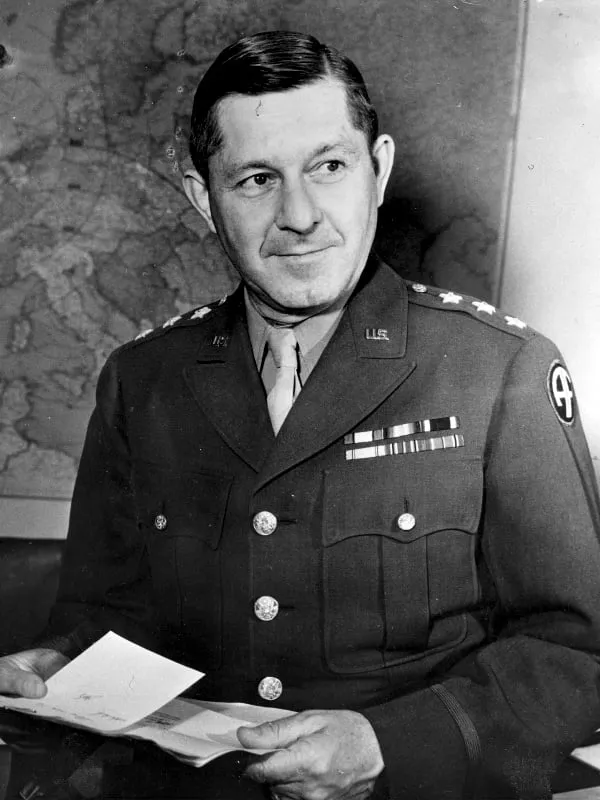
- Born:
- 8 September 1887, York, Pennsylvania (United States)
- Died:
- 15 October 1979, Washington (United States)
- Author:
- Łukasz
- Photo:
- United States Army, domena publiczna, Wikimedia Commons

Jacob Devers was one of the two American generals who commanded an army group in Europe in 1944–1945, and the one who is remembered far less. His 6th Army Group, made up of the American Seventh Army and the French First Army, landed in Provence, liberated Alsace, beat off the last German offensive in the west and ended the war in Bavaria and Austria. Before that Devers had built up the American armoured forces and prepared the base for the invasion in England. Dwight Eisenhower disliked him, and because it was the memoirs of Eisenhower and Omar Bradley that shaped the post-war picture of the campaign, Devers long remained in their shadow.
A gunner from Pennsylvania
Jacob Loucks Devers was born on 8 September 1887 in York, Pennsylvania, into the Lutheran family of a watchmaker. At school he was a good pupil and an athlete, and in 1909 he graduated from West Point in the same class as George Patton. He served in the artillery, first in mountain artillery with guns carried by mules, then returned to West Point to teach mathematics and coach sports teams; among his players were the young cadets Eisenhower and Bradley. In 1911 he married Georgie Lyon.
During the First World War Devers was promoted quickly, to colonel, but he did not get to France: he was an instructor at the artillery school at Fort Sill, Oklahoma, and when his regiment was ordered to the front, the armistice came. He went to Europe only in 1919, to learn from the experience of the French and German artillery in the occupied Rhineland.
Between the wars
After the war he went back to the rank of captain and for twenty years followed the usual slow path of an officer in a small peacetime army. He taught at West Point when Douglas MacArthur was superintendent, graduated from the staff school at Fort Leavenworth and from the Army War College, and at the artillery school at Fort Sill he worked on new fire-control methods that were later used in the Second World War. From the start he argued for replacing horses with tractors, which did not win him friends among older gunners.
In 1939, as a colonel, he was chief of staff of the command in the Panama Canal Zone. It was then that he was noticed by George Marshall, the new Army Chief of Staff, and in May 1940 Devers was made a brigadier general, passing over several hundred more senior colonels. In the autumn of that year he took over the newly formed 9th Infantry Division at Fort Bragg and within a few months carried through the expansion of the base, whose strength grew more than tenfold.
The armoured force
In August 1941 Marshall appointed him Chief of the Armored Force at Fort Knox. Devers found two armoured divisions and tanks armed with 37 mm guns; when he left in 1943 the army had sixteen armoured divisions. He argued with General Lesley McNair, who wanted to fight German tanks with light tank destroyers, and maintained that the best weapon against a tank was a better tank. He pressed industry to produce more powerful engines and pushed through the M4 Sherman medium tank with a 75 mm gun in a rotating turret. He backed the DUKW amphibious truck, observation aircraft in armoured divisions and cooperation between tanks, infantry, artillery and aircraft. Not all his decisions proved sound: he rejected a diesel engine in favour of a petrol one, which was later regretted.
England and the Mediterranean
In May 1943 General Frank Andrews, commander of the American forces in Europe, was killed in an air crash in Iceland, and Marshall sent Devers to replace him. For half a year he prepared the base for the invasion in Britain: in that time the number of American soldiers in the British Isles grew from about 130,000 to more than 770,000. He refused to hand over bombers to Africa and Italy because it would have weakened the air offensive against Germany; Eisenhower, who had asked for them, did not forget it. In the autumn he also asked for 250 of the new M26 Pershing heavy tanks for the invasion, but McNair turned the request down.
Devers hoped to lead the American army group in Normandy himself. After the Tehran conference, however, Eisenhower became commander of the invasion and brought his own people to London, and in January 1944 Devers went to Algiers as commander of the American rear organisation in the Mediterranean and deputy to the British supreme commander, General Henry Maitland Wilson. Despite the administrative nature of the post he was often at the front. In February, together with General Ira Eaker, he flew low over Monte Cassino, and both claimed to have seen soldiers in the abbey; their report contributed to the destruction of the abbey on 15 February. A day later he visited the beachhead at Anzio and backed the removal of General John Lucas, who was replaced by Lucian Truscott. Throughout the spring he also protected the stocks gathered for the landing in southern France while the operation was repeatedly postponed, and he entrusted its preparation to General Alexander Patch.
The 6th Army Group
On 1 August 1944 Devers activated the headquarters of the 6th Army Group on Corsica. On 15 August the Allies landed in Provence in Operation Dragoon, and within a few weeks they took Toulon and Marseille, advanced up the Rhône valley and in September linked up in Burgundy with the forces coming from Normandy. On 15 September the army group passed under Eisenhower’s command; alongside Patch’s Seventh Army it included General Jean de Lattre de Tassigny’s French First Army, according to American authors the largest French force ever commanded by a foreigner. Devers had to reconcile French ambitions, the orders that Charles de Gaulle gave de Lattre over his head, and supply running through wrecked ports and railways.
In November his troops broke through the front in the Vosges. The French reached the Rhine, and on 23 November General Philippe Leclerc’s 2nd Armoured Division liberated Strasbourg. When Eisenhower and Bradley came to Devers’s headquarters at Vittel the next day, they found him planning a crossing of the Rhine. Eisenhower forbade the crossing, wanting first to destroy the Germans on the west bank; the American official historians later called this decision difficult to understand, and some Seventh Army officers believed the crossing might have upset German preparations for the Ardennes offensive. In the south, meanwhile, a German pocket held out around Colmar.
After the blow in the Ardennes Devers had to take over part of Patton’s front and stretch his forces over more than two hundred kilometres. On 31 December the Germans attacked him in Operation Nordwind. Eisenhower ordered him to shorten the front and give up the Alsace plain with Strasbourg; Devers delayed carrying out the order, and de Gaulle threatened that French troops would defend the city on their own. On 3 January Eisenhower gave way and Strasbourg was held, as told in the article on the dispute over Strasbourg. VI Corps fell back to the Moder, but the front did not collapse. By 9 February the French and Americans had eliminated the Colmar Pocket; Devers later admitted that he had underestimated the German will to hold it.
On 8 March 1945 Devers received his fourth star, ahead of Bradley and Patton, even though Eisenhower would have preferred a different order. The Seventh Army crossed the Rhine on 26 March and in April advanced through Bavaria to Munich and the Alps. On 5 May General Hermann Foertsch signed at Haar near Munich, before Devers, the surrender of Army Group G, which came into force the next day. The last dispute with the French was over who should receive the surrender of the German 24th Army; de Lattre wanted to accept it himself, but Devers refused.
After the war
In June 1945 Devers took command of the ground forces in the United States and directed their demobilisation and reorganisation, and in 1949 he retired. He then worked in the aircraft industry, at Fairchild, where he promoted the C-123 transport aircraft and the AR-15 rifle, the later M16, and in the 1960s he chaired the American Battle Monuments Commission, which looks after the cemeteries of American soldiers abroad. He died on 15 October 1979 in Washington and was buried in Arlington National Cemetery.
For decades Devers was regarded as a second-rank general whose front was a sideshow, and as too self-confident and not loyal enough to Eisenhower. More recent research, especially James Scott Wheeler’s 2015 biography, judges him much more favourably: as an efficient organiser who knew how to cut through bureaucratic obstacles, a commander whose troops stood on the Rhine as early as November 1944, and a general who throughout the campaign managed to keep cooperation going with a difficult French ally. His dispute with Eisenhower over crossing the Rhine in November 1944 remains one of the open questions of the campaign in the west.
Sources
Commanded in battles
(02)Mentioned in battles
(01)Often appears with
People who appear in the same events.
On the timeline
(15)1943
1944
1945
January
February
March
May
- 07
- Key eventThe surrender at ReimsAt 2.41 a.m. on 7 May 1945, at Eisenhower's headquarters in Reims, General Alfred Jodl signed the unconditional surrender of all German armed forces.
- Göring taken prisonerOn 7 May 1945 Hermann Göring, freed from SS arrest, surrendered to the Americans in Austria. He hoped to meet Eisenhower but ended up in prison and in the dock.