Germany
Hans Jürgen von Arnim
Commander of the 52nd Infantry Division (1939–1940), 17th Panzer Division (1940–1941), XXXIX Panzer Corps (1941–1942), 5th Panzer Army (1942–1943) and Army Group Africa (March–May 1943)
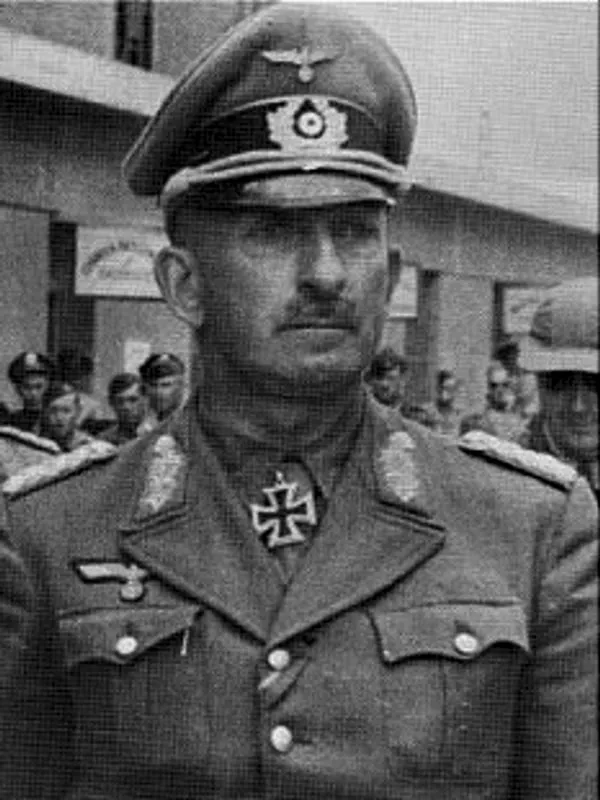
- Born:
- 4 April 1889, Ernsdorf, now part of Dzierżoniów, Silesia (German Empire)
- Died:
- 1 September 1962, Bad Wildungen (West Germany)
- Author:
- Łukasz
- Photo:
- autor nieznany, domena publiczna, Wikimedia Commons

Hans Jürgen von Arnim was a general from an old Brandenburg noble family and the last commander of the Axis forces in Africa. He arrived in Tunisia in December 1942, when the Allies, after landing in Algeria and Morocco, were trying to reach Tunis at a run, and for five months he fought a war there which he believed from the start could not be won. He quarrelled with Erwin Rommel over divisions and plans, replaced him at the head of Army Group Africa in March 1943, and on 12 May was taken prisoner by the British. At the time he was, after Paulus, the highest-ranking German prisoner of war in Allied hands.
A Prussian Guards officer
Hans-Jürgen Theodor von Arnim was born on 4 April 1889 in Ernsdorf in Lower Silesia, a village incorporated a year later into Reichenbach, today’s Dzierżoniów (PL). For centuries the Arnim family had given Prussia officers and officials; his father, Hans von Arnim, rose to the rank of major general. The son joined the army as an officer cadet in 1908, in the elite 4th Foot Guards Regiment, and after war school in Danzig was commissioned as a second lieutenant in 1909.
He went through the First World War as an infantry officer and staff officer. Wounded at Namur in August 1914, he then fought on the Eastern Front and from the autumn of 1915 in the west again, in Flanders, where in July 1916 he was wounded a second time. From 1917, by then a captain, he was adjutant of the 4th Guards Infantry Division, commanding a battalion when needed. He received both classes of the Iron Cross and the House Order of Hohenzollern with Swords. In 1917 he married Annemarie von Dechend in Berlin.
Between the wars
After the defeat Arnim found a place in the hundred-thousand-man Reichswehr, where he followed the usual path of an officer marked for higher posts: he commanded a company, took the covert staff course that replaced the war academy banned by the Treaty of Versailles, worked in the ministry’s Troop Office and on divisional staffs in Kassel and Munich. Promotion came slowly: he became a major in 1928, a colonel in 1934 and a major general on 1 January 1938. He was not one of the theorists of armoured warfare; he was a solid, careful infantry officer, valued more for order on a staff than for brilliance.
From Poland to Tikhvin
At the beginning of September 1939 Arnim took over the 52nd Infantry Division (PL), with which in 1940 he took part in the campaign in France. In the autumn of that year he was given the 27th Infantry Division, soon converted into the 17th Panzer Division, and with it in June 1941 he entered the Soviet Union as part of Heinz Guderian’s panzer group. As early as 28 June, near Stowbtsy, he was badly wounded and spent several months in hospital; during that time he received the Knight’s Cross. He returned to the division in September, just in time for the double battle of Vyazma and Bryansk. His tanks took Bryansk by surprise and then drove on Tula, in the offensive that was meant to end the war before Moscow.
In November 1941 Arnim took over XXXIX Panzer Corps in Army Group North, which stood at the farthest point of the German advance east of Leningrad, at Tikhvin. A Soviet counter-offensive forced him in December to fall back behind the Volkhov, but the corps came out of it still able to fight, and that same month Arnim was promoted to General of Panzer Troops. In May 1942, after several failed attempts, his troops broke through to the encircled garrison at Kholm, and the corps was then sent to Rzhev, to Walter Model’s 9th Army, into heavy defensive fighting.
Tunisia: a war without hope
When the Allies landed in North Africa in November 1942 in Operation Torch, the Germans rushed troops to Tunisia and won the race for Tunis. Command of the growing forces, however, was not left to General Walther Nehring, who was respected but at odds with his superiors; Hitler sent Arnim, newly promoted to colonel general, in his place. He flew into Tunis on 8 December and took over the newly formed 5th Panzer Army. Formally he answered to the Italian high command in Rome, in practice to Field Marshal Albert Kesselring, the German commander in the south. Hitler promised him reinforcements, but from the first weeks Arnim understood that the Allies would grow stronger faster than he could. According to some accounts, as early as the beginning of 1943 he suggested to Rommel that they should think about evacuation before Tunisia became a second Stalingrad.
Over the winter his troops held the bridgehead around Tunis and Bizerta, and in January, in Operation Eilbote, they pushed the French back in the mountains of central Tunisia. When Rommel’s army, retreating from Libya, reached the country in February, the main weakness of Axis command came into the open: two generals, neither of whom was subordinate to the other and who disliked each other. Rommel wanted to gather all the panzer divisions and smash the inexperienced Americans with a single blow; Arnim preferred a limited attack that would improve his own positions. On 14 February two of his panzer divisions, led by his deputy, General Heinz Ziegler, routed the Americans at Sidi Bou Zid. In the battle of the Kasserine Pass Arnim handed Rommel only part of his forces, keeping back a battalion of heavy tanks and part of the 10th Panzer Division. Historians still argue over how much this cost the Germans, but nobody claims that command worked well at the time.
At the end of February Arnim launched his own Operation Ochsenkopf (PL) against the British V Corps in the north. The attack, in rain and mud, stalled after a few days and cost him a great deal of infantry and most of the tanks committed. On 9 March Rommel, ill and convinced the cause was hopeless, flew to Europe and never came back, and Arnim took over Army Group Africa. In the south the army on the Mareth Line was commanded by the Italian Giovanni Messe, in the north the 5th Panzer Army by General Gustav von Vaerst.
Surrender
In the spring of 1943 the fate of the Axis forces was decided not by battles but by supply. Allied aircraft and warships sank more and more ships from Sicily, and transport aircraft were lost over the strait in whole groups. Arnim reported that he was short of fuel and ammunition and pressed Rome and Berlin to shorten the front; Hitler refused to withdraw a single soldier. After the lost battles on the Mareth Line and at Wadi Akarit, the Axis forces were squeezed into the north-eastern corner of the country. The final Allied offensive opened on 6 May, and a day later Tunis and Bizerta fell.
Arnim did not try to escape to Europe. On 12 May soldiers of the British 4th Indian Infantry Division reached his command post near Sainte-Marie-du-Zit and took him prisoner together with his staff. The general refused to issue an order for the general surrender of the remaining units. The next day the last Axis force, Messe’s Italian army, laid down its arms. By various counts between 230,000 and 275,000 German and Italian soldiers went into captivity, more than at Stalingrad; the full story of those days is told in the article on the surrender of the Axis forces in Africa.
His period of command in Tunisia also has a darker side, on which military biographies are usually silent. Under German occupation Tunisian Jews were forced to work on fortifications and the community was burdened with heavy levies; this was organised by an SS commando, but the forced labour was also used by the army Arnim commanded.
In captivity
Arnim was taken to Britain, first for interrogation and then to Trent Park near London, where the British held captured German generals and secretly recorded their conversations. As the senior officer he was the prisoners’ spokesman there for a year. According to historians who have studied the transcripts of the bugged conversations, he was unable to calm the quarrel between the generals who openly criticised Hitler, gathered around Wilhelm von Thoma, and his supporters led by Ludwig Crüwell; he manoeuvred between the two groups without taking either side.
In 1944 he was moved with a group of other generals to Camp Clinton in Mississippi. There too his conduct was ambiguous: on the one hand he had General Botho Elster, whom Nazi officers accused of cowardice for surrendering to the Americans in France, cleared of the charges; on the other he criticised him in writing for refusing to give the Hitler salute. He was released from captivity on 1 July 1947.
After the war
Arnim settled in Bad Wildungen in Hesse. He never stood before any court and played no significant part in the public life of West Germany; his papers later went to the German Federal Archives. He died on 1 September 1962 in Bad Wildungen and was buried there.
In the memory of the war in Africa he has remained in Rommel’s shadow, and judgements of him are usually measured. He was a competent, cautious commander who in Tunisia foresaw the end correctly and for several months delayed it despite the enemy’s superiority. At the same time his rivalry with Rommel in February 1943 helped waste the Axis’s only chance of a serious victory in that campaign, and his army made use of the forced labour of the Jewish population. The defeat in Tunisia, in which a whole army was killed or captured, hastened the Allied landing in Sicily and the fall of Mussolini.
Sources
Commanded in battles
(03)Often appears with
People who appear in the same events.