Italy
Giovanni Messe
Commander of the Special Corps in Albania (1940–1941), the Italian Expeditionary Corps in Russia (1941–1942) and the First Army in Tunisia (1943), Chief of the General Staff (1943–1945)
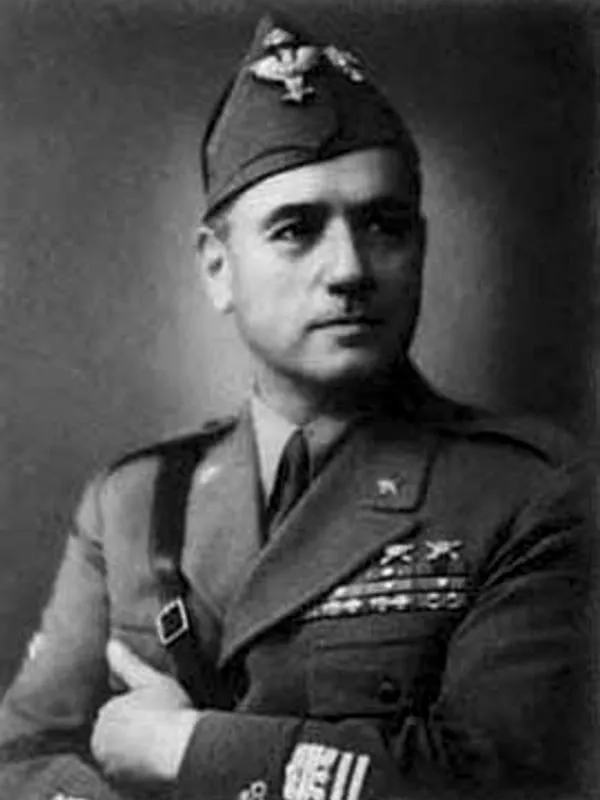
- Born:
- 10 December 1883, Mesagne (Italy)
- Died:
- 18 December 1968, Rome (Italy)
- Author:
- Łukasz
- Photo:
- autor nieznany, domena publiczna, Wikimedia Commons

Giovanni Messe is regarded as the ablest Italian commander of the Second World War, and his career was an exception in the army of royal Italy: the son of a bricklayer from Apulia who enlisted as a private, he ended it as a Marshal of Italy. In this war he was always given tasks that were difficult and badly equipped. In Albania he stopped the Greek advance on Vlorë, in Russia he led an expeditionary corps that lacked lorries, tanks and winter boots, and in Tunisia he commanded the last Axis army in Africa and was one of the last to surrender. After the armistice he came back from British captivity to rebuild, as Chief of the General Staff, an army that was now fighting against the Germans.
From private to arditi
Giovanni Messe was born on 10 December 1883 in Mesagne near Brindisi, one of eleven children of a master bricklayer. He left school early to work on building sites, and on 31 December 1901 he joined the 45th Infantry Regiment as a volunteer. From 1903 to 1905 he served in China, with the troops left there after the Boxer Rebellion. As an NCO he took a special course at the military school in Modena and in 1910 was commissioned as a second lieutenant. A year later he fought in Libya in the Italo-Turkish War.
In the First World War he commanded a battalion on the Austrian front, and was wounded and decorated several times. In January 1918, by then a major, he took over one of the assault units of the arditi, elite infantry trained to break into trenches. His IX Assault Unit fought in 1918 in the battles for the Monte Grappa massif (PL), and Messe himself, wounded in the final offensive at the end of October, was promoted to lieutenant colonel for war merit. He came out of the war with many decorations, among them the Knight’s Cross of the Military Order of Savoy.
The king’s aide and a general of the fast troops
In 1920 he fought Albanian insurgents near Vlorë. From 1923 to 1927 he was aide-de-camp to King Victor Emmanuel III; loyalty to the monarchy remained one of his traits from then on. Afterwards, as a colonel, he commanded the 9th Bersaglieri Regiment at Asti and at Zadar. On 1 January 1936 he was made a brigadier general, and during the war with Ethiopia he was deputy commander of a division in Eritrea, which, however, played no great part in the fighting. From 1938, as a major general, he commanded the 3rd Fast Division “Principe Amedeo Duca d’Aosta”, a formation of cavalry and bersaglieri.
Albania and Greece
In April 1939 Messe was deputy to General Alfredo Guzzoni, commander of the troops sent to Albania. He led the strongest column, some 4,700 men, which landed at Durrës on 7 April, overcame resistance in the port and set off for Tirana.
When Mussolini attacked Greece in the autumn of 1940, and after a few weeks the Greeks went over to the counter-offensive and advanced into Albania, Messe was given command of the Special Corps on the coast on 19 December. He stopped the Greeks on their way to the important port of Vlorë, and the front froze in the mountains (Greco-Italian War). He took part in the failed spring offensive in March 1941 and in the final phase of the campaign, after the German attack on Greece. As one of the few Italian generals to come out of this war with an enhanced reputation, he was promoted to corps general for war merit.
A corps in Russia
In July 1941, when General Francesco Zingales, appointed to command the Italian Expeditionary Corps in Russia, fell ill in Vienna, Messe took over the corps. The CSIR numbered some 60,000 men in three divisions, two of which, “Pasubio” and “Torino”, were called motorised although they marched on foot. There were no anti-tank guns able to pierce the armour of a T-34, and light tankettes served as tanks. From the start Messe pressed for lorries and winter equipment, and when he did not get them he bought horses, sledges and furs on the Romanian black market.
In Operation Barbarossa the corps operated with Ewald von Kleist’s 1st Panzer Group. On 28–30 September 1941, on the Dnieper, it carried out an encirclement of its own at Petrykivka, taking according to Italian figures some 10,000 prisoners. In October bersaglieri entered Stalino (today Donetsk), and in November the Italians took Horlivka and the neighbouring industrial centres of the Donets Basin. They advanced on the left wing of the German drive on Rostov and, as Messe later wrote, the Soviet counter-stroke that recaptured the city took Germany’s allies by surprise and dispelled the illusion of imminent victory. On 25–31 December the CSIR, with German help, repulsed a Soviet attack in the so-called Christmas battle. The corps came through the winter relatively well, thanks in part to the stores its commander had seen to.
In the summer of 1942 Mussolini, against the advice of Messe, who wanted rather to equip a smaller force better, expanded the corps into the Eighth Army of some 230,000 men. Command went to General Italo Gariboldi, who was senior in rank, and Messe became commander of XXXV Corps. In August, in the first defensive battle on the Don, he protested sharply against his divisions being placed under a German general. At odds with Gariboldi and with the Germans, he asked to be recalled and left the front on 1 November 1942, a few weeks before Operation Little Saturn, in which the Red Army smashed the Italian army on the Don.
Tunisia: the last army in Africa
On 23 January 1943, by then a full general, he was appointed commander of the First Army in Tunisia. According to the diary of Foreign Minister Galeazzo Ciano, Messe then called himself a “commander of stragglers” and believed that the Chief of the General Staff, Ugo Cavallero, was sending him to certain defeat. At the end of February Erwin Rommel took over Army Group Africa, and his former army, made up of the troops that had retreated through Libya, passed under Messe’s command as the Italian First Army. By British estimates it numbered some 85,000 soldiers, mostly Germans, several hundred guns and fewer than 150 tanks.
It was Messe, together with General Heinz Ziegler, who drew up the plan for the attack on the British at Medenine on 6 March, and it was he who that evening persuaded Rommel to break off the attack before the losses made a defence impossible. In the battle of the Mareth Line on 20–28 March he repulsed the frontal attack of Bernard Montgomery’s Eighth Army across the Wadi Zigzaou, counter-attacking with the 15th Panzer Division, and when the New Zealanders outflanked the line from the west through the Tebaga Gap, he withdrew his army in good order, covering the retreat with German divisions at El Hamma. Montgomery’s critics accuse him of letting Messe slip out of the trap. On the Wadi Akarit Messe held out until 7 April and then once again managed to withdraw, this time to the hills near Enfidaville.
When the German front in the north collapsed on 12 May, the First Army was still fighting. Messe wanted to surrender with military honours and only to the British. In the evening Mussolini cabled him to stop fighting and made him a Marshal of Italy. On 13 May Messe surrendered to General Bernard Freyberg’s New Zealanders (the Axis surrender in Africa). The interpreter remembered their conversation: asked whether he was a fascist, Messe replied that naturally he was, because his king had accepted a fascist head of government. Montgomery is said to have told him that had he known whom he was facing from Mareth onwards, he would have got hold of his photograph. Messe was sent to a camp for senior officers in England, where the British bugged the prisoners’ conversations.
Chief of staff of co-belligerent Italy
After the armistice of Cassibile and the declaration of war on Germany, the British judged Messe loyal to the king and sent him back to Italy in the autumn of 1943. He turned down the honorary post of army inspector offered by Marshal Pietro Badoglio, and on 18 November 1943 the king appointed him Chief of the General Staff. Messe had to overcome the resistance of the Allies, who at first did not want to give Italian units an active role at the front. From a small motorised group grew the Italian Liberation Corps, some 25,000 men in the spring of 1944, and in the autumn six combat groups. Five of them took part in the final offensive in Italy in the spring of 1945. At the same time Messe had to cope with the purge of officers compromised by collaboration with fascism or by their passivity towards the Germans in September 1943, and with the hostility of the new, anti-monarchist parties. Ivanoe Bonomi’s government curtailed the powers of the chief of staff, and on 1 May 1945 Messe left the post.
Politician and veteran
In January 1947 Messe retired. The rank of Marshal of Italy was abolished at the time, but he, the last marshal to be appointed, kept it personally. He went into politics on the side of the right and of the veterans; he also helped set up a semi-clandestine anti-communist association of officers. In 1953 he was elected to the Senate as an independent on the Christian Democrat list for Brindisi, later moved to the monarchists, and from 1961 to 1968 sat in the Chamber of Deputies, from 1963 on the Liberal list. He wrote memoirs and books about the war in Russia and in Tunisia, in which he defended the Italian soldier; his views sparked polemics with the communists. He died in Rome on 18 December 1968 (the Dizionario Biografico degli Italiani gives 12 December) and was buried in the Verano cemetery.
In a lost war Messe avoided the defeats that wrecked the reputations of many other generals of the Axis powers. Montgomery, who fought him in Tunisia, spoke of him with respect, and in Italy his name served as a counterweight to the generals blamed for the defeats of 1940–1943. At the same time he served Mussolini’s regime until the last day in Tunisia, and his books, like the memoirs of many generals, defend above all the author’s own decisions and the honour of the Italian soldier.
Sources
Commanded in battles
(03)Mentioned in battles
(01)Often appears with
People who appear in the same events.