Germany
Walther Model
Commander of the 3rd Panzer Division (1940–1941), the Ninth Army (1942–1943), Army Groups North, North Ukraine and Centre (1944) and Army Group B (1944–1945)
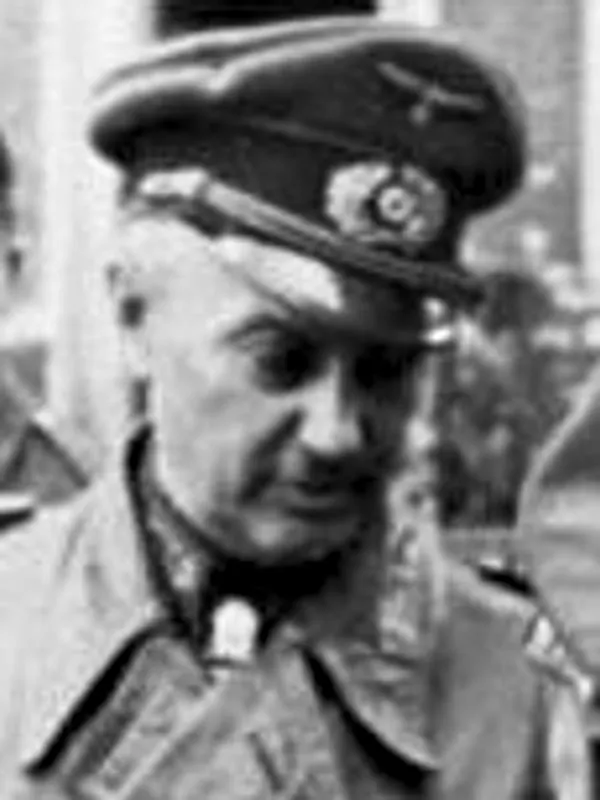
- Born:
- 24 January 1891, Genthin (Germany)
- Died:
- 21 April 1945, Forest near Lintorf, now Ratingen (Germany)
- Author:
- Łukasz
- Photo:
- Jäger, CC BY-SA 3.0 DE, Wikimedia Commons

Walther Model, called Walter in the documents and by most historians, was one of Adolf Hitler’s youngest field marshals and one of the few whom the dictator trusted almost to the end. From the winter of 1941–1942 Hitler sent him wherever a front was falling apart: to Rzhev, to Orel, to Estonia, to Galicia, to Belarus after the destruction of Army Group Centre, and finally to France after Normandy. In almost every one of these places Model managed to build a new line of defence out of the remnants of the troops, which earned him the name “Hitler’s fireman”. He was also the commander who won at Arnhem and led the Ardennes offensive. His retreats were marked by burnt villages and columns of deportees, and his war ended in a forest near Duisburg, where he shot himself.
A music teacher’s son
Otto Moritz Walter Model was born on 24 January 1891 in Genthin, in the Prussian province of Saxony. His father taught music at a girls’ school and was later a director of music; the family was middle-class and Protestant and had no military traditions at all. At the end of the war Model burnt his private papers, so we know little about his youth. He passed his school-leaving examination in 1909 at the cathedral grammar school in Naumburg (PL) and then joined the 52nd Infantry Regiment as an officer cadet. In August 1910 he was commissioned as a second lieutenant. His fellow officers remembered him as ambitious, not very sociable and blunt-spoken, which his superiors found hard to bear.
During the First World War he fought on the Western Front, at first as a battalion adjutant. Wounded several times, among others near Arras in 1915 and at Verdun in 1916, he received the Iron Cross First Class in 1915. His divisional commander, although he considered him an “uncomfortable subordinate”, sent him on a shortened staff course. In 1917 Model joined the Supreme Army Command, and in 1918, as a captain, he was a staff officer in divisions fighting in the spring offensive.
Reichswehr and technology
Model was one of the few officers taken into the 100,000-strong Reichswehr. In 1920 his company took part in suppressing the communist uprising in the Ruhr; it was there that he met Herta Huyssen, whom he married in 1921. They had three children; their son Hansgeorg became a general in the Bundeswehr after the war. Model’s career followed the usual path: company command, staffs, lectures on military history for future general staff officers, and from 1930 work in the training section of the disguised general staff. In 1931 he spent several weeks in the USSR, as part of the secret cooperation between the two armies, and afterwards wrote a study of the Red Army’s weapons.
In 1934, as a colonel, he commanded an infantry regiment in Allenstein (Olsztyn), and in 1935 he took over the technical department of the army general staff. There he supervised work on new weapons, including the assault gun and a heavy mortar, and supported the creation of panzer divisions. His enthusiasm for innovation earned him the nickname “Armee Modernissimus”. In March 1938 he became a major general, and in November chief of staff of IV Corps in Dresden. Like many officers he sympathised with the Nazis, although he did not get involved in politics.
From Poland to Moscow
In September 1939 IV Corps fought in the September Campaign as part of Walter von Reichenau’s Tenth Army. In October Model became chief of staff of General Ernst Busch’s Sixteenth Army, with which he went through the campaign in France; in April 1940 he was promoted to lieutenant general. In November 1940, although he had no experience of armour, he took over the 3rd Panzer Division. He trained it in his own way: tank crews together with infantry and engineers, in battle groups put together for the occasion, which later became the norm in the Wehrmacht.
In Operation Barbarossa Model’s division led Heinz Guderian’s 2nd Panzer Group. By early July 1941 it was on the Dnieper and crossed it almost without losses, for which Model received the Knight’s Cross. In August and September, after Guderian turned south, it drove into the rear of the South-Western Front and in mid-September linked up with the spearhead of Army Group South, closing the pocket at Kiev. On 26 October Model, appointed general of panzer troops, took over XLI Panzer Corps near Kalinin. In the last offensive against Moscow his spearheads got within a few dozen kilometres of the Kremlin, and after the Soviet counter-offensive Model covered the retreat of the 3rd Panzer Group. At congested crossroads, according to witnesses, he restored order with a pistol in his hand.
Rzhev
In mid-January 1942, passing over more than a dozen more senior generals, Hitler entrusted him with the Ninth Army, whose front at Rzhev had been broken. According to witnesses, the dictator said after talking to him that he trusted the man but would not want to serve under him. Model counter-attacked at once, cut off the Soviet 39th Army and beat off attempts to relieve it. In the Rzhev–Vyazma operation the Ninth Army held the salient from which the Germans still threatened Moscow. In February Model received the Oak Leaves and promotion to colonel general. His quarrel with Hitler over divisions that the dictator wanted to take from him is also well known; according to the accounts, Model asked bluntly who commanded the Ninth Army, he or the Führer, and got his way.
In May 1942, while flying over the front, he was shot through the lung and was out of action for almost three months. He returned in August, in the middle of the Soviet summer offensive, and in November and December he beat off Operation Mars, launched by Georgy Zhukov, although he too suffered heavy losses. His method rested on a continuous line, however thin, on successive positions built in the rear (against Hitler’s bans), on concentrated artillery and on breaking up the reserves sent to him into battalions with which he plugged the gaps. The British military historian Basil Liddell Hart wrote that Model could gather a reserve from an almost empty battlefield.
In March 1943 the Ninth Army abandoned the Rzhev salient in a planned withdrawal called Operation Büffel (Buffalo). The withdrawal was preceded by anti-partisan sweeps in which, according to historians’ estimates, about 3,000 people were killed, most of them unarmed, and during the retreat itself Model’s troops destroyed villages, wells and bridges and drove the men fit for work westwards.
Kursk and Orel
In the planned offensive at Kursk the Ninth Army was to form the northern arm of the pincers. Model knew that Konstantin Rokossovsky’s Central Front was strongly dug in and pressed for the attack to be postponed until the new tanks arrived. Some historians believe that he hoped in this way to quietly bury the whole operation. When the Battle of Kursk began on 5 July 1943, his divisions, which he sent into battle infantry first, got stuck in successive belts of fortifications and in a week advanced only a dozen or so kilometres.
On 12 July the Red Army struck the Orel salient. Model, who had taken the precaution of having positions built across its base in advance, also took command of the Second Panzer Army and within three weeks led both armies out of the salient. The Germans abandoned Orel at the beginning of August. This retreat too meant scorched earth: crops and buildings were destroyed, and according to historians’ estimates about a quarter of a million civilians were taken west. In the autumn Model went on leave.
Fireman of the Eastern Front
On 31 January 1944 Hitler sent him to Army Group North after the Soviet Leningrad–Novgorod offensive had broken the blockade of Leningrad and the previous commander, Georg von Küchler, wanted to withdraw. Model proclaimed the principle of “shield and sword”: every yielding of ground was to be combined with a counter-attack. In practice, although he reported offensive action to Hitler, he conducted a staged withdrawal to the Panther Line and reached it by 1 March, while holding on to Narva. In March he became a field marshal and took over Army Group North Ukraine in Galicia from Erich von Manstein.
On 28 June, when Operation Bagration shattered Army Group Centre, he took command of it as well. He did not save Minsk, but by pulling in divisions from the neighbouring army groups he managed to set up a new front at the turn of July and August. At Radzymin and Wołomin his panzer divisions destroyed the Soviet 3rd Tank Corps and stopped the Red Army before right-bank Warsaw, just as the Warsaw Uprising broke out in the city. According to his biographers, he regarded the suppression of the uprising as a matter for the SS and the administration rather than for the front. On 17 August Hitler awarded him the Diamonds to the Knight’s Cross.
Arnhem, the Ardennes and the Ruhr pocket
On the same day Model replaced Günther von Kluge as Commander-in-Chief West and commander of Army Group B. The front in Normandy was already collapsing; Model forced Hitler to agree to a retreat from the Falaise pocket and saved some of the men, but nearly all the heavy equipment was lost. At the beginning of September he handed command of the Western Front to Gerd von Rundstedt and concentrated on rebuilding Army Group B.
On 17 September 1944, as he was having lunch at his headquarters in Oosterbeek, British paratroopers landed all around. Model quickly grasped the aim of Operation Market Garden and threw into battle the II SS Panzer Corps, which was resting in the area. The British 1st Airborne Division was destroyed, and the Rhine bridges remained in German hands. In the autumn his troops bled the Americans white in the Hürtgen Forest and at Aachen. Model judged the plan for an Ardennes offensive with Antwerp as its objective to have no foundation, and together with Rundstedt proposed a more modest version. Hitler rejected it, and Model led the Ardennes offensive, which in December 1944 stalled at Bastogne and short of the Meuse.
After this defeat Hitler took away his freedom of action. After the loss of the bridge at Remagen and the Allied crossing of the Rhine, on 1 April 1945 Army Group B was encircled in the Ruhr. Model did not carry out the Nero Decree, which ordered the destruction of industrial plants, but according to German historians on 7 April he ordered prisoners in jails to be handed over to the Gestapo, which for many of them meant death. He rejected the call to surrender from the American General Matthew Ridgway, invoking his oath. In mid-April he dissolved the army group by order: he sent the youngest and oldest soldiers home and allowed the rest to surrender or to break out on their own. The Americans took about 317,000 prisoners in the pocket. On 21 April 1945 Model shot himself in a forest between Duisburg and Lintorf.
Assessment
His adjutant buried him on the spot. In 1955 his son moved the remains to the soldiers’ cemetery at Vossenack, in the Hürtgen Forest. Model was an exceptionally energetic commander, constantly present in the front line, with a memory for detail and a talent for improvisation; his defence at Rzhev, at Orel, in Estonia and in Belarus cost the Red Army enormous losses. Staffs could not stand him: he was rough and foul-mouthed, reprimanded officers in public and bypassed the chain of command. Hitler was impressed by his middle-class background, his toughness and his readiness to defend every scrap of ground; in reality Model often got round orders, and his reports had little to do with what was happening at the front.
After the 20 July plot he was the first of the field marshals to assure Hitler of his loyalty. His biographer Steven Newton sees him not so much as a Nazi as an authoritarian militarist who saw in Hitler the strong leader Germany needed and shared the prejudices against Slavs and Jews. The German “Neue Deutsche Biographie” notes that he closed his eyes to the regime’s crimes. The Soviet Union declared him a war criminal, above all for the scorched earth and deportations during the retreats of 1943.
Sources
Commanded in battles
(10)- 8 January – 20 April 1942Rzhev–Vyazma offensive (1942)Eastern Front
- 5 July – 23 August 1943Battle of KurskEastern Front
- 6 June – 30 August 1944Battle of NormandyWestern Front
- 22 June – 29 August 1944Operation BagrationEastern Front
- 13 July – 29 August 1944Lwów–Sandomierz offensiveEastern Front
- 17–25 September 1944Operation Market GardenWestern Front
- 19 September 1944 – 10 February 1945Battle of Hürtgen ForestWestern Front
- 16 December 1944 – 25 January 1945Battle of the BulgeWestern Front
- 7–31 March 1945The Rhine crossingsWestern Front
- 1–18 April 1945The Ruhr PocketWestern Front
Mentioned in battles
(06)Often appears with
People who appear in the same events.
On the timeline
(38)1941
1942
1943
1944
January
February
March
June
July
August
- 01
- Key eventThe Warsaw Uprising beginsAt 5 p.m. on 1 August 1944 Home Army units attacked the Germans in Warsaw to liberate the capital before the Red Army entered it.
- The capture of KaunasOn 1 August 1944 the 5th Army of the 3rd Belorussian Front took Kaunas, Lithuania's former capital, weeks after the Germans liquidated its ghetto camp.