Germany
Karl Wolff
Chief of the Personal Staff of the Reichsführer-SS (1936–1943), Supreme SS and Police Leader in Italy (1943–1945), Plenipotentiary General of the Wehrmacht in Italy (1944–1945)
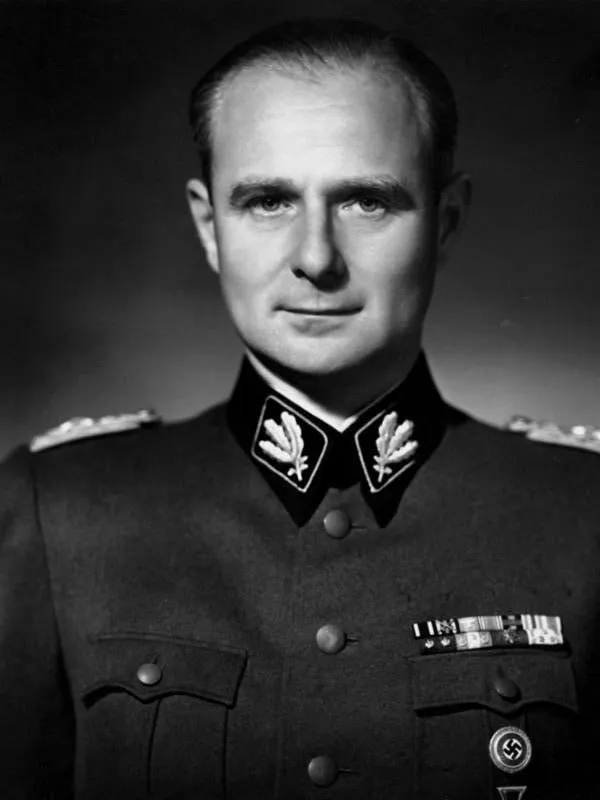
- Born:
- 13 May 1900, Darmstadt (Grand Duchy of Hesse, German Empire)
- Died:
- 15 July 1984, Rosenheim (West Germany)
- Author:
- Łukasz
- Photo:
- Bauer, Friedrich Franz, CC BY-SA 3.0 DE, Wikimedia Commons

For ten years Karl Wolff stood right beside Heinrich Himmler. As head of his personal staff and the SS liaison at Hitler’s headquarters he was among the best-informed men in the Third Reich, and his signature is on the letter in which, in the summer of 1942, he thanked the railways for the daily trains carrying Jews from Warsaw to Treblinka. From the autumn of 1943 he was Supreme SS and Police Leader in occupied Italy, responsible for the war on the partisans and for the apparatus of terror. In the spring of 1945 the same man, behind Hitler’s back, negotiated with the Americans the surrender of the German forces in Italy. That service spared him a trial at Nuremberg, and justice caught up with him only in the 1960s.
Officer, banker, advertising salesman
Karl Friedrich Otto Wolff was born on 13 May 1900 in Darmstadt, the son of a judge, into a prosperous Hessian family of officials. In April 1917 he sat an accelerated wartime school-leaving examination and joined the Hessian Life Guards Infantry Regiment No. 115 as an officer cadet. On the Western Front he rose to lieutenant and won both classes of the Iron Cross. After the war he served for a year and a half in a Hessian Freikorps (PL), and when the army was cut down under the Treaty of Versailles he returned to civilian life. He trained at a bank in Frankfurt, worked briefly for Deutsche Bank in Munich, and in 1925 set up his own advertising agency there. The Great Depression convinced him, as he later said, that only the radicals could break the political deadlock.
At Himmler’s side
In October 1931 Wolff joined the NSDAP and the SS. He was ambitious, articulate and well-mannered, which made him stand out in the SS of the day. In the spring of 1933 he became adjutant to the new Reich governor of Bavaria, General Franz von Epp (PL), and in the summer he moved to Himmler as his personal adjutant. He rose at lightning speed: in under three years he went from a rank equivalent to captain to SS general. Around the turn of 1935 and 1936 he became head of the Reichsführer-SS’s personal staff. Formally this was not one of the SS main offices, but in practice everything not assigned to another office crossed Wolff’s desk: the chancellery, personnel matters, the SS courts, finance, the businesses owned by the organisation, the Lebensborn association, the Ahnenerbe institute and the circle of industrialists who supported Himmler with money. From 1936 he sat in the Reichstag. He was a friend of Reinhard Heydrich and was seen as one of Himmler’s possible successors.
Liaison at Hitler’s headquarters
When the war broke out Wolff became Himmler’s liaison officer to Hitler and spent most of his time at his headquarters. The Munich prosecutors later called him Himmler’s “eyes and ears” beside the Führer. In January 1942 he was made SS-Obergruppenführer and general of the Waffen-SS. As chief of staff he received copies of the most important letters from the SS main offices, including the reports on the murder of Jews. In the summer of 1941 he accompanied Himmler in Minsk, where the Reichsführer watched an execution carried out by Einsatzgruppe B; after the war Wolff himself admitted in a television interview that he had seen several dozen prisoners shot. Among his friends was Odilo Globocnik, the organiser of Operation Reinhard.
The most damning evidence against him became a letter of 13 August 1942. During the Great Action in the Warsaw Ghetto there was a shortage of wagons, and Wolff intervened with the state secretary in the transport ministry, Albert Ganzenmüller. When Ganzenmüller replied that since 22 July a train with five thousand people had been leaving Warsaw every day for Treblinka, Wolff thanked him and added that he had learned “with great joy” of the daily transports of “members of the chosen people”. He also assured him that he had himself been in touch with the offices concerned so that the whole operation would run smoothly.
In 1943 Wolff’s position began to slip. He suffered from kidney disease and was often away from headquarters, and in March, against Himmler’s wishes, he divorced and remarried, asking Hitler directly for permission. Himmler, for whom the family was the foundation of the SS, did not forgive him. Wolff lost his posts as liaison officer and chief of staff, and after a short spell without an assignment he was sent south.
Supreme SS and Police Leader in Italy
In September 1943, when after the announcement of the Italian surrender the Wehrmacht occupied the north and centre of the country, Wolff became Supreme SS and Police Leader in Italy and at the same time police adviser to the puppet Italian Social Republic of Benito Mussolini. Under him were the police forces, prisons, labour and transit camps, and the recruitment of workers for the Reich. On 16 October 1943 the security police in Rome, led by Herbert Kappler and subordinate to Wolff, arrested more than a thousand Roman Jews, who were deported to Auschwitz. Kappler afterwards reported to him on how the operation had gone. In March 1944 Kappler’s men shot 335 prisoners and hostages in the Ardeatine Caves; according to some historians the Americans had documents after the war suggesting that Wolff had approved the executions, but they were judged insufficient for a charge. After the war he spoke of having thwarted an alleged plan to kidnap Pope Pius XII, but historians treat these accounts with great caution.
In July 1944 Wolff also became Plenipotentiary General of the Wehrmacht in Italy, which gave him the rear areas of the front and the whole war against the partisans. It was waged with great brutality, with hostages shot and villages burned. In December 1944 he received the German Cross in Gold, and the citation named precisely the fight against the partisans and the maintenance of war production in Italy. His part in particular crimes of this period remains largely unexplained, partly because of gaps in the sources.
Operation Sunrise
At the beginning of 1945 Wolff, convinced that the war was lost, made contact through Swiss intermediaries, among them the intelligence officer Max Waibel, with Allen Dulles, head of the American intelligence station in Bern. On 8 March he met him in Zurich and, as a token of goodwill, brought along freed leaders of the Italian resistance, among them Ferruccio Parri. On 19 March in Ascona he talked to two officers from the staff of Field Marshal Harold Alexander. The talks went on without Hitler’s knowledge, and when Stalin learned of them he accused the Western Allies of making a separate peace. Some historians believe Wolff was counting on impunity, and at first he even wanted to save the German forces for further fighting against the Red Army.
The talks dragged on because the commanders of Army Group C, first Albert Kesselring and then Heinrich von Vietinghoff, hesitated for a long time. Only when the front on the Po collapsed during the Allied spring offensive did matters come to a head. On 29 April 1945 at Caserta the envoys of Vietinghoff and Wolff signed the unconditional surrender of the German forces in Italy. It came into force on 2 May, six days before the surrender of the whole Reich, although in the final hours Wolff still had to talk round, by telephone, commanders who wanted to annul it.
A witness, not a defendant
On 13 May 1945 the Americans detained Wolff in Bolzano. At Nuremberg he was not put in the dock and appeared only as a witness. The British and American officers with whom he had negotiated spoke up for him, and historians link the leniency he enjoyed precisely to Operation Sunrise. In November 1948 a denazification court in Hamburg-Bergedorf sentenced him to five years in prison for membership of the SS; on appeal the sentence was cut to four years, counted as served in custody. In 1949 he was freed and went back to advertising. He lived by Lake Starnberg.
His own talkativeness was his undoing. After the trial of Adolf Eichmann Wolff told the press that he had learned of the murder of the Jews only in 1945. The prosecutors took an interest, and the letter to Ganzenmüller had long been known. On 18 January 1962 Wolff was arrested. On 30 September 1964 the jury court at the Munich II regional court sentenced him to 15 years’ penal servitude for aiding and abetting the murder of at least 300,000 Jews deported to Treblinka. The court did not believe that he had not known where the trains were going. He was never held to account for his activities in Italy. Because of poor health he left prison after serving part of his sentence: according to German accounts in 1969, while a formal pardon came in 1971.
Last years and verdict
In old age Wolff liked to appear as a witness to history: he gave interviews, appeared in the British documentary series “The World at War”, and in 1980, in a lengthy interview for German television, posed in front of his own portrait in full-dress SS uniform. He grew close to the “Stern” reporter Gerd Heidemann, with whom in 1979 he travelled around South America in search of old Nazis, and advised him on the purchase of the supposed Hitler diaries, which in 1983 turned out to be forgeries. He died on 15 July 1984 in hospital in Rosenheim, a few weeks after converting to Islam.
Historians see Wolff as a textbook example of the smooth, polished SS functionary who did no shooting himself but without whom the machinery of crime would not have run so efficiently. His biographer Kerstin von Lingen believes that he knew of the extermination of the Jews to such an extent that he was an accomplice in it. The surrender in Italy probably spared many soldiers and cities, but it also became his ticket to lenient treatment, one of the most glaring examples of post-war indulgence towards the men around Himmler.
Sources
Mentioned in battles
(01)Often appears with
People who appear in the same events.