Germany
Heinrich von Vietinghoff
Commander of the 5th Panzer Division (1938–1939), XIII and XXXXVI Corps (1939–1942), Fifteenth Army (1942–1943), Tenth Army in Italy (1943–1944) and Army Group C (1944–1945)
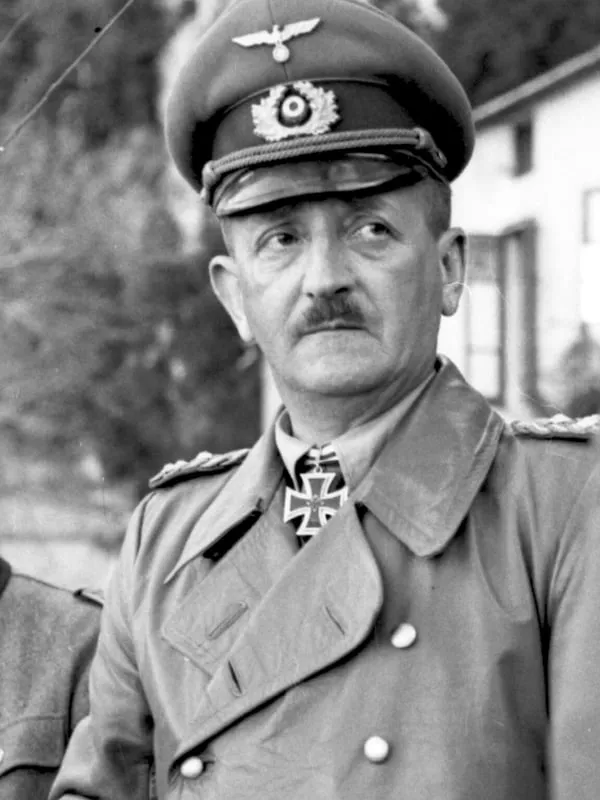
- Born:
- 6 December 1887, Mainz, Grand Duchy of Hesse (German Empire)
- Died:
- 23 February 1952, Pfronten (West Germany)
- Author:
- Łukasz
- Photo:
- Gutjahr, CC BY-SA 3.0 DE, Wikimedia Commons

Heinrich von Vietinghoff was a German colonel general who for a year and a half commanded in the front line of the defence of Italy. His Tenth Army took the brunt of the Allied landing at Salerno, defended the Gustav Line with the Monte Cassino massif, where the Polish II Corps fought in May 1944, and in the autumn the Gothic Line on the Adriatic. In the spring of 1945, by then commander of Army Group C, he agreed behind Hitler’s back to the surrender of the German forces in Italy, the first surrender of an entire front in this war. Earlier his panzer corps had fought in Yugoslavia and, in Guderian’s panzer group, at Smolensk and Moscow. He was not one of the flamboyant generals: he was a dependable specialist in defence and withdrawal, who twice found himself in command of the whole Italian front.
From an officer family
Heinrich Gottfried Otto Richard von Vietinghoff genannt Scheel was born in Mainz on 6 December 1887. He came from an old Westphalian noble family; he was the eldest son of a Prussian lieutenant general of artillery, also called Heinrich, and Countess Leona von Schmettow. He was brought up in cadet schools, including the main cadet institute at Berlin-Lichterfelde. On 6 March 1906 he joined the 2nd Emperor Francis Guard Grenadier Regiment in Berlin as an officer cadet, and the following year he was commissioned as a second lieutenant.
During the First World War he fought at the front and in July 1915 was promoted to captain. He received both classes of the Iron Cross, the Knight’s Cross of the House Order of Hohenzollern with Swords, and Austro-Hungarian, Bulgarian and Turkish decorations.
The Reichswehr and the new armoured arm
After the war he remained in the 100,000-strong Reichswehr. He alternated work in the ministry with command: he led a company of the 9th (Prussian) Infantry Regiment in Potsdam, became a major in 1926 and in 1931 a lieutenant colonel and battalion commander in the 14th (Baden) Infantry Regiment, then commanded by Johannes Blaskowitz. On 1 April 1933 he was promoted to colonel.
He saw the future in motorisation. In 1935 he took over the 1st Rifle Brigade of the newly formed 1st Panzer Division, in 1936 he became a major general, and from October 1937, as Inspector of Armoured Troops and Army Motorisation, he helped to build up the expanding armoured arm. On 24 November 1938, by then a lieutenant general, he took command of the Silesian 5th Panzer Division.
Poland, France, the Balkans
In September 1939 the 5th Panzer Division attacked from Upper Silesia in the September Campaign as part of Wilhelm List’s Fourteenth Army. On 2 September it broke through the weakly fortified positions of the Polish 6th Infantry Division near Pszczyna. On 26 October 1939 Vietinghoff took over XIII Army Corps, with which he fought in the French campaign; on 1 June 1940 he was promoted to General of Panzer Troops, and on 24 June he received the Knight’s Cross of the Iron Cross.
From November 1940 he commanded the new XXXXVI Motorised (later Panzer) Corps. In April 1941, during the invasion of Yugoslavia, the corps belonged to Maximilian von Weichs’s Second Army, which advanced on Croatia from Carinthia, Styria and western Hungary.
Smolensk, Moscow, Rzhev
In Operation Barbarossa XXXXVI Panzer Corps formed part of Heinz Guderian’s Panzer Group 2. In the Battle of Smolensk Vietinghoff crossed the Dnieper at Shklov on 10–11 July, and his 10th Panzer Division took Yelnya on 19–20 July and seized a bridgehead there, the point of the German front furthest forward towards Moscow. Like all corps commanders in the East, he put into effect the Commissar Order, which required captured Red Army political commissars to be shot. In the autumn his corps took part in the advance on Moscow.
In the winter of 1941–1942, during the Soviet Rzhev–Vyazma offensive, the headquarters of XXXXVI Corps assembled two panzer divisions, an infantry division and most of the SS division “Das Reich” near Sychevka and, in the January fighting in bitter frost, cleared the ground between Sychevka and the Volga, helping to cut off the Soviet 39th Army and 11th Cavalry Corps. In June 1942, when General Walther Model was wounded, Vietinghoff replaced him at the head of the Ninth Army and defended the Rzhev salient in heavy summer fighting. On 1 December 1942 he took over the Fifteenth Army on the English Channel, from February 1943 as its permanent commander.
Salerno and the Gustav Line
In August 1943, as Italy wavered after the fall of Mussolini, Vietinghoff was given the newly formed Tenth Army in southern Italy, under Field Marshal Albert Kesselring. On 17 August Hitler explained to him that the area of Naples and Salerno was what mattered, while Calabria could be given up in a delaying action. On 1 September Vietinghoff was promoted to colonel general. When Mark Clark’s Fifth Army landed in the Gulf of Salerno on 9 September, the Tenth Army brought every available division up to the beachhead. On 13 September Vietinghoff launched his main counter-attack and pushed the Americans to the brink of defeat. Naval gunfire, air attacks and reinforcements saved the beachhead, however, and on 16 September Vietinghoff reported to Kesselring that he was unable to offset Allied superiority in the air and at sea, and proposed a withdrawal. The Battle of Salerno was a German defeat, but it bought time.
The withdrawal was conducted methodically. Vietinghoff promised Kesselring to hold the Volturno line until 15 October and kept his word. In the autumn he fell ill for a short time, and in November, during the assault on the Winter Line, the army was commanded in his stead by General Joachim Lemelsen. At the turn of 1943 and 1944 the Tenth Army occupied the Gustav Line, anchored on the Garigliano and Rapido rivers and on the Monte Cassino massif.
Cassino, Anzio and the retreat north
In January 1944 Vietinghoff was caught out: as late as 17 January he reassured Kesselring that the enemy would not attack on moonless nights, and on the night of 17–18 January the British crossed the Garigliano. A few days later his troops bloodily repulsed the Americans on the Rapido, but the landing at Anzio on 22 January forced him to give up part of his forces. Over the following months the Tenth Army beat off attack after attack in the Battle of Monte Cassino; on 16 April 1944 Vietinghoff received the Oak Leaves to the Knight’s Cross.
The great Allied offensive of 11 May found him away from the front: according to the American official history, a few hours earlier he had left for Germany to receive a decoration from Hitler. In the fourth battle of Monte Cassino the French broke through in the Aurunci mountains, and on 18 May Władysław Anders’s soldiers raised their flag over the ruins of the monastery. Clark’s decision to make for Rome instead of cutting off the Tenth Army’s retreat, however, allowed Vietinghoff to escape northwards. After the capture of Rome on 4 June his army fell back in good order through Umbria and Tuscany towards the Gothic Line in the Apennines.
When the British Eighth Army struck the Gothic Line on the Adriatic on 25 August, Vietinghoff was on leave, and for several days the German command took the attack for a diversion. After heavy fighting it was he who on 20 September persuaded Kesselring that further defence of Rimini was pointless.
At the head of Army Group C
On 23 October 1944 Kesselring was badly injured in a car accident, and until mid-January 1945 Vietinghoff stood in for him as commander of Army Group C and Commander-in-Chief South-West. He proposed a withdrawal behind the Po and towards the Alps, which would have shortened the front, but Hitler ordered every scrap of northern Italy to be defended. At the end of January he was sent to Courland, where for a few weeks he commanded the encircled army group. On 10 March 1945, when Kesselring took over the Western Front, Vietinghoff returned to Italy as commander of Army Group C and Commander-in-Chief South-West.
For some weeks the head of the SS and police in Italy, General Karl Wolff, had been holding secret talks in Switzerland with American intelligence about a surrender. At first Vietinghoff would not hear of a “premature” capitulation. What he did want was to give up the Romagna without a fight and pull his armies back behind the Po. Hitler refused, and on 9 April the Allied spring offensive began. On 20 April, faced with the threat of encirclement, Vietinghoff ordered a retreat behind the Po on his own responsibility, but it was too late: the bridges had been destroyed, and his divisions lacked fuel and transport. On 22 April, at Vietinghoff’s headquarters in Recoaro, it was agreed with Wolff to send plenipotentiaries to the Allies.
On 29 April, in the royal palace at Caserta, Lieutenant Colonel Viktor von Schweinitz on behalf of Vietinghoff and SS Major Eugen Wenner on behalf of Wolff signed the unconditional surrender of the German forces in Italy, to take effect at 14.00 on 2 May. Then the whole thing nearly collapsed. Kesselring, who as Commander-in-Chief South was once again Vietinghoff’s superior, on 30 April relieved him together with his chief of staff, General Hans Röttiger, and summoned them before a court martial. Vietinghoff complied. Only in the early hours of 2 May, after Hitler’s death, did Kesselring agree to the surrender and cancel the arrest orders. Nearly a million German soldiers in Italy and part of Austria laid down their arms.
After the war
Vietinghoff went into British captivity and spent most of it in the camp for senior German officers at Island Farm near Bridgend in Wales; he was released in 1948. Unlike Kesselring, he was never put on trial. The anti-Nazi opposition figure Rudolf Pechel claimed in 1947 that at the turn of 1944 and 1945 Vietinghoff, Röttiger and a few officers had planned to arrest Hitler at a meeting with Mussolini and hand him over to the Allies; the source of this account is unclear, however, and it has never been confirmed.
In October 1950 Vietinghoff was one of the group of former generals who, at the request of Konrad Adenauer’s government, drew up at Himmerod Abbey a memorandum on a West German contribution to the defence of Europe, the starting point for the creation of the Bundeswehr. He did not live to see it founded: he died at Pfronten in the Allgäu on 23 February 1952.
Verdict
Vietinghoff had neither Rommel’s fame nor Kesselring’s standing, but for a year and a half it was his army that set the pace of the Italian campaign. At Salerno he came close to throwing the Allies back into the sea, and afterwards his skilful defence of one mountain line after another cost the Allies many months and heavy losses. At the same time, like the other commanders in the East, he bore responsibility for carrying out criminal orders in 1941. The surrender of 29 April 1945, often credited mainly to Wolff and American intelligence, would not have been possible without the commander of Army Group C, who at the last moment concluded that further fighting was pointless.
Sources
Commanded in battles
(03)Mentioned in battles
(03)Often appears with
People who appear in the same events.