United Kingdom
Miles Dempsey
Commander of 13th Infantry Brigade (1939–1940), XIII Corps (1942–1943), Second Army (1944–1945), Fourteenth Army and Allied Land Forces South East Asia (1945–1946)
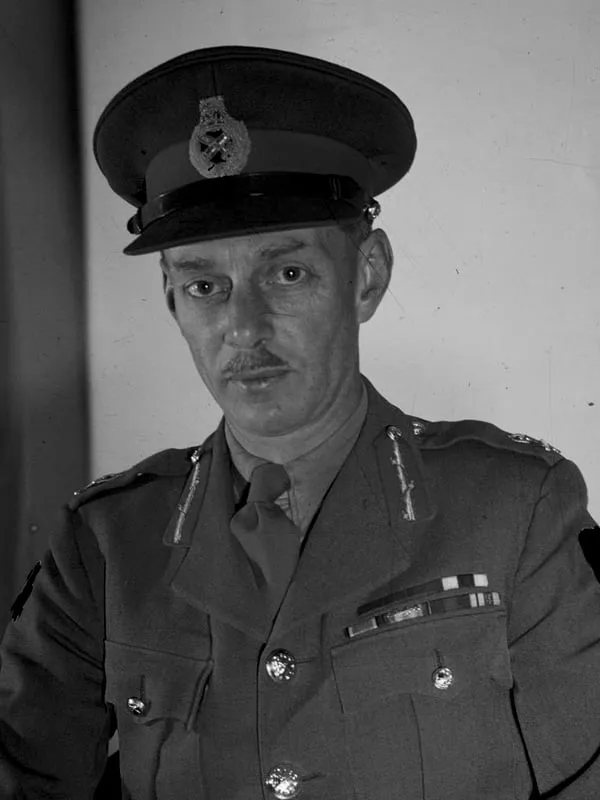
- Born:
- 15 December 1896, New Brighton (United Kingdom)
- Died:
- 5 June 1969, Yattendon (United Kingdom)
- Author:
- Łukasz
- Photo:
- War Office official photographer, domena publiczna, Wikimedia Commons

Miles Dempsey commanded the British Second Army, which landed on Gold, Juno and Sword beaches on 6 June 1944, bled for two months in front of Caen, in September went from Normandy to Brussels and Antwerp in a matter of days, and in the spring of 1945 crossed the Rhine and reached the Elbe and the Baltic. Even so, he remains one of the least known Allied army commanders. He was Bernard Montgomery’s man: Montgomery chose him for the post, and his fame eclipsed Dempsey’s own, while Dempsey himself wrote no memoirs and had his diaries burned. Subordinates and superiors alike valued him as a first-rate professional, calm, with an exceptional memory for maps and ground.
Gas at Cambrai
Miles Christopher Dempsey was born on 15 December 1896 in New Brighton in Cheshire, the youngest of three sons. The Dempsey family came from Ireland. He was educated at Shrewsbury School, where he captained the school cricket eleven, and in October 1914, aged seventeen, he entered the Royal Military College at Sandhurst. In February 1915 he was commissioned as a second lieutenant in the Royal Berkshire Regiment, to which he remained loyal all his life.
From June 1916 he served on the Western Front with the regiment’s 1st Battalion. In the Battle of the Somme he fought at Delville Wood and in the November attack on Munich Trench; in February 1917 he became battalion adjutant, and in the autumn he fought in Bourlon Wood near Cambrai. On 12 March 1918, just before the great German offensive, the battalion at La Vacquerie came under a bombardment of mustard gas shells. Dempsey was one of some 260 men of the battalion who were gassed, and he returned to the front only in July. According to his biographers one of his lungs was removed in England. For his service in France he received the Military Cross.
An officer of the Empire
After the war the battalion went to Iraq during the 1920 revolt, then to northern Persia and to India. Dempsey played first-class cricket, and in 1923–1927 he taught cadets at Sandhurst, where his superior was Major Richard O’Connor. After service in the British Army of the Rhine he attended the Staff College at Camberley in 1930–1931, in a year full of the future generals of this war. He was then a staff officer at the War Office, a brigade major at Aldershot and a staff officer with the defence forces of the Union of South Africa. In February 1938, as a lieutenant colonel, he took command of the 1st Battalion of his regiment.
From Dunkirk to the desert
In September 1939 Dempsey led the battalion to France, and in November, aged 42, he became one of the youngest brigadiers in the army and commander of the 13th Infantry Brigade of the 5th Division. In May 1940 the brigade fell back from the Dyle, held the line of the Scarpe, and in the last days of May, in the hard battle on the Ypres–Comines canal, closed the gap left by the Belgian surrender, covering the withdrawal of other divisions, among them Montgomery’s 3rd Division. It then fought in the rearguard during the evacuation from Dunkirk. Of nearly three thousand men, fewer than five hundred came back to England. Dempsey received the Distinguished Service Order for the campaign.
For the next two years he prepared troops against a German invasion. He was chief of staff of a corps that included Canadian divisions, in June 1941 he took over the 46th Infantry Division, and a few months later the 42nd Division, which was being converted to armour. He thus gained experience in combining tanks with infantry, something rare among British generals. Montgomery, who had long rated him, brought him to the Eighth Army in December 1942. As a lieutenant general Dempsey took over XIII Corps in Egypt from Brian Horrocks.
Sicily and Italy
The corps did not fight in Tunisia, and Dempsey was assigned to planning the invasion of Sicily. In the spring of 1943 he was among the first to criticise the original plan of dispersed landings, which exposed the Allied divisions to being beaten one by one, and his objections reached Montgomery, who pushed through a concentrated landing. On 10 July XIII Corps came ashore in the Gulf of Noto, near Avola and Cassibile, and that same day took Syracuse with its port undamaged. The advance on Catania, however, stalled against German defences on the plain, and the parachute assault on the Primosole bridge brought no breakthrough. In August Dempsey removed the commander of the 5th Division, Major General Horatio Berney-Ficklin.
On 3 September 1943 his corps crossed the Strait of Messina in Operation Baytown, the first Allied landing on the Italian mainland. The landing was unopposed, but the Germans blew the bridges on the mountain roads of Calabria, and only after nearly two weeks and almost five hundred kilometres of marching did Dempsey’s troops link up with the American Fifth Army fighting at Salerno. In the autumn the corps fought on the eastern side of the peninsula; in November, during the offensive on the Sangro, its task was to feint an attack in the mountains to draw German reserves away from the main axis.
Second Army in Normandy
When at the end of 1943 Montgomery left for England to take over 21st Army Group, he chose Dempsey to command the Second Army, although according to some historians he was not his first choice. The army headquarters began work in London on 26 January 1944. In May Dempsey presented his plan at the briefing at St Paul’s School: his British and Canadian divisions were to attack on the three eastern sectors, while the 6th Airborne Division covered the flank on the Orne. On 6 June 1944 the landing succeeded and the next day the British took Bayeux, but Caen, which was supposed to fall on the first day, stayed in German hands.
The Battle of Normandy was for Dempsey a series of costly attacks. The attempt to outflank Caen ended in the defeat of the 7th Armoured Division’s vanguard at Villers-Bocage, Operation Epsom at the end of June got only as far as the Odon valley, and the northern part of the city was taken only on 9 July, after a raid by heavy bombers which in Dempsey’s view was above all meant to lift the spirits of his men. The most controversial operation was Goodwood, which he devised himself and talked Montgomery into: on 18 July three armoured divisions attacked south of Caen after a massive bombardment. They advanced only a few kilometres and lost hundreds of tanks. At Dwight Eisenhower’s headquarters there was talk of removing Montgomery, who took the blame on himself, although some of the tactical mistakes were Dempsey’s. Dempsey later defended the operation as a strategic success: at the end of July some 600 German tanks faced the Second Army and about 100 faced the Americans, which made the Cobra breakout easier.
To Brussels and Arnhem
After the Falaise pocket was closed, the Second Army set off in pursuit. It crossed the Seine, and its spearheads covered hundreds of kilometres in a few days: on 3 September the Guards Armoured Division entered Brussels, and the next day the 11th Armoured Division took Antwerp with its port intact. Dempsey moved his tactical headquarters five times in that period. On 15 October King George VI knighted him in the field.
In Operation Market Garden the Second Army carried out the ground advance, spearheaded by Horrocks’s XXX Corps. Dempsey had doubts about the plan. He proposed crossing the Maas at Venlo and the Rhine at Wesel, closer to the Americans, but Montgomery chose Arnhem. All Dempsey won was the commitment of three airborne divisions and two additional corps. Watching American paratroopers cross the Waal at Nijmegen in canvas boats, he judged the 82nd Airborne Division the best on the Western Front. When the advance stalled, on 25 September he and Montgomery decided to withdraw the remnants of the 1st Airborne Division from across the Rhine.
The Rhine and the Baltic
In the winter the Second Army cleared the west bank of the Maas; in January 1945 XII Corps under Lieutenant General Neil Ritchie carried out Operation Blackcock. On the night of 23–24 March 1945 Dempsey’s troops crossed the Rhine at Rees and Wesel in Operation Plunder, and he himself was the first British army commander on the east bank. It was he who set the objectives for the airborne assault, Operation Varsity. In April his army advanced through Lower Saxony, and on 15 April its soldiers entered the Bergen-Belsen camp. In early May it took Bremen and Hamburg, whose surrender Dempsey arranged with the German commandant, and reached the Baltic. On 3 May a German delegation under Admiral Hans-Georg von Friedeburg arrived at his headquarters. Dempsey sent it on to Montgomery, and the next day the surrender on Lüneburg Heath was signed.
Asia and the Middle East
In the summer of 1945 Dempsey flew to Asia to lead the Fourteenth Army in the planned landing in Malaya. He took command on 10 August, a few days before Japan’s surrender. Instead of fighting, he had to organise the repatriation of more than 120,000 Allied prisoners and internees and the disarming of more than 700,000 Japanese, while facing the outbreak of the Indonesian struggle for independence. In November he succeeded General William Slim as commander of Allied land forces in South East Asia. In April 1946 he became Commander-in-Chief Middle East, where Palestine gave him the most trouble. He advised the government to withdraw from it if it did not intend to send much larger forces there. In the autumn of 1946 he was promoted to full general.
After the war
In August 1947, seeing no chance of becoming Chief of the Imperial General Staff, he retired. In 1948 he married Viola O’Reilly from County Westmeath in Ireland. He bred racehorses and chaired the boards of breweries and of the board controlling racecourse betting. He kept his ties with the army: in 1951–1956 he was designated commander-in-chief of home land forces in the event of war, and as honorary colonel of the 21st SAS Regiment he successfully lobbied for the unit to be given a permanent place in the army’s structure in 1950. He wrote no memoirs. He died of cancer on 5 June 1969 at his home in Yattendon in Berkshire (some sources give 6 June, the 25th anniversary of D-Day).
Assessment
Dempsey was a conscientious commander, sparing of his men’s lives, which mattered particularly in an army that remembered the slaughter of the First World War. Horrocks recalled that he never flapped, and the American historian Carlo D’Este wrote of his remarkable grasp of the map and his ability to read ground. Montgomery considered him cleverer and a better tactician than Oliver Leese, though less ruthless. Critics reproach him for relying too much on air bombardment at Caen and in Goodwood and for sending the armoured divisions forward without enough infantry support; he turned down O’Connor’s proposal to carry infantry in armoured personnel carriers. His quiet loyalty to his superior meant, however, that Montgomery collected both the fame and the criticism for the Second Army’s campaign, while its commander, as the historian Peter Caddick-Adams put it, lived out the rest of his life in relative obscurity.
Sources
Commanded in battles
(02)Mentioned in battles
(01)Often appears with
People who appear in the same events.