United Kingdom
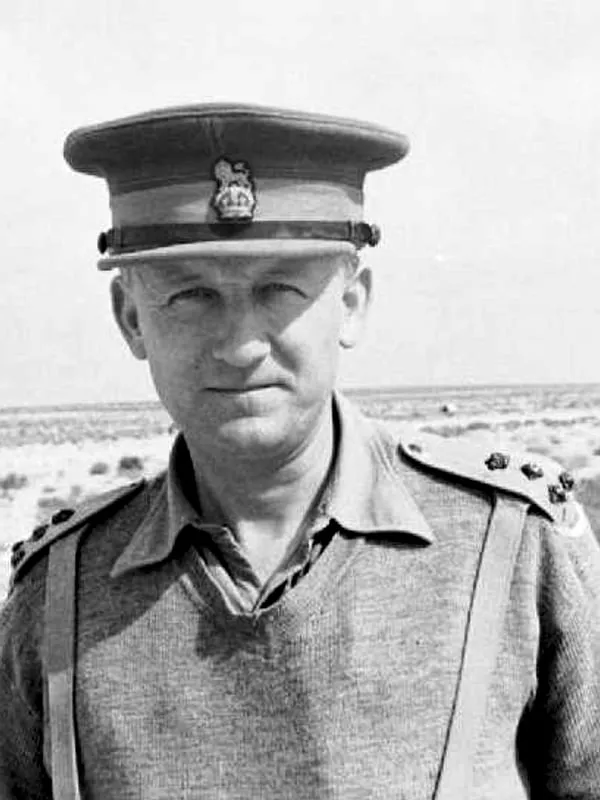
William Gott
Commander of the 7th Armoured Division’s Support Group (1940–1941), the 7th Armoured Division (1941–1942) and XIII Corps (1942)
- Born:
- 13 August 1897, Scarborough (United Kingdom)
- Died:
- 7 August 1942, Western Desert (Egypt)
- Author:
- Natalia
- Photo:
- William George Vanderson, domena publiczna, Wikimedia Commons

William Gott, known to everyone as “Strafer”, was one of the few British generals who fought in the Western Desert from the first to the last day of his war. In two years he rose from battalion commander to corps commander and took part in almost every battle against the Italians and the Afrika Korps, from the skirmishes on the Egyptian frontier in 1940 to the First Battle of El Alamein. His soldiers adored him, and his superiors valued his calm and experience. In August 1942 Churchill chose him to command the Eighth Army, but before he could take over, German fighters shot down the aircraft in which he was flying to Cairo. His death opened the way for Bernard Montgomery and changed the further course of the war in Africa.
Rifleman
William Henry Ewart Gott was born on 13 August 1897, the eldest son of an officer from a family settled in Leeds. According to British records his birth was registered in the Scarborough (PL) district of Yorkshire; some works give his birthplace as Harrow near London, where he went to the famous Harrow School. After the Royal Military College at Sandhurst he was commissioned in February 1915 as a second lieutenant in the King’s Royal Rifle Corps.
He fought on the Western Front from August 1916. In the summer of 1917 he was wounded and taken prisoner by the Germans, returning after the war with the Military Cross. The nickname “Strafer” was a joke on his surname: the German wartime slogan “Gott strafe England” meant “God punish England”.
Between the wars
Gott stayed in the regular army. He was adjutant of a Territorial battalion in London, attended the Staff College at Camberley in 1930–1931, and in the mid-1930s held staff posts in India, among others in the Baluchistan District. In 1934 he married Pamela Kays, a brigadier-general’s daughter; they had two daughters. In October 1938, as a lieutenant-colonel, he took command of the 1st Battalion of his regiment, which was moved from Burma to Egypt and joined the Mobile Division being formed there – the future 7th Armoured Division, the famous “Desert Rats”.
The Support Group in the desert
In 1939 Gott became the division’s chief staff officer, and early in 1940 commander of its Support Group, its motorised infantry and artillery, with the rank of brigadier. When in September 1940 the Italians invaded Egypt, it was his small force that delayed their advance along the coast, falling back without allowing itself to be pinned down (see the Italian invasion of Egypt). The commander in the desert, General Richard O’Connor, later praised the endurance and tactical skill of his troops. The Support Group then took part in Operation Compass, which ended in the destruction of the Italian Tenth Army.
In the spring of 1941 Erwin Rommel arrived in Africa and within a few weeks recovered Cyrenaica (Rommel’s first offensive). Gott, whose units were resting in the Nile Delta, was sent to the frontier to gather the retreating troops and stop the enemy. In May he commanded the force that in Operation Brevity retook the Halfaya Pass but achieved nothing more, and a few days later the Germans recaptured the pass. In June his Support Group fought in the failed Operation Battleaxe.
Division and corps commander
In September 1941 Gott took over the whole 7th Armoured Division as an acting major-general. In November, in Operation Crusader, his division suffered heavy losses at the Battle of Sidi Rezegh, where the German panzer divisions smashed the British brigades one after another. Even so it stayed in the field and contributed to the final success when Rommel withdrew from Cyrenaica in December.
On 9 February 1942, as an acting lieutenant-general, Gott took over XIII Corps, which in the Battle of Gazala in May and June held the northern part of the line with the 1st South African Division and the British 50th Division. The battle exposed the weaknesses of British command. Gott and the commander of XXX Corps, General Willoughby Norrie, were more experienced than the army commander, General Neil Ritchie, and often treated his orders as proposals for discussion. Gott’s relations with the commander of the South African division, General Dan Pienaar, were also very bad. The infantry brigades in their fortified “boxes” fought separately: the 150th Brigade of Gott’s corps was destroyed on 1 June, although it defended its position to the end. When Ritchie decided to abandon the line, Gott withdrew both divisions towards the Egyptian frontier: the South Africans left along the coast road, while the 50th Division, for which there was no room on it, broke out westwards at night through the Italian lines and reached Egypt by a roundabout route across the desert.
The heaviest blow was the fall of Tobruk. Gott, whose headquarters was still in the fortress, offered to take charge of its defence himself, but Ritchie refused. On 16 June Gott left, and on 21 June General Hendrik Klopper’s garrison surrendered. After this defeat General Claude Auchinleck dismissed Ritchie and took command of the Eighth Army himself.
El Alamein
In the First Battle of El Alamein in July 1942 Gott’s XIII Corps held the southern part of the front, with General Bernard Freyberg’s 2nd New Zealand Division and Indian units. The army stopped Rommel, but the successive counter-attacks prepared by Auchinleck’s staff and the corps commanders went badly: the infantry took its objectives at night and in the morning was left without tank support and fell victim to German counter-attacks (see the fighting for Tel el-Eisa and Ruweisat). On 22 July, in an attack within Gott’s corps, the fresh 23rd Armoured Brigade ran into a minefield under anti-tank fire and lost most of its tanks within a few hours. Gott tried to change the axis of the attack, but the new orders did not arrive in time.
Appointment and death
At the beginning of August 1942 Winston Churchill and the Chief of the Imperial General Staff, General Alan Brooke, flew to Egypt. They decided to dismiss Auchinleck and were looking for a new commander for the Eighth Army. Churchill liked the energetic Gott, who had been in the desert since the start of the war and who was strongly recommended by Anthony Eden, who had known him since the First World War. Brooke knew Gott well and thought highly of him, but on 5 August, after talking to him, he noted that the general was tired and had already tried most of his ideas on the Germans, while the army needed someone with new ones. Gott himself is said to have told him that he was not the right man for the job, although he would take it on if ordered. Churchill nevertheless pushed his candidate through.
On the afternoon of 7 August Gott was flying from the front to Cairo to rest for a few days before taking over the army. The route was considered safe; Churchill had flown it without an escort. The slow Bristol Bombay transport of No. 216 Squadron RAF, flown by 19-year-old Sergeant Hugh James, was nevertheless attacked by Messerschmitt Bf 109 fighters of the German Jagdgeschwader 27. The pilot put the damaged aircraft down in the desert, but the fighters strafed it on the ground and it burned out. Gott and most of the passengers were killed. The German airmen, as one of them recounted years later, learned whom they had killed only on returning to base. Later there were suggestions that the Germans had known the flight plan from intercepted signals, but this was never proved.
The general was laid to rest among his soldiers, in the British war cemetery at El Alamein. That same evening Churchill agreed to Brooke’s candidate and the Eighth Army went to Bernard Montgomery (see Montgomery takes command of the Eighth Army). Brooke later wrote that it seemed as if the hand of God had put their mistake right.
Assessment
Gott was a big, open and straightforward man, one of the very few generals known and liked by the rank and file. The future Field Marshal Michael Carver, who served under him, wrote that everyone, high and low, came to him for advice, sympathy and encouragement, but also that he was too good a man to be a really great soldier. The historians John Bierman and Colin Smith find nothing in his command in Africa to match Rommel. Churchill himself, seeing how quickly Montgomery transformed the Eighth Army, eventually conceded that choosing Gott had been a mistake. There is no knowing how Gott would have led the army; what is certain is that his death placed it in the hands of the man who in October won the Second Battle of El Alamein. In 2012 Gott’s daughters presented his medals to the museum of his old regiment.
Sources
Mentioned in battles
(06)Often appears with
People who appear in the same events.