United States
Walter Krueger
Commander of the Third Army (1941–1943), of the Sixth Army and Alamo Force in the South West Pacific (1943–1946)
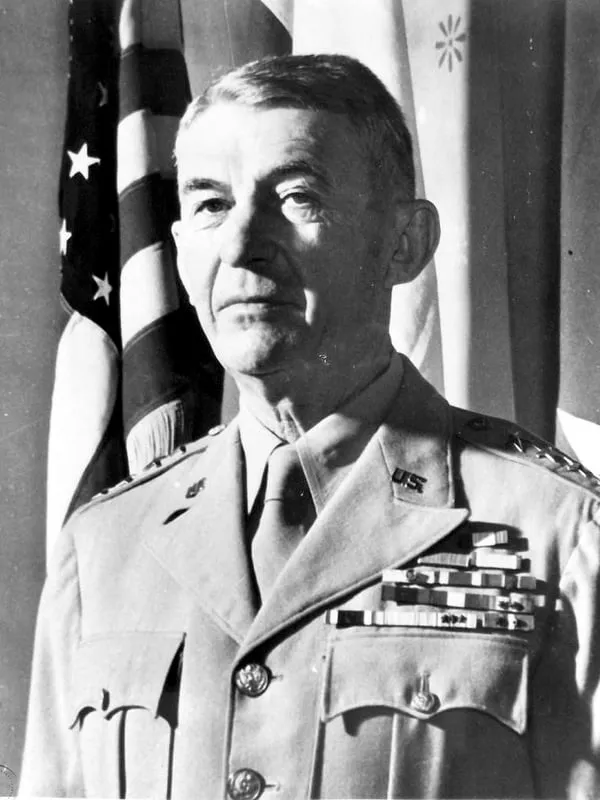
- Born:
- 26 January 1881, Złotów (Flatow), West Prussia (German Empire)
- Died:
- 20 August 1967, Valley Forge (United States)
- Author:
- Łukasz
- Photo:
- U.S. Army, domena publiczna, Wikimedia Commons

Walter Krueger commanded the American Sixth Army, which between 1943 and 1945, under Douglas MacArthur, fought its way from New Guinea to Luzon. Born in Złotów, then a Prussian town, he joined the United States Army as a private and rose to four-star rank. His name stayed in MacArthur’s shadow, but it was he who turned the supreme commander’s bold plans into actual landings, supply and attacks. He was regarded as methodical, even over-cautious; yet MacArthur himself considered him the finest army commander the United States had.
From Prussia to America
He was born on 26 January 1881 in Złotów (PL), then Flatow in West Prussia, the son of Julius Krüger, a Prussian landowner and veteran of the Franco-Prussian War. After his father’s death his mother took eight-year-old Walter and his siblings to the United States, to relatives in St. Louis (PL). There she remarried, to a Lutheran pastor, and the family settled in Madison, Indiana. The boy wanted to become a naval officer, but his mother objected. So he learned blacksmithing at a technical school in Cincinnati and thought of studying engineering.
The Spanish–American War changed his plans. In June 1898 the seventeen-year-old Krueger enlisted as a volunteer and was sent to Cuba, to Santiago, where he served in the occupation troops and rose to sergeant. Back home, he lasted only a few months as a civilian. In 1899 he enlisted again, this time as an infantry private, and sailed to the Philippines to fight Emilio Aguinaldo’s insurgents in the Philippine–American War. He marched then across the same central plain of Luzon that his army would cross forty-five years later. In 1901 he passed the officers’ examination and was commissioned a second lieutenant.
Translator, staff officer, teacher
Without a West Point diploma, Krueger made up for it with study. He completed the courses at Fort Leavenworth with distinction and taught languages there, and since he had known German from childhood he translated German military manuals, among them Wilhelm Balck’s “Tactics”, which was widely read in the American army. During the First World War he was operations officer and chief of staff of the 84th Division, taught at the general staff school at Langres in France, and in October 1918 became chief of staff of the Tank Corps of the American Expeditionary Forces. His origins told against him: the French once asked for him to be sent home precisely because he had been born in Germany. For his wartime service he received the Distinguished Service Medal.
Between the wars he passed through every level of military education. He graduated from the Army War College and, at his own request, from the Naval War College at Newport, where he later taught. He worked in the War Plans Division of the general staff, including on War Plan Orange for a war with Japan. In 1927 he tried to transfer to the air arm, but on the flying course he was failed by his instructor, Claire Chennault. In 1936 he became head of the War Plans Division, and from 1939, as a major general, he commanded the 2nd Infantry Division in Texas, on which the army tested the new “triangular” divisional structure.
The Louisiana Maneuvers
In May 1941 Krueger was promoted to lieutenant general and given command of the Third Army in San Antonio, and with it of the Southern Defense Command. As chief of staff he chose Colonel Dwight Eisenhower. In September his army faced Lieutenant General Ben Lear’s Second Army in the great Louisiana Maneuvers, the largest exercise in the history of the American army. Krueger came across as a modern and quick-thinking commander; in the second phase he sent George Patton’s 2nd Armored Division on a wide outflanking move through Texas. He himself, though, expected that at the age of sixty-one he would spend the war at home training troops.
Sixth Army and Alamo Force
In early 1943 MacArthur asked for him in his theatre, citing their long acquaintance. Krueger flew to Australia in February and took over the newly formed Sixth Army, which then had few troops and an incomplete staff. Krueger’s headquarters operated as “Alamo Force”, a task force answering directly to MacArthur rather than to the Allied Land Forces of the Australian General Thomas Blamey. MacArthur’s General Headquarters set the objective, the date and the troops, and Krueger worked out the details.
The first operation, the occupation of Woodlark and Kiriwina in June 1943, was unopposed, but it showed how costly it was to build airfields in jungle and mud; dissatisfied, Krueger replaced the commander on Kiriwina. Worried by conflicting estimates of Japanese strength, in November 1943 he formed his own reconnaissance unit, the Alamo Scouts, trained on Fergusson Island. In December his troops landed on New Britain, at Arawe and Cape Gloucester, and in January 1944 at Saidor on New Guinea. There caution took its toll: Krueger allowed the trails behind the beachhead to be blocked too late, and the retreating Japanese got away.
In the Admiralty Islands in February 1944 it was the other way round. Airmen reported that the islands were empty and MacArthur brought the landing forward, but an Alamo Scouts patrol sent in by Krueger confirmed that the Japanese were there. Krueger sped up the shipment of 1st Cavalry Division reinforcements and the islands were taken. In April he carried out the largest operation yet in the area: Robert Eichelberger’s corps landed at Hollandia and a separate force at Aitape. Relations with Eichelberger, the most senior of his subordinates, were cool from the start and in time turned into open dislike.
In the spring and summer of 1944 Alamo Force fought on several fronts at once. On Wakde and Biak there were far more Japanese than intelligence had assumed. MacArthur pressed Krueger, and Krueger pressed the commander of the 41st Division, Major General Horace Fuller, until in June he sent Eichelberger to the island to take over command of the task force from him. At the same time, on the Driniumor River near Aitape, the Japanese 18th Army of Lieutenant General Hatazō Adachi attacked. Krueger, who knew the enemy’s intentions from decrypted signals, refused to give up ground and demanded a vigorous defence and a counter-attack. By August the Japanese offensive had been broken. The historian Edward Drea remarked that this resolute stance was quite out of keeping with Krueger’s usual methodical style.
Leyte and Luzon
On 20 October 1944 the Sixth Army landed on Leyte. The rainy season and typhoons hampered the building of airfields, and the Japanese shipped division after division to the island. The Battle of Leyte turned into a grinding struggle of attrition. Krueger, fearing a Japanese landing in Carigara Bay behind X Corps, first had the northern coast fortified instead of pushing straight into the mountains. The historian Ronald Spector called this halt of the drive into the mountains west of Carigara in favour of beach defence disastrous. Krueger relied on many intelligence sources, not only on radio intercepts. On 26 December he handed Leyte over to Eichelberger’s Eighth Army.
On 9 January 1945 his army landed in Lingayen Gulf and began its largest, longest and last campaign, the Battle of Luzon. MacArthur’s intelligence estimated the forces of General Tomoyuki Yamashita at about 172,000 men, Krueger’s at 234,000; in reality there were about 287,000. Krueger, mindful of the Japanese concentrations in the mountains to the east and north, advanced on Manila more slowly than MacArthur wanted. MacArthur prodded him with signals, moved his own headquarters forward of Krueger’s, and from the south sent Eichelberger’s Eighth Army towards the capital. Krueger eventually dispatched a flying column of the 1st Cavalry Division, but MacArthur’s hope that the Japanese would not defend the city proved an illusion, and the Battle of Manila lasted a whole month.
On 5 March 1945, on MacArthur’s recommendation, Krueger was promoted to four-star general. The fighting against Yamashita’s Shōbu Group in the mountains of northern Luzon went on into the summer. On 30 June Krueger handed the island over to the Eighth Army and began preparing for the landing on Kyushu that the Sixth Army was to carry out in the autumn as part of Operation Downfall. Japan’s surrender made these preparations unnecessary. In September 1945 the Sixth Army occupied Kyushu, Shikoku and southern Honshu, and Krueger set up his headquarters in Kyoto. The army was disbanded in January 1946.
Last years and assessment
In July 1946 Krueger retired and settled in San Antonio. The war had left him with a large tax bill, so friends helped him buy a house. In 1953 he published “From Down Under to Nippon”, a reliable but dry account of the Sixth Army’s history which disappointed historians, as it said little about the reasons for decisions. His retirement was blighted by family misfortunes. His son James was dismissed from the army in 1947, his wife Grace died of cancer in 1956, and in 1952 his daughter Dorothy stabbed her husband, a colonel, to death in his sleep in their quarters in Japan. A court-martial sentenced her to life imprisonment, but in 1957 the Supreme Court ruled in Reid v. Covert, heard together with her case, that in peacetime the dependants of servicemen could not be tried by courts-martial for capital crimes, and Dorothy was freed. Krueger died of pneumonia on 20 August 1967 at Valley Forge, Pennsylvania, and was buried at Arlington National Cemetery.
Krueger never won the fame of Patton or Bradley. His strength lay in the operational level of war: logistics, reconnaissance and the coordination of successive landings across the vast spaces of the Pacific. He is often described as an over-cautious commander who slowed down MacArthur’s fast-paced strategy. MacArthur’s biographer William Manchester suggested that this was exactly why the supreme commander valued him: the plodding subordinate balanced his own bravura. MacArthur wrote of him that he knew of no better army commander in American history, and that he did not know how Krueger would have behaved in defeat, because he was never defeated.
Sources
Commanded in battles
(07)- 15 December 1943 – 21 August 1945New Britain campaignPacific
- 29 February – 18 May 1944Admiralty Islands campaignPacific
- 22 April – 6 June 1944Landings at Hollandia and AitapePacific
- 27 May – 17 August 1944Battle of BiakPacific
- 10 July – 25 August 1944Battle of the Driniumor RiverPacific
- 17 October – 31 December 1944Battle of LeytePacific
- 9 January – 15 August 1945Battle of LuzonPacific
Mentioned in battles
(01)Often appears with
People who appear in the same events.