Japan
Hajime Sugiyama
War Minister (1937–1938, 1944–1945), commander of the North China Area Army (1938–1939), Chief of the Army General Staff (1940–1944), commander of the 1st General Army (1945), field marshal
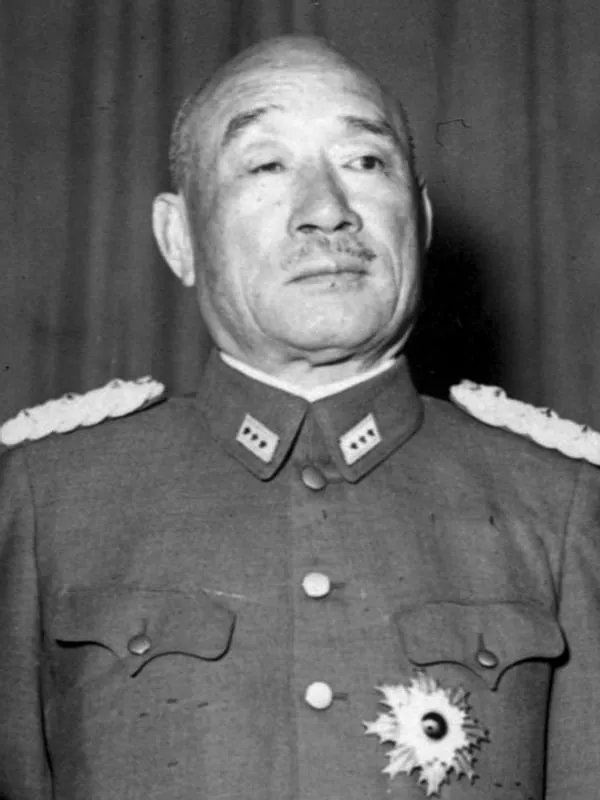
- Born:
- 2 January 1880, Kokura, Fukuoka Prefecture (Japan)
- Died:
- 12 September 1945, Tokyo (Japan)
- Author:
- Natalia
- Photo:
- autor nieznany, domena publiczna, Wikimedia Commons

Hajime Sugiyama was one of only two Japanese generals who held all three of the highest posts in the Imperial Army – War Minister, Chief of the General Staff and Inspector-General of Military Training – and rose to the rank of field marshal. He was neither an ideologue nor an outstanding strategist. But he was always where the decisions were made: in July 1937, as War Minister, he came out in favour of sending troops to northern China, which unleashed an eight-year war, and in 1941, as army chief of staff, he pressed for war with the United States and Britain, assuring the Emperor that it would last a few months. He left notes of the conferences he attended, known as the “Sugiyama memorandum”, which are one of the basic sources for the history of the decision to go to war in the Pacific. Ten days after Japan’s surrender he shot himself in his office.
Intelligence officer and airman
Sugiyama was born on 2 January 1880 (some Western sources give 1 January) in a village near Kokura, today part of Kitakyushu on the island of Kyushu. In 1900 he graduated from the army’s officer school, and in the Russo-Japanese War he fought in Manchuria as a battalion adjutant in the 14th Infantry Regiment. In October 1904, at the Battle of the Shaho, he was wounded in the face. The scar and a half-closed right eye stayed with him for life.
After graduating from the Army War College in 1910 he joined the intelligence branch of the General Staff. In 1912 he travelled incognito to the American-ruled Philippines and, according to Japanese sources, posing as a naval officer from a visiting training squadron, inspected the American naval base at Subic Bay. He then toured South East Asia from Singapore, and from 1915 to 1918 he was military attaché in British India. On his way home he observed the Middle Eastern front of the First World War and was impressed by what aircraft and armour could do. From the end of 1918 he commanded an air battalion, and in 1922 he became the first head of the aviation section in the War Ministry. The Japanese later called him the father of army aviation.
In the factional struggles
In the 1920s Sugiyama joined the inner circle of War Minister Kazushige Ugaki. He headed the Military Affairs Bureau, and in 1930 became Vice Minister of War. In March 1931 he was among the officers involved in an abortive plot to make Ugaki prime minister with the help of the army. In September of that year, after the Mukden Incident, he publicly defended the actions of the Kwantung Army. When General Sadao Araki, leader of the Kōdō-ha faction, took control of the ministry, Sugiyama, as Ugaki’s man, was sidelined, and in 1932 he took over a division on Kyushu and later the army air headquarters.
He returned to the centre in 1934 as Vice Chief of the General Staff. During the coup attempt of 26 February 1936 he was the de facto chief of staff, because the nominal chief, Prince Kan’in, was elderly. He was among the staunchest opponents of any concession to the rebels, and on the morning of 27 February he obtained from Emperor Hirohito an order directing the troops to return to barracks. After the coup was crushed and the Kōdō-ha supporters purged, Sugiyama became one of the pillars of the victorious Tōsei-ha faction. He was made Inspector-General of Military Training, and in November 1936 a full general.
War Minister and the war with China
In February 1937 Sugiyama became War Minister in the government of General Senjūrō Hayashi, and in June he kept the post in the first cabinet of Prince Fumimaro Konoe. A month later came the Marco Polo Bridge Incident. Two positions clashed in the army. The head of the General Staff’s operations section, General Kanji Ishiwara, warned against drawing the army into a war in China when the main enemy was the Soviet Union. Sugiyama sided with the advocates of a “show of force”. On 11 July the conference of five ministers adopted his proposal to send reinforcements from Manchuria and Korea to northern China and to make three divisions ready in Japan. He assured the Emperor that the matter would be settled quickly; according to some accounts he spoke of two or three months.
It turned out otherwise. At the end of July the Japanese took Beijing and Tianjin, in August the fighting spread to Shanghai, and in December the army captured Nanking, where the troops committed mass killings and rapes. The war, called the “China Incident” in Tokyo, had no end in sight. When in 1938 Konoe decided to change his China policy, Sugiyama had to leave the ministry in June. At the end of the year he took command of the North China Area Army. His troops fought guerrillas and Chinese forces in Shanxi and Shandong provinces, and in the summer of 1939, during the Tientsin Incident, they blockaded the British concession in Tianjin. In September 1939 Sugiyama returned to Japan.
Chief of staff: the decision for war
In October 1940, after the conclusion of the Tripartite Pact, Sugiyama succeeded Prince Kan’in as Chief of the Army General Staff. When Germany invaded the Soviet Union in June 1941, part of the army demanded a strike into Siberia. Sugiyama did not support an immediate attack, but agreed to a large reinforcement of the troops in Manchuria. Together with the navy, on the other hand, he pushed for the occupation of southern Indochina, to which the United States responded by freezing Japanese assets and imposing an oil embargo. In the negotiations with Washington the army under his leadership refused any concession on the withdrawal of troops from China.
On 5 September 1941, on the eve of the Imperial Conference that was to adopt a timetable for war preparations, Hirohito summoned both chiefs of staff. When Sugiyama assured him that operations in the South Pacific would take about three months, the Emperor reminded him that as War Minister in 1937 he had promised a quick end to the war in China, which was by then in its fourth year. The general explained that China had a vast hinterland. Hirohito retorted that if China was vast, the Pacific was vaster still. The next day the Emperor broke his customary silence and read out a poem by his grandfather about peace, but the resolution was passed unchanged.
After the fall of the Konoe government Sugiyama agreed that the new prime minister, Hideki Tōjō, should remain on the active list and keep the War Ministry. At the liaison conference of government and high command on 1 November 1941, together with his deputy, General Osamu Tsukada, he demanded an immediate decision for war, with hostilities to begin in early December; diplomacy was to be merely a screen. In the end he agreed to negotiations continuing until 1 December, and the Imperial Conference of 5 November approved this compromise. On 2 December, together with the Chief of the Navy General Staff, Admiral Osami Nagano, he presented the Emperor with the date for the start of hostilities, and the orders went out that same day.
The Pacific War
In the first months of the war Sugiyama directed the army’s operations from Malaya and Burma to the Philippines and the Dutch East Indies. It was from him that Hirohito demanded explanations when things went wrong. In early 1942 the Emperor twice pressed him over the drawn-out Philippines campaign, and Sugiyama passed the pressure on to General Masaharu Homma. He also reprimanded General Hitoshi Imamura, whose mild policy towards the people of Java displeased Tokyo. Over Portuguese Timor he demanded the occupation of Dili against the wishes of the Foreign Minister.
From mid-1942 the defeats came. At the end of December, after six months of fighting for Guadalcanal and heavy losses in New Guinea, Sugiyama and Nagano presented the Emperor with a plan to withdraw the troops from the island, which was approved on 31 December. In June 1943 Sugiyama received the title of field marshal.
In February 1944, after the American strike on Truk, Prime Minister Tōjō decided to take over the post of army chief of staff himself, while remaining prime minister and War Minister. Sugiyama opposed this, invoking the principle that the high command was independent of the government, but on 21 February he was removed. Five months later the tables were turned. After the fall of Saipan the Tōjō government fell in July 1944, and Sugiyama returned as War Minister in the cabinet of General Kuniaki Koiso, his classmate at the officer school and the war college. Their cooperation soon broke down. They quarrelled over attempts to sound out peace with the Chinese government in Chongqing and over the defence of the Philippines: Koiso hoped for a decisive victory on Leyte, while the army shifted the weight of the fighting to Luzon. In April 1945 the Koiso cabinet resigned.
The end
Sugiyama handed the ministry over to General Korechika Anami and took command of the 1st General Army, which was to defend the eastern part of Japan, including Tokyo and the Kantō plain, against the expected invasion. On the morning of 14 August 1945 the Emperor summoned three field marshals: Sugiyama, Nagano and Shunroku Hata. According to Japanese accounts, Sugiyama and Nagano argued for continuing the fight. Later that same morning, at a conference held in his presence, Hirohito made the final decision to surrender, and Sugiyama, together with the other senior commanders, signed a declaration that the army would submit to the Emperor’s will. That night young officers of the War Ministry tried to seize the Imperial Palace, but the Kyūjō Incident was brought to an end at dawn by the commander of the Eastern District Army, which was subordinate to Sugiyama, General Shizuichi Tanaka.
After the surrender Sugiyama oversaw the disarming of his troops. On 11 September the Americans began arresting members of the Tōjō government. The following afternoon Sugiyama shot himself in his office at the headquarters of the 1st General Army. That same day his wife Keiko took her own life at home.
Assessment
Sugiyama was a typical representative of the generation of generals who in the 1930s took control of Japan’s policy. He had no vision of his own, but he moved deftly between the factions and usually adopted the position backed by most of the staff officers. A Japanese biographical dictionary calls him outright the person chiefly responsible for the army’s conduct of the war on the road to the Second World War. In 1937 he underestimated the strength of Chinese resistance, in 1941 he played down the vastness of a war in the Pacific, and on both occasions he assured the Emperor of a short campaign. Because he took his own life, he never faced the International Military Tribunal for the Far East, which convicted his closest colleagues. His notes of the liaison conferences and Imperial Conferences from the years when he headed the General Staff make it possible today to retrace precisely the road by which Japan arrived at Pearl Harbor.
Sources
Mentioned in battles
(01)Often appears with
People who appear in the same events.