USSR
Vasily Blyukher
Chief military adviser in China (1924–1927), commander of the Special Far Eastern Army (1929–1938) and of the Far Eastern Front (1938)
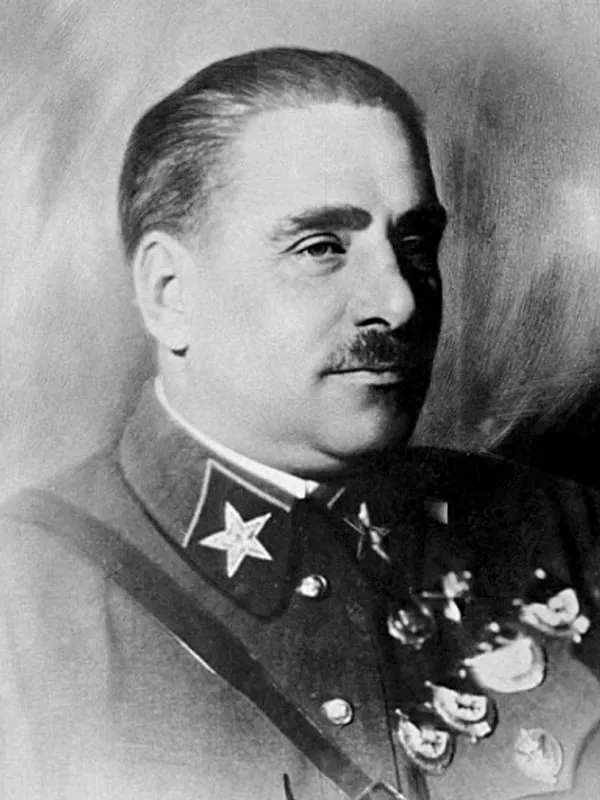
- Born:
- 1 December 1890, Barshchinka, Yaroslavl Governorate (Russian Empire)
- Died:
- 9 November 1938, Moscow (USSR)
- Author:
- Natalia
- Photo:
- Ministerstwo Obrony Federacji Rosyjskiej, CC BY 4.0, Wikimedia Commons

Vasily Blyukher was the first hero of the Red Army and one of its best-known figures in the 1920s and 1930s. A worker with no military education, he won the first Order of the Red Banner in the Civil War, in China, under the name Galin, he planned Chiang Kai-shek’s campaigns, and for nine years he ruled the Soviet Far East, where his army was the main opponent of Japan’s Kwantung Army. In the summer of 1938 he was in command in the first serious clash with the Japanese, at Lake Khasan. A few weeks later he was in an NKVD prison, where he died after torture. His fate shows how the Great Purge stripped the Red Army of its commanders a few years before the war with Germany.
Worker and soldier
He was born into a peasant family in the village of Barshchinka in the Rybinsk district of Yaroslavl Governorate. According to the official biography, which he himself took care of, he was born on 1 December (19 November Old Style) 1890; some sources give 1889. The German surname was, according to family legend, a nickname that the local landowner gave his ancestor, a serf, when the man returned from war with medals: the squire joked that he was a real field marshal Blücher, like the Prussian victor of Waterloo. Vasily completed only one year at a parish school. At fourteen he went with his father to St Petersburg and worked in a shop and in a factory, then at the railway carriage works at Mytishchi near Moscow. In 1910 he was sent to prison for almost three years for calling for a strike. Some of these details could not be confirmed during the investigation in 1938, and his family also passed on other versions of his youth.
In August 1914 he was called up into the Russian army. He fought as a private, then as an NCO in the 8th Army, and received Crosses and the Medal of St George, though the number of these awards is disputed today. In January 1915 near Tarnopol he was seriously wounded, and after more than a year of treatment he was discharged. He worked in Kazan, joined the Bolshevik party in 1916, and in 1917 agitated among the soldiers in Samara.
The Ural raid and Perekop
In the Civil War he rose at lightning speed. At the end of 1917, as commissar of a Red Guard detachment, he fought Ataman Dutov’s Cossacks near Chelyabinsk. In the summer of 1918, after the revolt of the Czechoslovak Legion, the Red units in the southern Urals were cut off from their own side. Blyukher took command of a partisan army of more than ten thousand men and led it on a raid of some 1,500 kilometres through White territory until in September it joined up with the Red 3rd Army. For this march he became the first recipient in Soviet Russia of the Order of the Red Banner.
From July 1919 he commanded the 51st Rifle Division, with which he marched from Tyumen to Lake Baikal. In the summer of 1920 the division was moved against General Wrangel. It held the bridgehead at Kakhovka on the left bank of the Dnieper, and in November 1920 it stormed the Turkish Wall on the Perekop Isthmus and the positions at Yushun, opening the way into the Crimea for the Reds. On 15 November it took Sevastopol. Blyukher became a legend, and his method of breaking through fortifications with successive waves of infantry entered the Red Army’s repertoire.
In June 1921 Moscow sent him to the Far Eastern Republic, a buffer state on the Pacific, where he became commander-in-chief of the People’s Revolutionary Army and Minister of War. When the Whites took Khabarovsk in December, he prepared a counter-offensive in which his troops, in bitter frost, took the fortifications at Volochayevka station on 12 February 1922 and recovered the city two days later. Soon afterwards he was recalled; the end of the Civil War in the Far East fell to his successor, Ieronim Uborevich. In 1922–1924 he commanded a rifle corps in Petrograd.
Galin in China
In the autumn of 1924 Blyukher arrived in Canton as chief military adviser to Sun Yat-sen. He used the pseudonym Galin, often written Galen in Western literature, formed from the names of his wife and children. It was the time of the First United Front of the Kuomintang and the communists: Moscow supplied weapons, money and instructors, and Soviet officers taught at the Whampoa Academy, whose commandant was Chiang Kai-shek. Blyukher drew up the plan of the Eastern Expedition against General Chen Jiongming, which in February and March 1925 gave the Kuomintang army its first big victory. In the summer of 1925 he left, ill, for treatment, but in May 1926 he returned and helped draw up the plan of the Northern Expedition, which within a year brought the Kuomintang’s armies to the Yangtze, to Wuhan, Nanjing and Shanghai.
Then the alliance fell apart. In April 1927 Chiang turned on the communists in the Shanghai massacre, and in the summer the Kuomintang left too broke with Moscow. In August 1927 Blyukher left China. In Moscow doctors diagnosed nervous exhaustion and other illnesses that were to trouble him for the rest of his life. For a year he was deputy commander of the Ukrainian Military District.
Master of the Far East
On 6 August 1929 Blyukher took command of the newly formed Special Far Eastern Army, headquartered in Khabarovsk. A dispute was then under way over the Chinese Eastern Railway, which the Manchurian ruler Zhang Xueliang was trying to take out of Soviet control. In the autumn Blyukher’s army, supported by the Amur flotilla and aircraft, routed the Manchurian forces, first on the Sungari and then, in November, in the operation at Zhalainor and Manchuria station, in which one of the cavalry brigades was commanded by Konstantin Rokossovsky. According to Russian figures the Red Army lost 123 killed. On 22 December a protocol restoring the previous position on the railway was signed in Khabarovsk. During the conflict the American Secretary of State Henry Stimson invoked the Kellogg–Briand Pact, to no effect. Blyukher received the first Order of the Red Star ever awarded, and the army, decorated with the Order of the Red Banner, took the name of the Special Red Banner Far Eastern Army.
For the next few years he was the most important man in the Soviet Far East, with far greater power than an ordinary district commander. After Japan seized Manchuria in 1931 and set up Manchukuo, his army faced the Japanese, and Moscow reinforced it with divisions, aircraft and fortifications along the border. In November 1935 Blyukher became one of the first five Marshals of the Soviet Union, alongside Kliment Voroshilov, Mikhail Tukhachevsky, Alexander Yegorov and Semyon Budyonny. His weaknesses were known too: no training in operational command, frequent illness and, according to General Staff documents, bouts of heavy drinking.
In the shadow of the purge
In June 1937 Blyukher sat on the special court that sentenced Tukhachevsky, Uborevich, Yakir and other commanders to death for an alleged conspiracy. They were all shot the following day. Membership of that court did not save its members: most of them perished in the months that followed. In the Far East the NKVD arrested officers of his army en masse, and Blyukher consented to these arrests, though according to some historians he tried to limit their scope. On 13 June 1938 the head of the Far Eastern NKVD, Genrikh Lyushkov, fled to Manchukuo and handed the Japanese his knowledge of the Soviet forces. Lev Mekhlis and the deputy head of the NKVD, Mikhail Frinovsky, then arrived in Khabarovsk to carry out further arrests and to watch the commander.
On 1 July 1938 the army was turned into the Far Eastern Front. A few days later Soviet border guards occupied the disputed summit of Zaozernaya hill by Lake Khasan, where the borders with Manchukuo and Korea met. On 24 July Blyukher, wishing to avoid war, sent a commission there which found that the border guards had crossed the border in several places, and he ordered the barbed wire to be moved back. In Moscow this was regarded as undermining the government’s position. When at the end of July the Japanese 19th Division took both hills, on 1 August Joseph Stalin asked him over the telegraph whether he really wanted to fight the Japanese. Blyukher arrived at Posyet on 2 August and threw the 40th Rifle Division into the attack, without reconnaissance, with the artillery not ready and under a ban on crossing the border. The attack across marshes and narrow defiles broke down. The next day command passed to the front’s chief of staff, Grigory Shtern. After further bloody attacks Japan agreed to a truce on 11 August and withdrew from the hills, but Soviet losses were several times higher than Japanese ones.
Death in the Lubyanka
On 31 August 1938 the Main Military Council, with Stalin present, found the Far Eastern Front poorly prepared for war and blamed Blyukher for it; he was reproached for the July commission and for not having purged the front of “enemies of the people”. By an order of 4 September he was removed, and the front was disbanded. Voroshilov suggested he rest at his dacha, Bocharov Ruchey near Sochi. There, on 22 October 1938, the NKVD arrested the marshal, his wife Glafira and his brother Pavel. Taken to Moscow, he was held in the internal prison of the Lubyanka, and for some of the interrogations in Lefortovo prison. He was charged with taking part in a “military-fascist conspiracy” and with spying for Japan. In eighteen days he was interrogated more than twenty times, seven times in the presence of Lavrentiy Beria. He was beaten so badly that witnesses spoke of a face beyond recognition. Under torture he made statements incriminating himself.
On the evening of 9 November 1938, according to documents published by Russian historians, he was brought without a pulse to the dispensary of the internal prison at the Lubyanka, where he died a few minutes later; some sources give Lefortovo prison as the place of death. The post-mortem found a pulmonary embolism originating in clots in the pelvic veins, in other words a result of the beatings. The body was cremated the next day and the case was closed because of the death of the accused. Only on 10 March 1939 was Blyukher posthumously stripped of the rank of marshal and “sentenced” to death. On the same day his first wife, Galina Pokrovskaya, was shot, and soon afterwards his second, Galina Kolchugina; his brother Pavel was shot on 26 February 1939, his third wife was given eight years in the Gulag, and the children were sent to orphanages.
Memory
For years rumours circulated abroad that Blyukher was alive or had been quietly executed. When Chiang Kai-shek asked Stalin about him, he was told that the marshal had been shot for helping a Japanese spy. On 9 March 1956, during the thaw after Stalin’s death, the military prosecutor’s office annulled the decision of 1938 and rehabilitated Blyukher and the surviving members of his family. The circumstances of his death were made public only in 1989. In the USSR he became a hero of films and books again, and streets and ships bore his name.
Historians judge him more cautiously than the Soviet legend. He was a brave and inventive Civil War commander, but he never grew into the command of large formations of a modern army, and at Lake Khasan he commanded badly. His downfall, however, had little to do with these mistakes. He died because he was independent, popular and had stayed too long beyond Moscow’s reach. Of the first five Marshals of the USSR, only Voroshilov and Budyonny survived to see the war with Germany. The Japanese army concluded from Khasan that the USSR did not want a war over Manchukuo, and the Kwantung Army blamed the defeat on the weakness of the Korea Army. A year later, at Khalkhin Gol, it suffered a heavy defeat itself at the hands of a Red Army now commanded by Georgy Zhukov.
Sources
Commanded in battles
(01)Mentioned in battles
(01)Often appears with
People who appear in the same events.