Poland
Edward Raczyński
Polish Ambassador in London (1934–1945), Polish Foreign Minister (1941–1943), President of Poland in exile (1979–1986)
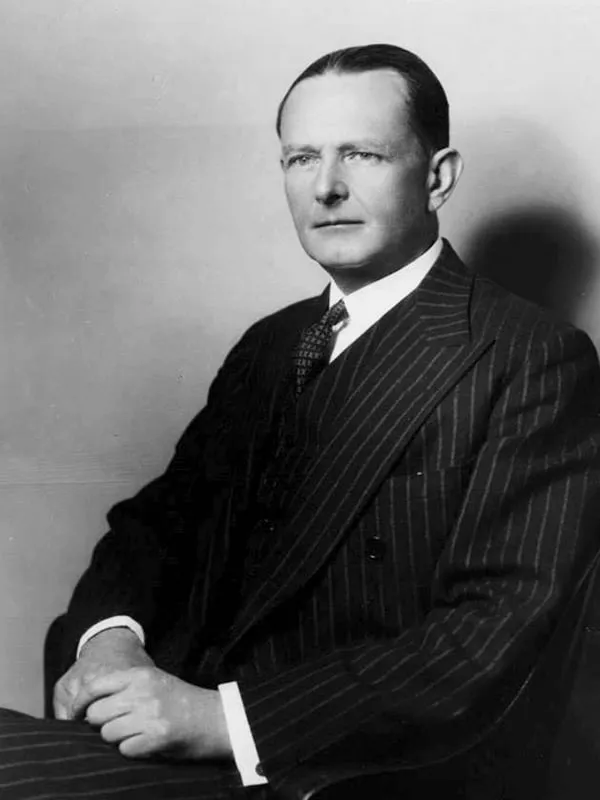
- Born:
- 19 December 1891, Zakopane (Austria-Hungary)
- Died:
- 30 July 1993, London
- Author:
- Natalia
- Photo:
- autor nieznany, domena publiczna, Wikimedia Commons

Edward Bernard Raczyński was Poland’s voice in London throughout the Second World War. As ambassador he signed the Anglo-Polish alliance in August 1939, and on 1 September he relayed to the British government the news of the German invasion. In 1941–1943 he directed the diplomacy of the government-in-exile, and on 10 December 1942 he sent the governments of the United Nations a note on the mass extermination of the Jews in occupied Poland, which helped to bring about the joint Allied declaration a week later. After the war he remained in exile, was for many years one of the leaders of the pro-independence émigré community, and at the age of 87 became President of Poland in exile. He died at more than 101 years of age, the longest-lived of all Polish presidents.
Rogalin, Kraków, Leipzig
He was born on 19 December 1891 in Zakopane, the son of Count Edward Aleksander Raczyński, an art collector and owner of Rogalin near Poznań, and Róża, née Potocka, the widow of Władysław Krasiński. The Raczyński family, of the Nałęcz coat of arms, was among the most distinguished in Greater Poland. His father founded a gallery of Polish and European painting at Rogalin, and his mother brought the family connections with the Potocki and Krasiński families; from her first marriage came Edward’s half-brother, Adam Krasiński.
He spent his childhood and school years in Kraków, in the house of his grandmother, the wife of Adam Potocki, in the Palace Under the Rams (Pałac pod Baranami), and later in his parents’ flat in Szpitalna Street. He was taught first at home and later at the King John III Sobieski Gymnasium in Kraków. He studied law in Leipzig, attended lectures at the London School of Economics and took his doctorate in law at the Jagiellonian University. The knowledge of England and of English that he acquired in his youth later proved one of his greatest assets.
In the diplomatic service of reborn Poland
In November 1918 he joined the Polish Army, and in May 1919 he moved to the newly created Foreign Ministry. He was secretary of the legation in Copenhagen (1919–1922) and then legation secretary in London (1922–1926). In 1926 he returned to the Foreign Ministry in Warsaw, where he dealt with, among other things, eastern affairs, and from 1931 he headed the International Organisations Department. In November 1932 he went to Geneva as envoy and permanent delegate of Poland to the League of Nations.
In these years he married twice. His first wife, the Englishwoman Joyous Markham, died in 1931. In August 1932 he married Cecylia Jaroszyńska, with whom he had three daughters: Wanda, Wirydianna and Katarzyna.
On 1 November 1934, when foreign policy was in the hands of Józef Beck, Raczyński became Polish Ambassador in London. The diplomat, not yet 43, was to convince the British that Poland was an independent and serious partner, not a state doomed to choose between Germany and the USSR. For several years his task was a thankless one: London was pursuing a policy of concessions to Hitler and kept Poland at arm’s length, while Beck’s policy aroused distrust in the Foreign Office.
From the guarantee to war
The situation changed in the spring of 1939, when the Germans occupied the Czech lands and Hitler demanded from Poland Gdańsk (Danzig) and an extraterritorial road across the Polish Corridor. On 31 March the Prime Minister, Neville Chamberlain, announced in the House of Commons the British guarantee to Poland. Raczyński took part in the talks that led to it and to Beck’s visit to London at the beginning of April, and in the following months he pressed for the unilateral declaration to be turned into a full alliance and for British financial aid and arms deliveries, of which little arrived in time.
On 25 August 1939, two days after the signing of the Molotov–Ribbentrop Pact, Raczyński and the Foreign Secretary, Lord Halifax, signed the Agreement of Mutual Assistance in London. The news of it contributed to Hitler’s decision to halt the attack planned for 26 August and postpone it by a few days. A secret protocol to the agreement, however, limited the British obligation to aggression by Germany.
On the morning of 1 September Raczyński called on Halifax and informed him that the Wehrmacht had crossed the frontier and was bombing Polish towns. Over the next two days, while the British and French governments delayed declaring war, he insisted that they honour their obligations as allies. On 3 September Britain and France declared war on Germany, but Poland received no real military help. After the Soviet invasion of Poland on 17 September the ambassador issued a statement listing the agreements Moscow had broken: the Treaty of Riga, the Litvinov Protocol, the non-aggression pact of 1932 and the 1933 Convention for the Definition of Aggression. At the Foreign Office he was told that Britain’s obligations did not extend to the USSR.
After the defeat of September 1939 the London embassy became one of the most important outposts of the state reconstituted in exile. Raczyński maintained contact with General Władysław Sikorski’s government in France and with President Władysław Raczkiewicz, and after the fall of France in June 1940 he helped with the transfer of the Polish authorities and the evacuation of Polish soldiers to Britain. From the summer of 1940 London was the seat of the government, and the ambassador found himself at the very centre of Polish politics in exile.
Foreign Minister
In the summer of 1941, after the German attack on the USSR, Sikorski concluded on 30 July an agreement with the Soviet ambassador, Ivan Maisky, which restored diplomatic relations and opened the way to forming a Polish army in the USSR, but did not settle the question of the eastern frontier unambiguously. In protest against this concession the Foreign Minister, August Zaleski, General Kazimierz Sosnkowski and others left the government. On 22 August 1941 Raczyński took charge of the Foreign Ministry while keeping his post as ambassador to the British government. He soon had to define Poland’s attitude to the Atlantic Charter: he welcomed it as a herald of victory but warned that its general principles might not fit the realities of Central Europe.
The main problem of his tenure was relations with the USSR. After Sikorski’s visit to Moscow in December and the Sikorski–Stalin declaration, cooperation seemed possible, but as early as the turn of 1941 and 1942 Moscow was demanding that the British recognise its frontiers of June 1941, and therefore also the lands seized from Poland in 1939. Raczyński and Sikorski urged the British and Americans not to agree to any territorial settlement behind Poland’s back. When Vyacheslav Molotov came to London in May 1942, the Anglo-Soviet Treaty was eventually signed without any provisions on frontiers, which the Polish government received with relief.
Raczyński also dealt with German crimes in occupied Poland. Poland was one of the signatories of the St James’s Palace Declaration of January 1942, in which the occupied countries made the punishment of war criminals one of their war aims, and when the Bund Report reached London in the summer of 1942 his ministry helped to publicise the news of the murder of the Jews. He later admitted that at first he had doubted the Bund’s reports, as he had doubted that total extermination was possible, and that in dealings with the Foreign Office care had to be taken not to invite the charge of exaggeration.
The note of 10 December 1942
At the end of November 1942 Jan Karski, a courier of the Polish Underground State, reached London with microfilmed documents and an eyewitness account of the Warsaw Ghetto and the transit camp at Izbica. On the basis of these materials, reports from the underground and information from the Jewish affairs section of the Home Army (AK) High Command, Raczyński prepared a note, which on 10 December 1942 he sent to the foreign ministers of all 26 signatory states of the Declaration by United Nations. The document, entitled “The Mass Extermination of Jews in German Occupied Poland”, described the liquidation of the ghettos and the deportations to Treblinka, Bełżec and Sobibór, and stated that the Germans were seeking to murder the Jews completely, including those brought to Poland from other European countries. In it the Polish government called on the Allies not only to condemn the crimes and punish those responsible but also to find means that might stop Germany from continuing the extermination.
The note was the first formal diplomatic note from an Allied government devoted entirely to the extermination of the Jews. Together with the Riegner telegram, the campaign of Rabbi Stephen Wise in the United States and pressure from the British churches, it led to Anthony Eden reading out in the House of Commons on 17 December the joint declaration of eleven Allied governments and the French National Committee. Raczyński spoke about the fate of the Jews on the BBC, and the Polish Foreign Ministry published the note as a pamphlet in English. The declaration did not, however, lead to any of the rescue measures for which the Polish government had pressed. In 2020 Polish Post commemorated Raczyński with a stamp in its series “Poles Saving Jews”.
Katyn, the death of Sikorski and Yalta
In April 1943 the Germans announced the discovery in Katyn Forest of the graves of Polish officers murdered by the NKVD in the spring of 1940 in the Katyn massacre. Raczyński personally drafted the Polish government’s statement on the matter and approached the International Red Cross to investigate the crime. Stalin used this as a pretext and on 25 April 1943 broke off relations with the Polish government. On 4 July 1943 Sikorski was killed in an air crash at Gibraltar. In the new government of Stanisław Mikołajczyk, formed on 14 July, the Foreign Ministry passed to Tadeusz Romer, while Raczyński remained ambassador in London.
In the last years of the war he watched the Polish cause depend more and more on agreements between the great powers. He sought British support for Operation Tempest and for the Warsaw Uprising in 1944, and after the Yalta Conference of February 1945, which settled the eastern frontier on the Curzon Line and the shape of the future government in Warsaw, he joined the government-in-exile in protesting against its decisions. On 5 July 1945 Britain and the United States withdrew recognition from the Polish government in London and recognised the Provisional Government of National Unity. For Raczyński this meant the end of the mission he had held since the autumn of 1934.
In exile
He did not return to a country ruled by the communists. After the war the state took over the family estate at Rogalin. Raczyński stayed in London and joined in the life of the pro-independence emigration. When in 1954 President Zaleski did not step down at the end of his seven-year term, part of the emigration regarded his continuation in office as illegitimate. Raczyński then helped to create the Council of Three, a collective centre of authority set up as an alternative to Zaleski, on which he sat with, among others, General Władysław Anders and Tomasz Arciszewski. He was the Council’s only permanent member until it was dissolved in 1972, when the emigration was reunited after Zaleski’s death. He was also active in institutions supporting the homeland, among them the Fund for Aid to the Homeland (Fundusz Pomocy Krajowi).
He wrote memoirs of the war years, published in English in 1962 as In Allied London and in Polish as W sojuszniczym Londynie. The book, based on a diary kept at the time, is one of the essential sources for the history of Polish diplomacy during the war. At the turn of 1975 and 1976 he signed a letter from émigré writers expressing solidarity with the signatories of the Letter of 59, a protest by intellectuals in Poland against changes to the constitution of the Polish People’s Republic.
On 8 April 1979, at the age of 87, he succeeded Stanisław Ostrowski as President of Poland in exile. He served a seven-year term, spanning the rise of Solidarity and martial law in Poland, and on 8 April 1986, as he had announced, he handed over the office to Kazimierz Sabbat.
Last years and significance
After the changes of 1989 he was able to turn once more to the affairs of his family’s Rogalin. At the end of 1990 he set up the Raczyński Foundation in Poznań and transferred to it the palace (PL) and park at Rogalin and the rights to the family picture gallery; in December that year he was made an honorary citizen of Poznań. In 1991, many years after the death of his second wife (1962), he married for the third time, to Aniela Lilpop. He died in London on 30 July 1993, aged 101, and was buried in the Raczyński family mausoleum church at Rogalin.
Raczyński belonged to the generation of diplomats who built the foreign policy of reborn Poland and then defended its cause when the state was under occupation. The alliance with Britain that he signed in 1939 turned the war against Poland into a European war, and his note of December 1942 was one of the most important acts that informed the world of the extermination of the Jews. For the Polish emigration he was a symbol of the continuity of the state and of loyalty to an alliance that in 1945 brought the Poles bitter disappointment.
Sources
Often appears with
People who appear in the same events.
On the timeline
(18)1939
March
August
- 25
- Key eventThe Anglo-Polish allianceOn 25 August 1939 Raczyński and Halifax signed a mutual assistance agreement in London. A secret protocol stated that the “European Power” meant Germany.
- Hitler halts the attack on PolandOn 25 August 1939 Hitler ordered an attack on Poland for the next dawn, but that evening revoked it after news of the London alliance and Mussolini's refusal.
September
- 01
- Britain and France demand a German withdrawal from PolandOn the evening of 1 September 1939 Henderson and Coulondre demanded that Germany withdraw from Poland. The notes were a warning, not an ultimatum.
- Roosevelt’s appeal to spare civiliansOn 1 September 1939 Roosevelt urged the belligerents not to bomb civilians. Hitler gave his pledge on the very day the Luftwaffe destroyed Wieluń.