Germany
Albert Speer
General Building Inspector for the Reich Capital (1937–1942), Minister of Armaments and Munitions, from 1943 of Armaments and War Production (1942–1945)
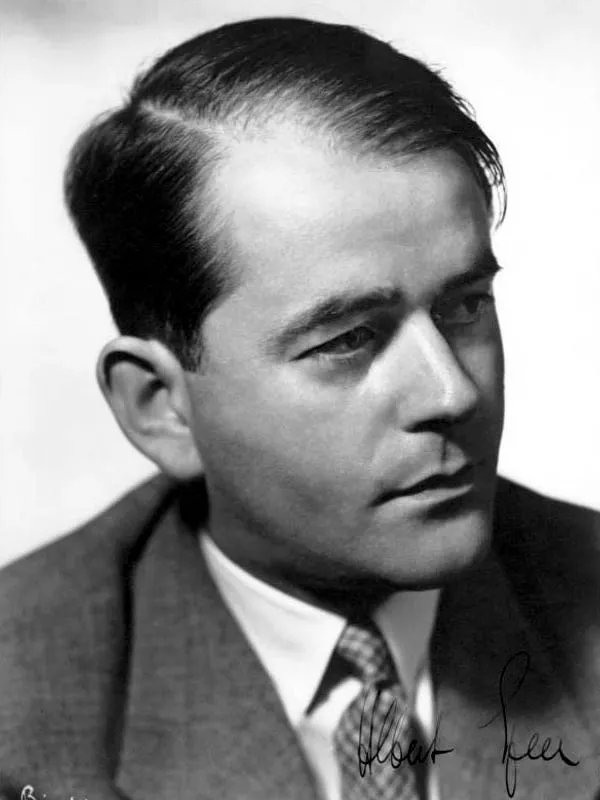
- Born:
- 19 March 1905, Mannheim (Baden, German Empire)
- Died:
- 1 September 1981, London (United Kingdom)
- Author:
- Natalia
- Photo:
- Atelier Binder, CC BY-SA 3.0 DE, Wikimedia Commons

Albert Speer was the youngest and most influential technocrat of the Third Reich. He began as Adolf Hitler’s favourite architect, the designer of party spectacles and of the new Reich Chancellery, and from 1942, as armaments minister, he ran the German war economy. It was largely thanks to his organisation that until the summer of 1944 the Wehrmacht received ever more tanks, aircraft and ammunition, but his factories ran on the labour of millions of forced workers and concentration camp prisoners. At Nuremberg he was one of the few defendants to accept responsibility for the regime’s crimes, and it was precisely this that allowed him to create the legend of the “decent Nazi”, which historians spent the next half-century taking apart.
The architect’s son from Mannheim
Albert Speer was born on 19 March 1905 in Mannheim, into the prosperous family of an architect of the same name. He studied architecture at his father’s urging: first in Karlsruhe, then in Munich and finally in Berlin, where his master was Heinrich Tessenow, an advocate of plain, austere form. In 1928 Speer became his assistant at the technical university and married Margarete Weber, with whom he had six children.
In crisis-ridden Berlin the young assistant was carried away by a speech Hitler gave to students, and at the beginning of 1931 he joined the NSDAP. His first commissions came from the party: Karl Hanke, a Berlin NSDAP official, gave him the conversion of a party building, and later recommended him to Joseph Goebbels. After the seizure of power in 1933 Speer fitted out the propaganda ministry and designed the setting for the National Labour Day at Berlin’s Tempelhof, with gigantic flags lit by searchlights at night.
Hitler’s architect
Hitler, a frustrated architect himself, found in Speer someone who could give shape to his visions. After Paul Troost died in January 1934, Speer became in practice the party’s chief architect. He designed the party rally grounds in Nuremberg, where at the rallies he placed more than a hundred anti-aircraft searchlights around the arena, shining straight up into the sky; foreign guests called it the “cathedral of light”. In 1937 he built the German pavilion at the Paris World Exhibition and became General Building Inspector for the Reich Capital. He was to rebuild Berlin as the monumental “Germania”, with a great avenue and a dome under which some 150,000 people or more would fit. In less than a year he put up the new Reich Chancellery, handed over in January 1939. He became one of the few people close to Hitler in private; he stayed with his family at the Berghof, and in June 1940 he accompanied the Führer in Paris.
The plans for “Germania” had a dark side. Speer’s office, needing flats for Berliners displaced from the sites of the future rebuilding, took them from Jews from 1939 onwards. Between January 1941 and January 1943 it carried out four eviction campaigns in which some 5,000 flats were taken from Jews; many of their former tenants later ended up in transports to the east. After the war Speer claimed he had known nothing about it. Researchers later established that the version of his office’s chronicle which he himself had handed to the archives had been cleansed of these entries.
Armaments minister
On 8 February 1942 the armaments minister, Fritz Todt, was killed in a plane crash. Hitler named Speer as his successor that same day (the formal appointment was announced a few days later), to the surprise of everyone, Hermann Göring above all, who had hoped to take over this domain himself. Speer also took over the Todt Organisation. He was neither an economist nor an industrial engineer, but he had Hitler’s trust and a gift for organisation. He relied on industrialists, to whom he gave wide freedom in production committees and rings, and in April 1942 he set up Central Planning, which allocated raw materials and labour. The number of weapon types was cut, mass production and new working methods were introduced. According to the ministry’s official index, armaments output roughly tripled by the summer of 1944. Propaganda called it the “armaments miracle”, and Speer became one of the most important men in the state.
The British historian Adam Tooze has shown, however, that the miracle was largely a legend: the growth began under Todt, came from decisions taken earlier, from sacrificing quality to quantity and from the ruthless exploitation of labour, and the ministry’s statistics made it look better than it really was. Speer’s factories constantly demanded new workers. They were supplied by the plenipotentiary for labour, Fritz Sauckel, through round-ups and deportations from occupied Europe, and increasingly by the SS, from the concentration camps. In March 1943 Speer visited the Mauthausen camp. When British bombs fell on Peenemünde in August 1943, together with Heinrich Himmler and Hitler he moved V2 rocket production into tunnels under the Kohnstein mountain, where thousands of prisoners of the Dora camp worked and died in inhuman conditions. He visited the tunnels himself in December 1943.
On 6 October 1943 Speer spoke in Posen (Poznań) at a meeting of party leaders. On the same day Himmler talked there openly about the murder of the Jews. All his life Speer maintained that he had left before Himmler’s speech. In a letter to the widow of a Belgian resistance member, written in 1971 and made public in 2007, he admitted, however, that he had been in the hall when Himmler announced that all the Jews would be killed.
Under the bombs
From 1943 Speer’s main adversary was the Allied bomber. After the destruction of the Ruhr dams in May 1943 he threw thousands of workers into the repairs; after the raids on Hamburg he warned Hitler that a few more such blows against big cities would paralyse production; and after the raids on Schweinfurt he dispersed the ball-bearing plants. He also backed Heinz Guderian’s efforts to rebuild the German armoured force and advised against the offensive at Kursk. In January 1944 he fell seriously ill and was out of action for several months, which his rivals, above all Martin Bormann, used to weaken his position. In March 1944, after the “Big Week” of American raids on aircraft factories, Speer and Field Marshal Erhard Milch set up the Fighter Staff, which dispersed aircraft production and raised it to record levels. From May 1944, however, the attacks on refineries deprived the Luftwaffe of fuel, and in the autumn the raids on the railways shattered the entire economy.
The end of the Reich
Speer was not privy to the plot of 20 July 1944, although his name appeared on the conspirators’ list as a candidate minister. At the end of January 1945, after the loss of Upper Silesia, he wrote to Hitler in a memorandum that the war was lost economically. On 19 March Hitler issued the Nero Decree, ordering the destruction of factories, bridges, power stations and stocks before the enemy arrived. Speer, who wanted to save the basis of German life after the war, toured the industrial regions and urged gauleiters, industrialists and commanders not to carry out the order; among others he worked with General Gotthard Heinrici. The Nuremberg tribunal later found that he had sabotaged the scorched-earth policy at considerable personal risk. On 23 April he flew into the bunker in besieged Berlin for the last time to say goodbye to Hitler. In his testament Hitler left him out of the new government, but Karl Dönitz made him minister of the economy and production at Flensburg. On 23 May 1945 Speer was arrested together with the whole government.
Nuremberg and Spandau
At the Nuremberg trial Speer chose a strategy that saved his life. Unlike most of his co-defendants, he accepted a share of responsibility for the regime’s crimes as a member of its leadership, while insisting that he had known nothing about the murder of the Jews. The tribunal acquitted him on the counts of conspiracy and crimes against peace but found him guilty of war crimes and crimes against humanity. In its reasoning it stated that when Speer made his demands on Sauckel he knew they would be met by foreign workers serving under compulsion, and that he used concentration camp labour. As a mitigating circumstance it took into account his opposition to the destruction of Germany in the last months of the war. On 1 October 1946 Speer was sentenced to 20 years in prison; the Soviet judge wanted the death penalty.
He served his whole sentence in Spandau prison, together with Rudolf Hess, Dönitz and Baldur von Schirach. There he secretly wrote memoirs and a diary, smuggled out on scraps of paper. He was released at midnight between 30 September and 1 October 1966.
The legend of the “good Nazi”
His “Memoirs”, published in 1969 (in English as “Inside the Third Reich”), became a bestseller in West Germany, and the “Spandau Diaries” followed in 1975. In them Speer presented himself as an apolitical expert who had fallen under Hitler’s spell and built him an army, but had no idea of the worst crimes. For decades this image shaped what people in Germany and around the world knew about the Third Reich. He died of a stroke on 1 September 1981 in London, where he had come to record an interview for the BBC.
Historians gradually took the legend apart. In 1982 Matthias Schmidt exposed the falsification of the chronicle of Speer’s office and his part in evicting Jews, Gitta Sereny in her 1995 biography described his long struggle with the truth, and Adam Tooze undermined the myth of the armaments miracle. The German historian Magnus Brechtken, in his 2017 biography, argues that Speer was an ambitious careerist who knowingly profited from the regime’s anti-Jewish policy and knew far more about the genocide than he admitted. Today he is regarded not as a decent exception among the Nazis but as one of the men without whom the war machine and slave labour of the Third Reich would not have kept going for so long.
Sources
Mentioned in battles
(03)Often appears with
People who appear in the same events.