United States
Joseph Lawton Collins
Commander of the 25th Infantry Division (1942–1943) and of VII Corps (1944–1945), Chief of Staff of the United States Army (1949–1953)
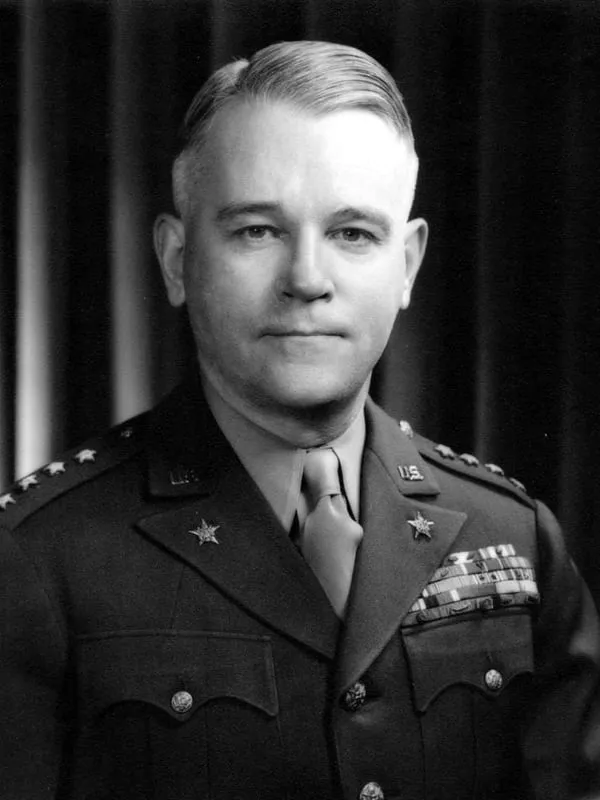
- Born:
- 1 May 1896, New Orleans (United States)
- Died:
- 12 September 1987, Washington (United States)
- Author:
- Łukasz
- Photo:
- US Army, domena publiczna, Wikimedia Commons

Joseph Lawton Collins, known in the army as “Lightning Joe”, was one of the best American corps commanders of the Second World War and one of the few who fought both the Japanese and the Germans. On Guadalcanal and New Georgia he led the 25th Infantry Division, and in Europe VII Corps, which landed on Utah Beach, took Cherbourg, broke through the front in Operation Cobra, stopped the German tanks in the Ardennes and closed the Ruhr Pocket. He was energetic, quick to decide and ruthless with commanders who in his view moved too slowly. Omar Bradley wrote that had another American army been created in Europe, Collins, despite his youth, would have been named its commander. After the war he headed the whole United States Army during the Korean War.
A boy from New Orleans
He was born on 1 May 1896 in New Orleans, the tenth of eleven children of an Irish immigrant who owned a shop and a bar. His elder brother, James Lawton Collins, was already an officer; James’s son Michael, Joseph’s nephew, flew the command module of the Apollo 11 mission in 1969. Joseph got into West Point as an alternate candidate, because the congressman’s first choice failed the examinations. He later called this his “Irish luck”. His class graduated early, in April 1917, just after the United States entered the war. Collins was 35th out of 139.
He did not get to France before the armistice. He commanded a battalion at home and reached Europe only in 1919, with the occupation forces in Germany. In Koblenz in 1921 he married Gladys Easterbrook, the daughter of an army chaplain.
The interwar years
Between the wars Collins taught chemistry at West Point, and from 1927 to 1931 tactics at the Infantry School at Fort Benning. There he met its assistant commandant, George Marshall, who was later to play a great part in his career, and Bradley, who was also teaching there. Collins served in the Philippines, graduated from the Army Industrial College and the Army War College, and from 1938 to 1940 taught at the latter himself. By 1941 he was a colonel and chief of staff of VII Corps in Birmingham, Alabama.
Hawaii, Guadalcanal and New Georgia
After the attack on Pearl Harbor the army commander in Hawaii, Lieutenant General Walter Short, was recalled. His successor was Lieutenant General Delos Emmons, and Collins, who flew to the islands on 17 December 1941, became his chief of staff. In February 1942 he was promoted to brigadier general, and in May to major general, taking over the 25th “Tropic Lightning” Infantry Division. He was forty-six and the youngest division commander in the army. For six months he trained the division, which did not enjoy a good reputation, in jungle fighting.
Around the turn of 1942 and 1943 the division arrived on Guadalcanal and joined Alexander Patch’s XIV Corps. In the last offensive on the island, launched on 10 January 1943, his regiments assaulted the ridges called Galloping Horse and Sea Horse, and on 22 January took Hills 90 and 91. On 11 January Collins himself walked several hundred metres through sniper-infested ground to a front-line battalion and, under machine-gun fire, directed mortar fire; he received the Silver Star for this. It was then that the nickname “Lightning Joe” stuck to him: according to some from the radio code name of the division’s headquarters, according to others from the pace of his attacks. In the summer of 1943 the division fought in the New Georgia campaign, in the jungle north of Munda airfield.
VII Corps in Normandy
At the end of 1943, on Marshall’s recommendation, Collins was sent to Europe. Bradley and Dwight Eisenhower were looking for a commander with amphibious and combat experience to replace Major General Roscoe Woodruff, who had none. After a short conversation in which Collins explained that in the Pacific he had always attacked the high ground first, Bradley told Eisenhower that Collins “talks our language”. In February 1944 Collins took over VII Corps and was the youngest corps commander in the American army. Preparations for the landing brought tragedy: in April German torpedo boats attacked a landing exercise of his troops, and at Slapton Sands at least 749 soldiers were killed.
On 6 June 1944 VII Corps landed on Utah Beach with the lightest losses of the day, because paratroopers of two airborne divisions had thrown the German defences behind the beach into confusion. Collins at once turned west and north. On 18 June his troops cut across the Cotentin peninsula, isolating the Germans in its northern part, and on 22 June, after heavy bombing, he attacked the ring of forts around Cherbourg. On 26 June the commander of the German garrison surrendered. The port, though wrecked by the Germans, was the first major port captured by the Allies in France.
In July VII Corps, like the whole First Army, got bogged down in the battle of the hedgerows south of Carentan. The breakthrough came with Operation Cobra. Collins helped draw up its plan, and after the carpet bombing of 25 July, when the infantry had not got as far as planned, he noticed that the Germans no longer had a continuous line of defence, only scattered strongpoints. That same evening he decided to commit his armoured divisions without waiting for the breach to be fully opened. The gamble paid off: the front in Normandy cracked and American columns poured deep into France. In August the corps helped beat off the German counter-attack at Mortain and close the Falaise pocket from the south.
From Mons to the Elbe
In early September VII Corps cut off the retreat of German units from northern France at Mons and took some 25,000 prisoners. On 12 September Collins obtained permission for a “reconnaissance in force”, and on 13 September he attacked the Siegfried Line south of Aachen. He stalled at Stolberg, but in October his 1st Infantry Division, together with XIX Corps, encircled and captured Aachen. In the autumn the corps bled in the Hürtgen Forest, which Collins, like his superior Courtney Hodges, regarded as a threat to his flank.
When the German offensive in the Ardennes began on 16 December, Bernard Montgomery, who had taken over the northern flank of the front, pulled VII Corps out of the line and wanted to keep it for a future counter-offensive. The German 2nd Panzer Division, however, was nearing the Meuse. On 24 December, against cautious instructions and in the absence of an explicit ban, Collins allowed Major General Ernest Harmon’s 2nd Armored Division to attack. In the fighting at Celles on 25 and 26 December the German spearhead was smashed a few kilometres from the river. On 3 January 1945 VII Corps attacked from the north towards Houffalize, where it linked up with the Third Army.
Around the turn of February and March Collins crossed the Erft and in early March 1945 entered Cologne. After crossing the Rhine via Remagen his 3rd Armored Division raced north towards Paderborn, covering more than a hundred kilometres a day, and on 1 April at Lippstadt his troops linked up with the Ninth Army, closing the Ruhr Pocket. In April Collins was promoted to lieutenant general. The corps passed south of the Harz mountains and reached the Elbe. Bradley described him as “independent, heady, capable and full of vinegar”, and German generals ranked him, alongside Troy Middleton, as one of the two best American corps commanders in the West. For the war he was also twice awarded the Soviet Order of Suvorov.
Army Chief of Staff
After the war Collins headed the army’s public information, and in 1947 he became Deputy Chief of Staff under Eisenhower, then under Bradley. On 16 August 1949 he became Chief of Staff of the United States Army and held the post for four years, throughout the Korean War. He was responsible for sending trained and equipped soldiers to Korea, brought the first Special Forces group into the army’s order of battle and helped shape the army’s contribution to the newly founded NATO. From 1953 to 1956 he was the United States representative on the NATO Military Committee.
In the autumn of 1954 President Eisenhower sent him with ambassadorial rank to South Vietnam to help shore up the government of Prime Minister Ngô Đình Diệm. Collins took a sceptical view of the situation and advised against American military intervention. In May 1955 he returned to NATO, and in March 1956 he retired after almost forty years of service. In 1979 he published his memoirs, “Lightning Joe”. He died of a heart attack on 12 September 1987 in Washington and was buried at Arlington National Cemetery. Historians see him as a model corps commander: fast, willing to take risks and able to seize the moment when the enemy began to waver.
Sources
Commanded in battles
(02)Mentioned in battles
(02)Often appears with
People who appear in the same events.