United States
Alexander Patch
Commander of the Americal Division and XIV Corps on Guadalcanal (1942–1943), of the US Seventh Army (1944–1945)
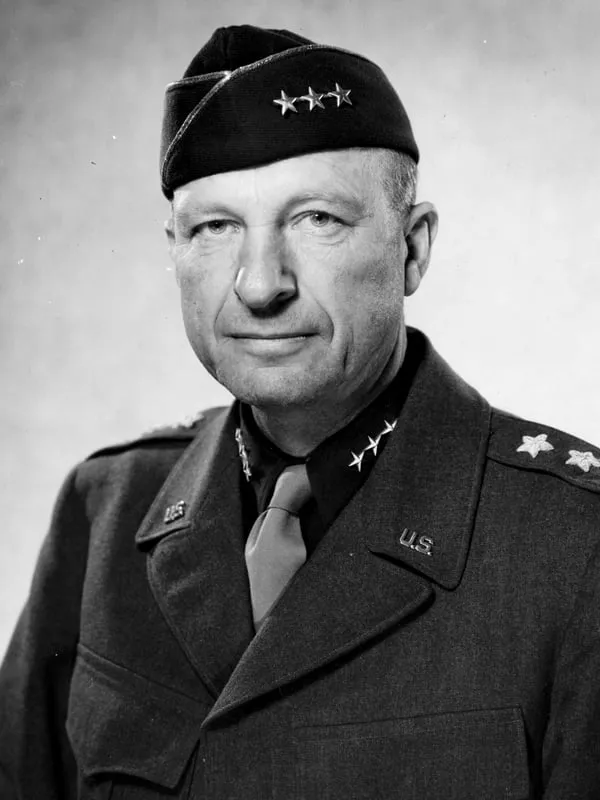
- Born:
- 23 November 1889, Fort Huachuca (United States)
- Died:
- 21 November 1945, San Antonio (United States)
- Author:
- Natalia
- Photo:
- Forrest C. Pogue, domena publiczna, Wikimedia Commons

Alexander Patch, known as “Sandy”, was one of the few American generals who fought in both great theatres of the war. On Guadalcanal he relieved the exhausted Marines and brought the campaign to its end, and in Europe he commanded the Seventh Army, which landed in Provence, marched up the Rhône valley, became the first army in history to fight its way through the Vosges, repelled the last German offensive on the Western Front and finished the war in the Alps. He was, together with Lucian Truscott, the only American general in this war to command in battle a division, a corps and an army in turn. Yet he did not live to enjoy fame: he died six months after victory, worn down by diseases brought back from the Pacific.
A cavalryman’s son
Alexander McCarrell Patch was born on 23 November 1889 at Fort Huachuca in Arizona Territory, where his father, a cavalry captain and West Point graduate, was serving. He spent his childhood in Pennsylvania. After a year at Lehigh University he entered the Military Academy at West Point in 1909, graduating in 1913 75th out of 93. He chose the infantry, having concluded that the cavalry’s best days were behind it. He served in Texas, and in 1916 on the Mexican border during the expedition against Pancho Villa. He married Julia Littell, a general’s daughter whom he had met while still a cadet.
In 1917 he sailed to France with the 1st Division. He completed the British machine-gun school, commanded a machine-gun battalion and ran the American school for that weapon, and in 1918 fought in the Second Battle of the Marne, at Saint-Mihiel and in the Meuse–Argonne offensive. He ended the war as a lieutenant colonel, and his leadership was noticed by George Marshall, then serving on General Pershing’s staff.
Between the wars
Patch spent much of the interwar period as an instructor. Several times he taught military science at Staunton Military Academy in Virginia, and he graduated with distinction from the Command and General Staff School at Fort Leavenworth and from the Army War College. From 1936 to 1939 he sat on the Infantry Board at Fort Benning and worked on the army’s transition from the four-regiment “square” division to the three-regiment “triangular” division with which the Americans went to war. In 1940 he took command of the 47th Infantry Regiment, and in August 1941 Marshall promoted him to brigadier general and gave him the task of training recruits.
New Caledonia and Guadalcanal
After Pearl Harbor Patch was given a hastily assembled task force of divisional strength and orders to defend New Caledonia, a French island on the route from America to Australia. On the way he fell ill with pneumonia. His convoy arrived at Nouméa on 12 March 1942. On the island he landed in the middle of a quarrel within the Free French camp: Admiral Georges Thierry d’Argenlieu expected the American to help him restore order, but Patch refused to use troops against the population and tried to remain neutral. In March 1942 he was promoted to major general, and in May he formed a new division out of scattered units. It had no number yet, so he named it Americal, from “America” and “New Caledonia”. It was the only American division of the war formed outside the United States.
In October 1942 its 164th Infantry Regiment went to Guadalcanal and helped the Marines beat off a Japanese attack on Henderson Field. On 9 December Patch took over command of the island from Alexander Vandegrift, and the malaria-ridden 1st Marine Division sailed away to rest. On 2 January 1943 he took command of the new XIV Corps, made up of the Americal Division, Joseph Lawton Collins’s 25th Infantry Division and the 2nd Marine Division. On 10 January the last offensive on Guadalcanal began: attacks on Mount Austen and the Galloping Horse and Sea Horse ridges, followed by a pursuit westwards along the coast.
The Japanese, however, were no longer preparing an attack but an evacuation. Patch, whose intelligence warned of a new Japanese offensive, would not strip the airfield’s defences and sent only about a regiment’s worth of troops after the enemy. In the first days of February Japanese destroyers took some 10,600 soldiers off the island. On 9 February 1943 Patch reported to Admiral William Halsey that the “Tokyo Express” no longer had a terminus on Guadalcanal and that organised resistance had ceased. Critics accused him of letting the enemy escape through excessive caution, but the Guadalcanal campaign, the Allies’ first great land offensive in the Pacific, ended in their victory.
From Oregon to Provence
Malaria, dysentery and the after-effects of pneumonia led Marshall to bring Patch home. Once recovered, he took over IV Corps at Fort Lewis and in the autumn of 1943 directed the great Oregon Maneuver, in which some 100,000 soldiers took part. At the start of 1944 he moved with the corps staff to Algiers, and on 2 March 1944 he took command of the Seventh Army, Patton’s former army from Sicily, which Mark Clark had taken over temporarily after him.
Its task was the landing in southern France, Operation Dragoon, contested to the last by the British, who preferred to reinforce the Italian front. For a long time Patch did not know what troops he would get, since that depended on the fighting in Italy. In the end he received Truscott’s American VI Corps and the French Army B of General Jean de Lattre de Tassigny. On 15 August 1944 the Americans landed in Provence against weak resistance, the French took Toulon and Marseille, and the Germans withdrew northwards. In August Patch received his third star as a lieutenant general. On 3 September Lyon was liberated, and on 10–12 September the troops from Provence linked up near Dijon with Patton’s Third Army. On 15 September they became part of General Jacob Devers’s 6th Army Group; the French forces henceforth formed a separate First Army, and Patch was left with the Seventh.
The Vosges, Strasbourg and Nordwind
In the autumn the Seventh Army attacked through the Vosges, mountains that no army had ever before taken by force. On 22 October 1944 the general’s son, Captain Alexander Patch III, was killed in Lorraine while leading a company of the 79th Infantry Division in an attack. In November his troops broke through the Saverne Gap, and on 23 November the French 2nd Armoured Division of General Philippe Leclerc, subordinated to the Seventh Army, burst into Strasbourg.
When in December the Third Army turned north to strike at the German salient in the Ardennes, Patch took over part of its front and had to defend some 135 kilometres of line from the Saar to the Rhine. On New Year’s Eve he warned his corps commanders that the Germans would attack before dawn. On 1 January 1945 Operation Nordwind, the last German offensive in the West, began. On Eisenhower’s orders Patch was to withdraw from the Strasbourg area, which provoked a sharp dispute over Strasbourg with de Gaulle, who had no intention of giving the city up to the Germans. In the end the French defended the city, and the Seventh Army, having fallen back to the line of the Moder river, stopped the German attacks in January.
The Rhine, Bavaria and the last months
In March 1945 the Seventh Army, working with the Third Army, broke through the Siegfried Line defences in the Saar and the Palatinate in Operation Undertone, and at the end of the month crossed the Rhine at Worms. In April it took Nuremberg, and on 29 April its soldiers entered Dachau and freed more than 30,000 prisoners. On 5 May the German Army Group G surrendered to his forces, and the spearheads of the Seventh Army reached Austria and the Alpine passes, meeting the troops coming up from Italy.
In the summer of 1945 Patch returned to the United States to take over the Fourth Army at Fort Sam Houston in Texas, earmarked for the invasion of Japan. Japan’s surrender put an end to those plans. In November he was admitted to hospital with pneumonia and died on 21 November 1945, two days before his 56th birthday. He was buried in the cemetery of the academy at West Point.
Assessment
According to the historian John Rickard, in February 1945 Eisenhower counted Patch among his most effective army commanders, ranking him above Courtney Hodges. Truscott wrote of him as a man of outstanding integrity, a courageous and competent leader and an unselfish comrade-in-arms. Patch did not seek publicity, and his army operated on a secondary, southern sector of the front, in the shadow of Patton and Montgomery, which is why he is much less known today. In 1954 Congress posthumously gave him the rank of general. Patch Barracks in Stuttgart, the headquarters of the United States European Command, bears his name.
Sources
Commanded in battles
(03)Mentioned in battles
(01)Often appears with
People who appear in the same events.