United States
Courtney Hodges
Commander of the Third Army (1943), deputy commander (1944) and commander of the US First Army (1944–1949)
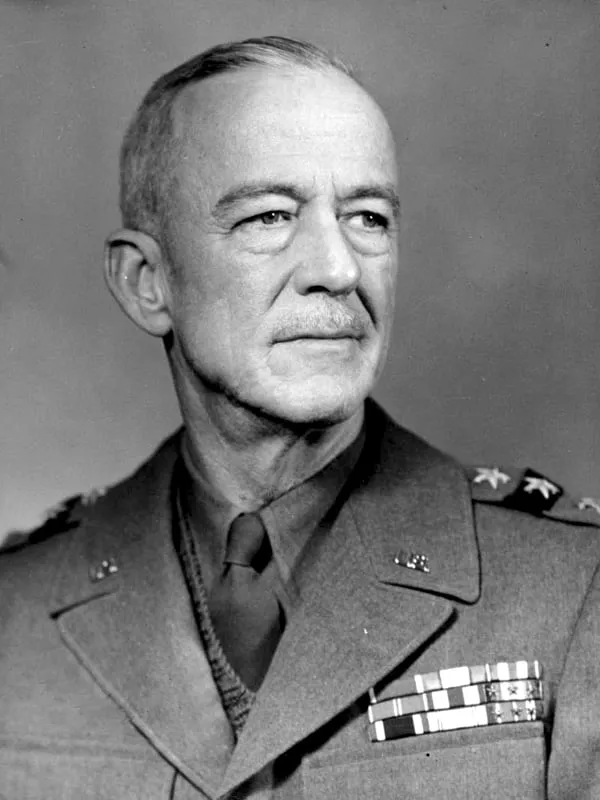
- Born:
- 5 January 1887, Perry (United States)
- Died:
- 16 January 1966, San Antonio (United States)
- Author:
- Łukasz
- Photo:
- U.S. Army, domena publiczna, Wikimedia Commons

Courtney Hodges commanded the American First Army, the largest and longest-fighting American army on the Western Front, from August 1944 to the end of the war in Europe. Its soldiers entered Paris, were the first to cross the border of the Reich, took Aachen, the first large German city, seized the bridge over the Rhine at Remagen and met the Red Army on the Elbe. The same army bled for months in the Hürtgen Forest and was caught by surprise in the Ardennes. Hodges was a quiet man who avoided the press, and to this day he remains in the shadow of his superior Omar Bradley and his neighbour George Patton. He is also one of the few American generals who began their service as privates.
A private from Georgia
Courtney Hicks Hodges was born on 5 January 1887 in Perry (PL), Georgia, into the family of the publisher of the local newspaper. After a year at an agricultural college in north Georgia he got into West Point, but after his first year he was dismissed from the academy because he could not cope with mathematics. He did not give up on the army. In 1906 he enlisted as a private in the 17th Infantry, rose to sergeant, and in 1909 passed the officers’ examination and in November was commissioned a second lieutenant, only a few months after his former classmates.
He served in Texas and in the Philippines, where one of his fellow officers was the future Army Chief of Staff George Marshall, and in 1916 he took part in General John Pershing’s punitive expedition into Mexico in pursuit of Pancho Villa. During the First World War he commanded a battalion of the 6th Infantry of the 5th Division in the attacks at Saint-Mihiel and in the Meuse–Argonne offensive. In early November 1918 near Brieulles he personally reconnoitred a crossing point on the Meuse, led an assault party and, after twenty hours of continuous fighting, got across to the far bank. For this he received the Distinguished Service Cross; he ended the war as a lieutenant colonel.
Infantry teacher
After occupation duty in Germany Hodges spent several years on the staff of West Point, the academy that had once thrown him out. He graduated from the Command and General Staff School at Fort Leavenworth and from the Army War College, taught at the Infantry School at Fort Benning and at the Air Corps Tactical School at Maxwell Field, and sat on the Infantry Board. In 1938 he became assistant commandant of the Infantry School, and in 1940 its commandant, as a brigadier general. It was then that he became friends with Bradley, who would later play a decisive part in his career. In May 1941, by now a major general, he became Chief of Infantry in the War Department. He helped bring the bazooka (PL) and the M1 carbine into service and to create the airborne forces.
Bradley’s deputy
In May 1942 Hodges took over X Corps, and in February 1943, now a lieutenant general, he succeeded Walter Krueger at the head of the Third Army and the Southern Defense Command in San Antonio. At the end of 1943 the Third Army sailed to Britain, but in January 1944 its command went to Patton, and Hodges became Bradley’s deputy in the First Army. The plan was that after the Normandy landings Bradley would take over an army group and Hodges his army. This made the change of command smooth, but Hodges inherited Bradley’s staff, made up of able and quarrelsome men with whom he did not always get on. As deputy he went through the whole Battle of Normandy with the First Army.
The First Army from Normandy to Germany
On 1 August 1944 Hodges took over the First Army. It then had three corps, including Joseph Lawton Collins’s VII Corps, and about a quarter of a million men. After the Germans were routed at Falaise his troops moved east; it was under his command that the American 4th Infantry Division and the French 2nd Armoured Division liberated Paris on 25 August. In early September VII Corps closed a pocket at Mons in which about 25,000 Germans were taken prisoner, and the First Army liberated Liège, Namur and most of Luxembourg. On 11 September one of its patrols became the first Allied unit to cross the German border, and two days later the Americans stood before the Siegfried Line. The offensive, however, was halted by shortages of fuel and ammunition.
In the autumn Hodges fought two battles at once. Aachen was encircled and, after heavy street fighting, taken on 21 October 1944. South-east of the city, meanwhile, the Battle of the Hürtgen Forest dragged on. Hodges decided that the forest could not be left on his flank and fed into it one division after another; each came out of the thickets bled white after a few weeks, having gained a few kilometres and a handful of villages. He realised too late that the real objective was the Rur dams, with which the Germans could flood the valley in front of the advancing Americans. He himself wrote in his diary that it was safer and quicker to strike straight at the enemy than to look for ways round.
On 16 December 1944 the German offensive in the Ardennes fell on an overstretched, thinly held sector of his army. As early as 17 December Hodges demanded that the two airborne divisions in reserve be committed, one of which went on to hold Bastogne. On 20 December, when the German wedge had cut communications with Bradley’s headquarters, Dwight Eisenhower placed the First and Ninth Armies under Bernard Montgomery. Montgomery drove to Hodges’s headquarters at Chaudfontaine that same day. He had doubts about Hodges’s condition and, according to some accounts, asked about the possibility of relieving him, but Eisenhower stood by Hodges, explaining that the general was simply quiet and did not look as determined as he really was. On 3 January 1945 the First Army attacked from the north towards Houffalize, where it linked up with Patton’s Third Army, and in mid-January it returned to Bradley’s command.
Remagen and the Elbe
On 7 March 1945 the 9th Armored Division of the First Army captured the intact bridge at Remagen, the only bridge over the Rhine that the Germans had failed to blow. Hodges quickly pushed more and more units across to the far bank, although Eisenhower limited the expansion of the bridgehead for the time being. On 25 March his divisions broke out of the bridgehead and drove east in armoured thrusts, and on 1 April at Lippstadt they linked up with the Ninth Army, closing the Ruhr Pocket around the whole of Field Marshal Walther Model’s Army Group B. More than 300,000 soldiers were taken prisoner there. On 15 April Hodges was promoted to four-star general. On 25 April patrols of his 69th Infantry Division met Red Army soldiers on the Elbe, near Strehla and at Torgau, and on 30 April Hodges himself met the commander of the Soviet 5th Guards Army, General Aleksei Zhadov.
After the war and assessment
After Germany’s surrender the First Army headquarters was to move to the Pacific and take part in the invasion of Japan, but Japan’s surrender put an end to these plans. Hodges commanded the First Army in the United States until his retirement in 1949. He died on 16 January 1966 in San Antonio, Texas, and was buried at Arlington National Cemetery.
Bradley considered him one of the best infantry tacticians in the army and wrote that of all his army commanders Hodges needed the least supervision. Eisenhower made efforts to ensure that the press recognised his achievements. Historians judge him more harshly. For the Battle of the Hürtgen Forest, which Charles MacDonald, author of the American official history of that fighting, called a defeat of the first magnitude, they blame above all him and his staff. Antony Beevor accused him of lacking operational imagination and of being slow to decide. On the other hand, as his defenders point out, the First Army under his command fought without a break for nine months, suffered the heaviest losses of any American army in Europe and took the most prisoners.
Sources
Commanded in battles
(05)Mentioned in battles
(01)Often appears with
People who appear in the same events.