Soviet Union
Pavel Rybalko
Soviet military attaché in Poland (1937–1939), commander of the 5th and 3rd Tank Armies (1942–1943) and the 3rd Guards Tank Army (1943–1946), Marshal of Armoured Troops (from 1945)
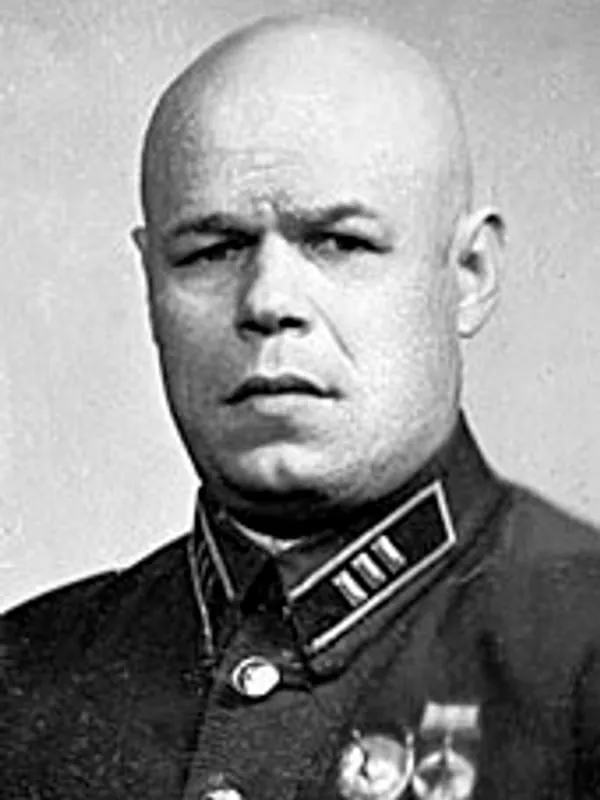
- Born:
- 4 November 1894, Maly Vystorop, Kharkov Governorate (Russian Empire, now Ukraine)
- Died:
- 28 August 1948, Moscow (Soviet Union)
- Author:
- Łukasz
- Photo:
- Ministerstwo Obrony Federacji Rosyjskiej, CC BY 4.0, Wikimedia Commons

Pavel Rybalko commanded a tank army for longer than anyone else in the Red Army and was among the best commanders of the armoured arm. His 3rd Guards Tank Army went from Orel and Kiev through Lvov, Silesia and Berlin all the way to Prague. Before the war, however, he was not a tankman but a cavalryman, a commissar and an intelligence officer, who in 1937–1939 was the Soviet military attaché in Warsaw. He reached the front only in 1942, after repeated requests, and his first army was destroyed by Manstein at Kharkov. Marshal Ivan Konev later wrote that he could rely on Rybalko completely: whatever he himself as front commander had failed to foresee, his subordinate would.
Worker, soldier, commissar
He was born on 4 November 1894 (23 October in the Julian calendar) in the village of Maly Vystorop in Lebedin district of Kharkov Governorate, today in Sumy Oblast in Ukraine, into the family of a sugar-mill worker. After parish school he worked in the sugar mill, and from 1912 as a turner’s assistant in the locomotive works in Kharkov. In 1914 he was called up into the army. As a private in the 82nd Infantry Division he fought in Galicia, among other places at Przemyśl (PL) and in the Brusilov offensive, in which he was wounded.
After the revolution he organised a workers’ squad in his village and took it over to the Red Guard. In 1918 he fought in a partisan detachment against Hetman Skoropadsky and the Germans, was captured and sat in prison in Kharkov until January 1919. In 1919 he joined the Bolshevik party. He commanded a regiment and was badly wounded fighting Denikin, and in 1920 he went to the First Cavalry Army as commissar of a regiment and then of a brigade of the 14th Cavalry Division. With it he fought in the war with Poland in Volhynia, where for a time he headed the revolutionary committee in Novograd-Volynsky, and then against Wrangel.
Intelligence officer and diplomat
In the 1920s he commanded a cavalry squadron, battalion and regiment, and in 1934 he graduated from the Frunze Military Academy. He was placed at the disposal of military intelligence and sent as an adviser to China’s Xinjiang, where he helped the pro-Soviet governor Sheng Shicai fight the rebels. In July 1937 he became the Soviet military attaché in Poland. He spent two years in Warsaw, until the summer of 1939, as relations between the two states headed towards the catastrophe of 17 September. In 1940 he was attaché in China, and from 1941 he taught tactics at the General Staff’s intelligence school.
The first armies
In May 1942, after repeated written requests to be sent to the front, he became deputy commander of the 3rd Tank Army, and in the summer commander of the 5th Tank Army, which had been mauled near Voronezh. In September he took over the 3rd Tank Army, which he trained through the autumn in the forests near Tula. That summer his only son, Lieutenant Vilen Rybalko, was killed at the front.
In January 1943 the army took part in the Ostrogozhsk–Rossosh operation, which destroyed the Hungarian 2nd Army on the Don, and in February it advanced on Kharkov, liberated on 16 February. When Manstein began his counter-stroke, the Stavka sent Rybalko’s army south. Exhausted, with few serviceable tanks, it ran into the advancing SS panzer divisions. On 3 March its 15th Tank Corps was encircled, and by 5 March the army had been destroyed in the Third Battle of Kharkov. In April its remnants were renamed the 57th Army.
Rybalko did not lose Stalin’s confidence. In May 1943 he was given the newly forming 3rd Guards Tank Army, which he commanded to the end of the war. In July, during the counter-offensive on the Kursk salient, it attacked the Orel bulge.
The Dnieper and Kiev
In September the army moved from the Sumy area to the Dnieper and on the night of 21–22 September crossed it at Bukrin on improvised means. In the Battle of the Dnieper, however, the Bukrin bridgehead became a trap: two attempts to advance on Kiev in October got stuck. Nikolai Vatutin decided to move Rybalko’s army to the Lyutezh bridgehead north of the city. At the turn of October and November the tanks moved by night, under radio silence, twice across the Dnieper and across the Desna, leaving dummies behind at Bukrin. On 4 November the army went into action from the Lyutezh bridgehead and cut the road from Kiev to Zhitomir, and on 6 November the city was liberated. For the Dnieper and Kiev Rybalko was made a Hero of the Soviet Union on 17 November, and in the last days of the year he took part in retaking Zhitomir and was made a colonel general.
In the spring of 1944, when after Vatutin was wounded the front was commanded by Georgy Zhukov, the army took part in the offensive in right-bank Ukraine and in the fighting for Tarnopol.
Lvov and Silesia
In the Lvov–Sandomierz operation Konev sent Rybalko’s whole army on 16 July 1944 into a narrow breach a few kilometres wide at Koltov, through which columns of tanks drove under fire from both sides. Soviet historiography regarded this as an unprecedented feat. The army went round Lvov from the north and west, cut the roads to Przemyśl and on 27 July, together with the army of Dmitry Lelyushenko, ended the fighting for the city. It then reached the Vistula at Sandomierz.
In January 1945, in the Vistula–Oder operation, the army advanced from the Sandomierz bridgehead towards Breslau. On 20 January Konev turned it south, along the upper Oder, into the rear of the German 17th Army defending Upper Silesia. The Germans withdrew from the industrial region, which fell into Soviet hands almost intact. On 6 April Rybalko received a second Gold Star of a Hero.
Berlin and Prague
On 16 April his army forced the Neisse, and after the defences on the Spree had been broken Stalin allowed Konev to turn both his tank armies towards Berlin. Around 21–22 April Rybalko’s tanks took Zossen, where the headquarters of the Army High Command lay in underground bunkers, and on 24 April they crossed the Teltow Canal and met Zhukov’s troops in the south-eastern suburbs. In the storming of Berlin Rybalko’s army got in the way of Vasily Chuikov’s army, and Stalin moved the boundary line so that the government quarter with the Reichstag fell to Zhukov. Rybalko’s army suffered heavy losses in the street fighting.
At the beginning of May it was moved to the Dresden area, from where it set off for Prague, where an uprising had broken out on 5 May. On the night of 8–9 May the tanks of Rybalko and Lelyushenko covered some 80 kilometres across the Ore Mountains. On the morning of 9 May, behind Lelyushenko’s units, troops of the 3rd Guards Tank Army entered the city. On 1 June 1945 Rybalko was made a Marshal of Armoured Troops.
After the war
In 1946 he became first deputy commander, and in April 1947 commander, of the armoured and mechanised forces of the Soviet Army, and directed their re-equipment. He was seriously ill with kidney disease. He died on 28 August 1948 in Moscow and was buried in the Novodevichy Cemetery.
Rybalko was one of those commanders who learned from their own defeats. In the spring of 1943 he lost a whole army at Kharkov, and half a year later he carried out the manoeuvre at Kiev that took the Germans by surprise. In 1944–1945 his army was one of the main instruments of Konev’s fast advances, and the move from Bukrin to Lyutezh and the passage through the breach at Koltov rank among the most skilful operations of Soviet armoured forces in that war.
Sources
Mentioned in battles
(06)Often appears with
People who appear in the same events.