Soviet Union
Nikolai Vatutin
First Deputy Chief of the Red Army General Staff (1941), commander of the Voronezh, South-Western and 1st Ukrainian Fronts (1942–1944)
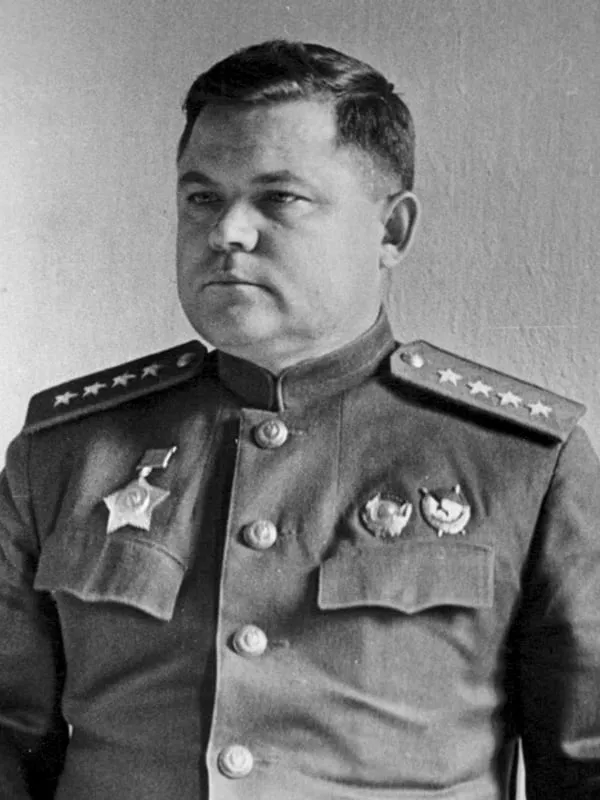
- Born:
- 16 December 1901, Chepukhino, Voronezh Governorate (Russian Empire)
- Died:
- 15 April 1944, Kiev (Soviet Union, now Ukraine)
- Author:
- Natalia
- Photo:
- autor nieznany, CC BY 4.0, Wikimedia Commons

Nikolai Vatutin belonged to the generation of Soviet commanders who rose on the ruins of an army wrecked by the Great Purge. Until 1942 he was purely a staff officer: he planned the march into Poland in September 1939, and in June 1941, as First Deputy Chief of the General Staff, he drafted with Georgy Zhukov the last pre-war directive to the western military districts. Then, in less than two years, he became one of the boldest front commanders of the Red Army. His troops closed the ring round the 6th Army at Stalingrad, withstood the strongest German blow at Kursk and in November 1943 liberated Kiev. His daring sometimes let him down: several times he overrated his own strength and was caught out by Erich von Manstein. He died not at the front but from the bullets of Ukrainian partisans, and today in Ukraine his memory is being removed from its streets and squares.
A boy from near Valuyki
He was born on 16 December 1901 (3 December in the Julian calendar) in the village of Chepukhino in Valuyki district. Soviet encyclopaedias placed the village in Kursk Governorate, more recent works in Voronezh Governorate; today it is the settlement of Vatutino in Belgorod Oblast in Russia, named in his honour. He came from a large peasant family and went to a parish school, a zemstvo school in Valuyki and a commercial school in Urazovo, which he left in 1917 when his scholarship was withdrawn.
In April 1920 he was called up into the Red Army and fought the bands of Nestor Makhno in eastern Ukraine. A year later he joined the Bolshevik party. In 1922, as he was finishing infantry school in Poltava, his father, grandfather and younger brother died of hunger in his home village. For several years he commanded a platoon and a company in a rifle division stationed in the Donbas, and in 1926 he went to Moscow to study.
Up the staff ladder
He graduated from the Frunze Military Academy (1929) and from its operations faculty (1934), and in 1937 from the General Staff Academy. The purge, which took hundreds of experienced commanders, opened the way for him. In 1938 he became chief of staff of the Kiev Special Military District, one of the most important in the country.
In September 1939 he was chief of staff of the Ukrainian Front, which on 17 September marched into Poland and occupied its south-eastern provinces. In June 1940, as chief of staff of Zhukov’s force, he took part in the seizure of Bessarabia and northern Bukovina. For these campaigns, in which there was almost no fighting, he was made a lieutenant general, and in July 1940 he was given the post of head of the Operations Directorate of the General Staff. In February 1941 he became first deputy to the chief of the General Staff, who was then Zhukov. Western historians, among them David Glantz, stress that he lacked combat experience and that his knowledge of operational art came from books. Stalin, however, valued him for his peasant origins, his youth and his party zeal.
On the evening of 21 June 1941, after a report about a German deserter warning of an attack the next morning, Zhukov and Vatutin drafted Directive No. 1, amended in person by Stalin. It ordered combat readiness but at the same time forbade giving in to “provocations”, and it reached the troops too late.
Chief of staff in the north-west
On 30 June 1941 Vatutin became chief of staff of the North-Western Front, which was falling back in disorder from the Baltic states. In mid-July he prepared the counter-attack at Soltsy, in which Soviet units surprised Manstein’s exposed panzer corps and held up the advance on Leningrad for a few days. The attackers’ losses, however, were very high and coordination was poor. On this front he met a young colonel, Ivan Chernyakhovsky, with whom he became friends and whom he later pushed for command of an army. In the winter of 1942 the front’s troops surrounded two German corps at Demyansk but could not destroy them: the Germans supplied them from the air, and in April broke through to them from outside.
Voronezh and Stalingrad
In May 1942 he returned to Moscow as deputy chief of the General Staff. When in the summer the German offensive in the south reached the Don, according to the memoirs of Aleksandr Vasilevsky he volunteered to command the new Voronezh Front, which surprised Stalin. He took it over on 14 July. The Germans captured the right-bank part of Voronezh but got no further, and Vatutin’s attacks, though unsuccessful, tied down their forces far from Stalingrad.
On 25 October 1942 he took command of the re-formed South-Western Front, which was to deliver the main blow in Operation Uranus. On 19 November his armies broke through the Romanian 3rd Army from the bridgeheads at Serafimovich and Kletskaya, and on 23 November the front’s tanks met units of Andrei Yeryomenko’s Stalingrad Front at Kalach and encircled the 6th Army of Friedrich Paulus. In December, in Operation Little Saturn, Vatutin’s armies smashed the Italian 8th Army on the middle Don and threatened the airfields from which the pocket was supplied, which helped to defeat Manstein’s relief attempt. In January 1943 Vatutin was among the first to receive the new Order of Suvorov, 1st Class, and on 12 February he was made a general of the army.
Defeat at Kharkov and victory at Kursk
Victory on the Volga raised hopes in Moscow that the Germans were fleeing all the way back behind the Dnieper. At the turn of January and February 1943 Vatutin’s front sent Markian Popov’s armoured group into the Donbas, where it cut an important railway line. Vatutin believed to the end that the enemy was retreating, and on 21 February refused to let the group withdraw, although it had about 25 tanks left. Manstein then struck its exposed flanks and in the Third Battle of Kharkov routed the advanced Soviet forces, retaking the city in March. The price was paid mainly by the commander of the neighbouring Voronezh Front, Filipp Golikov; on 28 March Vatutin took over his post.
On the southern face of the Kursk–Orel salient his troops spent three months building several defensive belts in depth. On 5 July the Voronezh Front was hit by the 4th Panzer Army and Army Detachment Kempf, the strongest blow of the entire Battle of Kursk. The Germans broke in about 30 kilometres, so Moscow gave Vatutin armies from the strategic reserve. On 12 July Pavel Rotmistrov’s 5th Guards Tank Army attacked at Prokhorovka and suffered huge losses, but the German attack soon came to a halt. In early August Vatutin and Ivan Konev went over to the counter-offensive: Belgorod fell on 5 August and Kharkov on 23 August, although the SS panzer divisions had earlier inflicted heavy losses on his tank armies at Bogodukhov and Akhtyrka.
Kiev
In September Vatutin’s troops reached the Dnieper and seized bridgeheads at Bukrin and Lyutezh. From Bukrin they twice tried to drive on Kiev and twice got stuck. On 20 October the front was renamed the 1st Ukrainian Front. Vatutin then decided to move Pavel Rybalko’s 3rd Guards Tank Army secretly north to the Lyutezh bridgehead, leaving dummy tanks in its old positions. The attack from Lyutezh, launched on 3 November, took the Germans by surprise, and on 6 November Soviet troops took Kiev. The member of the front’s military council was Nikita Khrushchev. It was the Red Army’s greatest success in the Battle of the Dnieper, but Vatutin again drove his troops too far: the German counter-attack at Zhitomir and Radomyshl in November and December inflicted heavy losses on him, though it did not take Kiev back.
In January and February 1944 his front, together with Konev’s 2nd Ukrainian Front, surrounded two German corps in the Korsun pocket. When the relief force threatened the sector of his 27th Army, Stalin entrusted the destruction of the pocket to Konev. Moscow saluted the victory of Konev’s troops alone, and Vatutin and Zhukov were left out, which Vatutin took bitterly.
The ambush at Milyatyn
On 29 February 1944 Vatutin was travelling from Rovno to the headquarters of Chernyakhovsky’s 60th Army at Slavuta. Near the village of Milyatyn, in the Ostrog area, his small convoy was fired on by a unit of the Ukrainian Insurgent Army. The general was badly wounded in the thigh. According to a report by the front’s counter-intelligence the attackers numbered 100–200, and historians point out that later accounts were often contradictory and that it is not even certain whether it was a planned attack or a chance encounter. Vatutin was taken to Kiev, where the best Soviet surgeons treated him, among them Nikolai Burdenko, but gangrene set in. He died on 15 April 1944, at the age of 42. Zhukov had taken over command of the front on 1 March.
Memory
He was buried in Kiev’s Mariinsky Park, and in 1948 a monument by Yevgeny Vuchetich (PL) was put up there. He was made a Hero of the Soviet Union posthumously only in 1965. In the Soviet Union towns, streets and schools were named after him. In independent Ukraine the verdict is the opposite: in 2014 the Institute of National Memory put him on a list of people involved in the struggle against Ukrainian independence, in 2017 Kiev’s Vatutin Avenue was renamed after Roman Shukhevych, and in February 2023, during the Russian invasion, the monument above his grave was taken down.
Military historians rate him more highly today than when the picture of the Eastern Front was shaped by the memoirs of German generals. Glantz sees him as one of the most creative commanders of the war: at Kursk he stopped Manstein and went over to the counter-offensive, and at Kiev he outmanoeuvred him. The same appetite for risk, however, cost him a defeat in February 1943 and heavy losses at Zhitomir. He was a staff officer who learned to command in the field faster than many cavalrymen of the Civil War, and one of the few Soviet commanders whom Manstein could not beat in open manoeuvre.
Sources
Commanded in battles
(06)- 23 August 1942 – 2 February 1943Battle of StalingradEastern Front
- 19–23 November 1942Operation UranusEastern Front
- 19 February – 15 March 1943Third Battle of KharkovEastern Front
- 5 July – 23 August 1943Battle of KurskEastern Front
- 26 August – 23 December 1943Battle of the DnieperEastern Front
- 24 January – 17 February 1944Battle of the Korsun–Cherkassy PocketEastern Front
Mentioned in battles
(02)Often appears with
People who appear in the same events.