Soviet Union
Dmitry Lelyushenko
Commander of the 21st Mechanised Corps (1941), the 5th, 30th and 3rd Guards Armies (1941–1944) and the 4th (Guards) Tank Army (1944–1945)
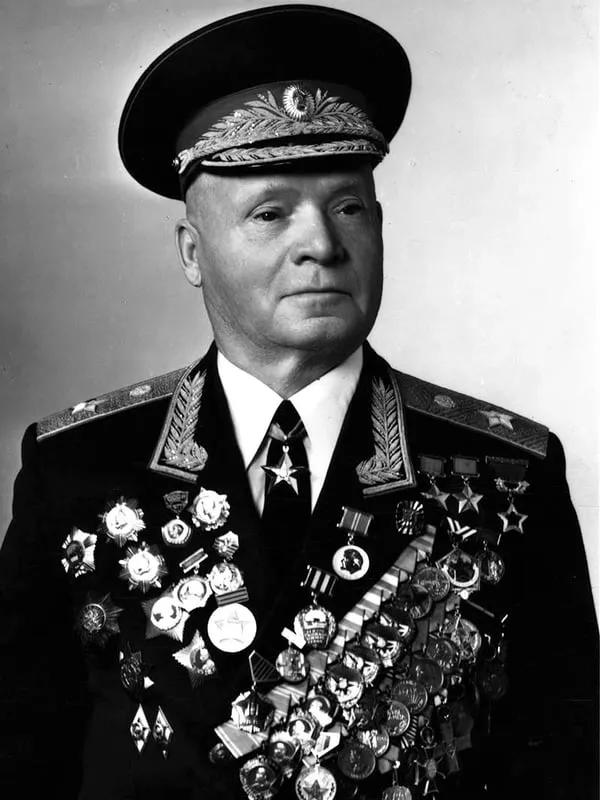
- Born:
- 2 November 1901, Novokuznetsovka, Don Host Oblast (Russian Empire, now Russia)
- Died:
- 20 July 1987, Moscow (Soviet Union)
- Author:
- Łukasz
- Photo:
- Ministerstwo Obrony Federacji Rosyjskiej, CC BY 4.0, Wikimedia Commons

Dmitry Lelyushenko was one of the commanders of the six Soviet tank armies that led the Red Army’s fastest advances in 1944–1945. What set him apart was that he fought in almost every phase of the war: in 1939 his tank brigade marched into Poland and then stormed the Mannerheim Line; in June 1941 his corps broke into Daugavpils, and in October he defended the road to Moscow at Mtsensk and Borodino. Twice badly wounded, he returned to duty each time. As commander of the 4th Guards Tank Army he liberated Lvov and Silesia, closed the ring round Berlin from the west, and on 9 May 1945 his tanks were the first to enter Prague.
From Dumenko’s partisans to tanks
He was born on 2 November 1901 (20 October in the Julian calendar) in the hamlet of Novokuznetsovka in the Mechetinskaya stanitsa on the Don, into a poor peasant family of incomers from outside the Cossack community, the youngest of seven children. From the age of nine he worked as a farmhand in the summer. In the spring of 1918 he joined the Red partisan detachment of Boris Dumenko (PL), and from 1919 he served in the cavalry, from November in the First Cavalry Army of Semyon Budyonny. He fought against Denikin, Wrangel and Makhno, and in 1920 in the war with Poland.
After the Civil War he was a political instructor and regimental commissar in a cavalry regiment near Leningrad, and in 1924 he joined the party. When the first mechanised units were being formed in the Red Army, he moved to the armoured forces. In 1933 he graduated from the Frunze Military Academy, then commanded a tank company and battalion, and in 1938 a training regiment in Ryazan.
Poland and Finland
In 1939 he took command of the 39th Independent Light Tank Brigade. In September it took part in the invasion of Poland as part of the forces that occupied the north-eastern provinces. In the winter the brigade fought in the Winter War on the eastern sector of the Karelian Isthmus. On 15 December 1939 its light T-26 tanks went into the assault at Taipale with the infantry and lost almost half their vehicles that day. Lelyushenko drew his conclusions: he had plates of armour from wrecked tanks hung on his vehicles, which reduced losses to Finnish anti-tank guns. In February 1940 the brigade helped to break through the Finnish fortifications, and its commander suffered a contusion when a shell hit his tank. On 7 April 1940 he was made a Hero of the Soviet Union.
In June 1940, by now a major general, he commanded the 1st Moscow Motorised Division, which took part in the occupation of Lithuania. In March 1941 he took over the 21st Mechanised Corps, then forming in the Moscow Military District.
Daugavpils and Mtsensk
The outbreak of war found the corps not far from the Latvian border. On 26 June 1941 the spearheads of Erich von Manstein’s panzer corps captured the bridges over the Dvina at Daugavpils. Two days later Lelyushenko was ordered to counter-attack. Without infantry or air support his tanks drove the Germans back some fifteen kilometres and fought for several hours in the streets of the town. They could not hold it, but Manstein had to halt his advance for a few days. In mid-July the remnants of the corps took part in the counter-attack at Soltsy. In August, when the corps had lost its last tanks, it was disbanded, and Lelyushenko became deputy head of the Main Armoured Directorate.
At the beginning of October 1941, in the first days of Operation Typhoon, Guderian’s tanks took Orel and there was no Soviet defence left in front of them. Stalin summoned Lelyushenko and ordered him to assemble the 1st Guards Rifle Corps from scattered units within a few days. At Mtsensk the 4th Tank Brigade of Colonel Mikhail Katukov, part of the corps, inflicted heavy losses on the 4th Panzer Division from ambushes and held up the advance on Tula for more than a week.
Around 11 October Lelyushenko took over the 5th Army, which on the Mozhaisk line defended, among other places, the battlefield of Borodino. In practice the army had one full division, a few tank brigades and regiments from military academies; guns were so short that even tanks without engines were dug into the ground. On 17 October Lelyushenko was badly wounded, and the army was taken over by Leonid Govorov.
From Klin to the Donbas
After recovering, in November, he took over the 30th Army on the right wing of the Western Front, which was falling back near Klin. When the counter-offensive at Moscow began on 6 December, his army, reinforced by divisions from the Urals and Siberia, broke through the front north of Klin and on 15 December, together with the 1st Shock Army, liberated the town. In 1942 the 30th Army bled in the battles of Rzhev without taking the town.
In November 1942 Lelyushenko took over the 1st Guards Army in Nikolai Vatutin’s South-Western Front, which during Operation Uranus formed the outer ring of the encirclement of the 6th Army. In December, renamed the 3rd Guards Army, it attacked the Italian 8th Army in Operation Little Saturn. In the winter of 1943 the army advanced on Voroshilovgrad, and in March, during the German counter-offensive, Lelyushenko was again badly wounded. He returned in August and until February 1944 led the 3rd Guards Army through the Donbas, Zaporozhye and Nikopol.
Lvov, Silesia, Berlin
On 29 March 1944 he took over the 4th Tank Army in Marshal Ivan Konev’s 1st Ukrainian Front. In the Lvov–Sandomierz operation Konev sent his army on 17 July into the narrow corridor at Koltov, behind the army of Pavel Rybalko. On the morning of 22 July the 10th Urals Volunteer Tank Corps of his army burst into Lvov from the south-east. Fighting for the city alongside it were units of the Home Army, which in the Lvov uprising wanted to liberate the city before the Russians arrived. By 27 July Lvov had been taken, and a few days later the NKVD arrested the Home Army commanders.
In January 1945, in the Vistula–Oder operation, the 4th Tank Army advanced from the Sandomierz bridgehead to the Oder and on 22–24 January seized the bridgehead at Steinau, north-west of Breslau. In March it was given Guards status, and on 6 April 1945 its commander received a second Gold Star of a Hero.
In the Berlin operation both of Konev’s tank armies forced the Neisse and the Spree and turned towards Berlin. Lelyushenko swung wide to the west of Rybalko, and on 25 April his units met Zhukov’s troops at Ketzin, closing the ring round the capital of the Reich. In the last days of April his army fought off the attack of XX Corps of Walther Wenck’s army, which was trying to break through to Berlin and reached Beelitz.
Prague
When the Prague uprising broke out on 5 May, Konev threw both tank armies south across the Ore Mountains. On the night of 8–9 May Lelyushenko’s tanks covered some 80 kilometres and at about four in the morning were the first to enter Prague, followed by Rybalko’s units. On the way they smashed the headquarters of Field Marshal Ferdinand Schörner’s Army Group Centre, although Schörner himself was no longer there. In 1970 Czechoslovakia made him a Hero of the ČSSR.
After the war
After the war he commanded the armoured forces in Germany, an army in the Far East, and then the Transbaikal and Urals military districts; in 1959 he became a general of the army. From 1960 to 1964 he headed DOSAAF, the paramilitary organisation that trained young people, and later served as an inspector in the Ministry of Defence. In 1970 he published his memoirs, “Moscow – Stalingrad – Berlin – Prague: Notes of an Army Commander”. He died on 20 July 1987 in Moscow and was buried in the Novodevichy Cemetery.
Lelyushenko was not a strategist but an energetic field commander. Sergei Shtemenko wrote that he hardly ever sat in his headquarters and spent days and nights in the front line. He started out as a cavalryman and commissar, and in four years of war he travelled the road from the desperate counter-attacks of 1941 to the deep, fast advances with which the Red Army ended the war in Europe. For Poles his army is both the one that took Lvov together with the Home Army and the one in whose wake the NKVD arrived.
Sources
Mentioned in battles
(05)Often appears with
People who appear in the same events.