Japan
Shigeyoshi Inoue
Director of the Naval Affairs Bureau of the Navy Ministry (1937–1939), commander of the Fourth Fleet (1941–1942), superintendent of the Naval Academy (1942–1944), Navy Vice-Minister (1944–1945)
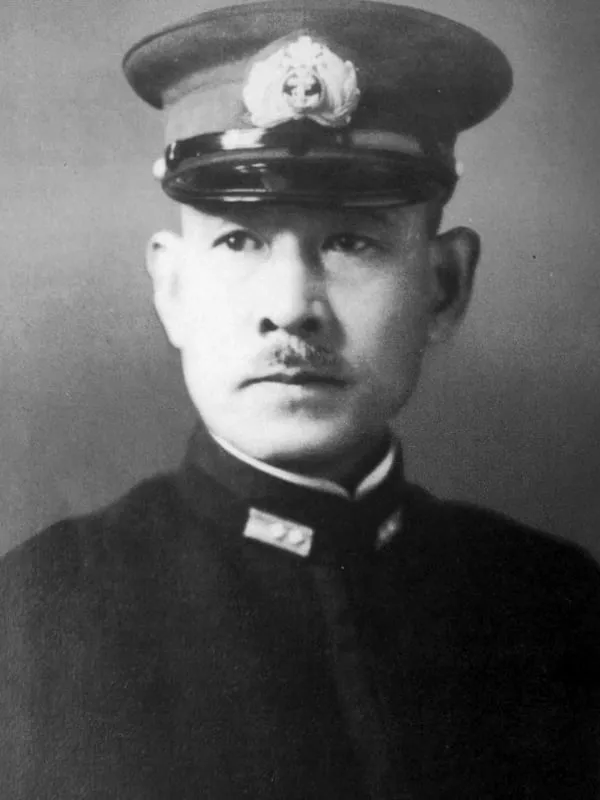
- Born:
- 9 December 1889, Sendai (Japan)
- Died:
- 15 December 1975, Yokosuka (Japan)
- Author:
- Łukasz
- Photo:
- autor nieznany, domena publiczna, Wikimedia Commons

Shigeyoshi Inoue belonged to the small group of Japanese admirals who said openly before the war that Japan could not beat America. Together with the minister Mitsumasa Yonai and the vice-minister Isoroku Yamamoto he blocked a military alliance with Germany in 1938–1939, and as head of naval aviation he argued that the age of the battleship was over. When war came he commanded the Fourth Fleet, which took Guam, Wake and Rabaul, and in May 1942 he directed the operation that ended in the Battle of the Coral Sea and the first retreat of a Japanese landing force in this war. Judged too cautious a commander, he returned to Japan as superintendent of the naval academy, and in the last year of the war, as Navy Vice-Minister, he secretly prepared the way to ending it.
Top of his class from Sendai
He was born on 9 December 1889 in Sendai (PL) in northern Japan (some Japanese dictionaries give 19 December, and Kent Budge’s American encyclopedia gives Tokyo as his birthplace). He was one of the youngest sons of Yoshinori Inoue, a former official of the shogunate who ran a vineyard after the Meiji Restoration. In 1906 he entered the Naval Academy at Etajima and graduated in 1909 second of the 179 cadets in his class. He served on cruisers and battleships, during the First World War on the battleship Fusō, but saw no action.
He spent the years 1918–1921 in Europe: he was attaché in Switzerland, where he learned German, took part in the work of the Japanese delegation to the Paris Peace Conference and then lived in France. In 1924 he graduated from the Naval Staff College, and in 1927–1929 he was naval attaché in Rome. His knowledge of Europe and its languages set him apart from many colleagues who knew the world mainly from a ship’s deck. Among officers he had a reputation as a cool, logical man who was uncompromising in argument.
Against the alliance with Hitler
In the early 1930s he worked in the Navy Ministry and the Navy General Staff; in 1933–1935 he commanded the battleship Hiei, and in November 1935 he became a rear admiral and chief of staff of the naval district at Yokosuka. He belonged to the so-called Treaty Faction, officers who considered the limits on naval armaments good for Japan, since it could not race American industry anyway. Nor did he hide his dislike of the cult of Admiral Heihachirō Tōgō, whose authority was used by those who wanted the treaties renounced.
On 20 October 1937 Inoue took over the ministry’s Naval Affairs Bureau, the navy’s most important political office. The minister at the time was Admiral Mitsumasa Yonai and the vice-minister was Yamamoto; the press called the three of them the fleet’s “left wing”. As early as December Inoue had to deal with the sinking of the American gunboat Panay on the Yangtze. He insisted on admitting fault quickly and paying compensation, which made it possible to avoid a crisis in relations with Washington.
The most important dispute of his tenure was over the talks on turning the Anti-Comintern Pact into a military alliance with Germany and Italy. The army wanted it; the navy was against. What Inoue objected to most was an automatic obligation to go to war alongside an ally, which could drag Japan into a conflict with Britain and the United States, against whom Japan stood no chance at sea. He also distrusted Hitler and pointed out that in Mein Kampf the Japanese figured as an inferior race. In the summer of 1939, when there was talk in Tokyo of a possible coup by the army, he had an armed naval guard brought into the ministry. The German–Soviet pact of August 1939 broke off the negotiations, and in September 1940, when Inoue and Yonai no longer had any influence on decisions, Japan signed the Tripartite Pact.
Chongqing and the battleship dispute
In October 1939 Inoue became chief of staff of the China Area Fleet, and in November a vice admiral. In this role he prepared Operation 101, the bombing of Chongqing, the temporary capital of Chiang Kai-shek’s government. From May to September 1940 navy and army aircraft dropped bombs on the city almost daily, killing thousands of civilians, but they did not break Chinese resistance. This chapter of Inoue’s life rarely appears in his Japanese portraits, which are dominated by the image of an opponent of the war.
On 1 October 1940 he took over the Naval Aviation Bureau. In January 1941 he presented to the navy minister Koshirō Oikawa a memorandum called the “new armaments plan”. In it he argued that the great battleship clash the fleet had been preparing for since Tōgō’s day would never take place, because the Americans would not accept it; the war would be long and would be a struggle for islands and sea lanes. He considered battleships unnecessary; the basis for defending the western Pacific was to be airfields on the islands, “unsinkable aircraft carriers”, together with aircraft, submarines and the protection of shipping. It was one of the most perceptive documents produced in the Japanese navy before the war, but it did not change the shipbuilding programme. The conservatives took it as an insult, and Inoue’s open statements that the fleet was no match for the American one damaged his career.
The Fourth Fleet: Wake and Rabaul
On 11 August 1941 Inoue took command of the Fourth Fleet, based at Truk atoll, with the training cruiser Kashima as his flagship. It was the weakest of the Japanese fleets, responsible for the South Seas Mandate, and some historians regard the transfer as the sidelining of an awkward admiral. Even so, under the war plan the Fourth Fleet was to seize the American islands in the central Pacific in the first days.
On 10 December 1941 its forces took Guam. Wake proved harder: on 11 December the island’s defenders beat off the landing, sinking two destroyers. Inoue decided that a second attempt could not be made while American fighters were still flying from the island, and asked for the support of the carriers returning from Pearl Harbor. With their cover the second landing on 23 December captured the island – the whole operation is described on the page on the Battle of Wake Island. On 23 January 1942 the Fourth Fleet and the South Seas Detachment took Rabaul on New Britain, which became the main Japanese base in the South Pacific. In late January and early February American carriers attacked the bases in the Marshall and Gilbert Islands, which were also under Inoue.
The Coral Sea
In March 1942 the Fourth Fleet landed troops at Lae and Salamaua in New Guinea, but on 10 March aircraft from two American carriers sank several of its transports there. Inoue concluded that a landing at Port Moresby would not succeed without carrier cover, and received from Yamamoto the two large carriers of Vice Admiral Takeo Takagi and the light carrier Shōhō. Operation MO, which he directed from Rabaul, was to take Port Moresby and Tulagi and bring northern Australia within range of Japanese aircraft. He did not know that American codebreakers knew its plan.
Tulagi was taken on 3 May without a fight. On 7 May American aircraft sank the Shōhō, which was covering the convoy of troops heading for Port Moresby, and Inoue turned the transports back north. On 8 May, in the clash of the carriers, the Americans lost the Lexington, but the Shōkaku was badly damaged and only remnants were left of the air groups of both Japanese carriers. That evening Inoue postponed the landing at Port Moresby. Yamamoto, dissatisfied with his caution, ordered him to pursue the enemy and complete the operation, but Inoue did not set the convoy moving again, and the pursuit found nothing. In mid-May he also called off Operation RY against Nauru and Ocean Island.
Tactically the battle was a Japanese victory, strategically the first defeat: Port Moresby was not taken from the sea, and the damaged Shōkaku and the depleted Zuikaku took no part in the Battle of Midway, where the Japanese were to miss them badly. On the Combined Fleet staff Inoue was held to blame. Yamamoto is said to have remarked that Inoue “does not know how to wage war”, and the Chief of the Navy General Staff, Prince Hiroyasu Fushimi, judged him unfit to conduct a war. Historians judge him more gently: after the loss of the Shōhō, and with Takagi’s carriers damaged, sending defenceless transports through the Jomard Passage could have ended in their destruction.
In June 1942 Inoue inspected the ground on Guadalcanal, where an airfield was begun on his initiative. On 14 July responsibility for the area passed to the newly formed Eighth Fleet of Vice Admiral Gun’ichi Mikawa, which did not expect an American blow. On 7 August the Americans landed on the island and the Guadalcanal campaign began. Some American authors accuse Inoue of ignoring intelligence warnings of an Allied landing.
Etajima and a plan to end the war
On 26 October 1942 Inoue became superintendent of the Naval Academy at Etajima. Against the fashion for rejecting everything Western, he kept English as a compulsory subject, even though the army had struck the language from the entrance examinations for its own schools. He stressed general education, restricted the lectures of nationalist ideologues and opposed further shortening of the cadets’ training, for which he was accused of a lack of patriotism. He believed that the academy should be training officers for the years after the war, not merely pilots and commanders for the coming months.
After the fall of Hideki Tōjō’s cabinet Yonai returned as navy minister and on 5 August 1944 brought Inoue in as vice-minister. From the end of August Inoue had Rear Admiral Sōkichi Takagi secretly study how to end the war; Takagi kept up contacts with the circle around Prince Fumimaro Konoe and with the court. Inoue believed that mediation should be sought through neutral states, and in April 1945 he supported the formation of the government of Admiral Kantarō Suzuki, in which Yonai remained minister. On 15 May 1945, against his own wishes, he was promoted to full admiral – he was one of the last two naval officers to receive that rank – and left the ministry for the Supreme War Council. His opposition to the promotion led to a falling-out with Yonai.
After the war
On 15 October 1945 Inoue retired. He was not put on trial, but as a former admiral he was covered by the purge and could not hold public office until 1952. He settled at Nagai near Yokosuka and for years taught English to local children, living very modestly and for a time in poverty; for a long time he refused to accept help from his former subordinates. He died on 15 December 1975 at Yokosuka, aged 86.
In Japan Inoue is remembered above all as the third, alongside Yonai and Yamamoto, of the admirals who opposed the alliance with Hitler, and as a prophet of air war in the Pacific: his 1941 memorandum foresaw that the war with America would be a war for islands and airfields, not a battleship battle. As a commander at sea he left a less flattering picture. His wartime record consists of the swift gains of the first weeks, the bombing of Chongqing and the battle in which the Japanese advance to the south was halted for the first time.
Sources
Commanded in battles
(01)Mentioned in battles
(01)Often appears with
People who appear in the same events.