- Category:
- Diplomacy
- Date:
- 13 April 1941
- Author:
- Łukasz
- Tags:
- Japan, Soviet Union, Yōsuke Matsuoka, Joseph Stalin
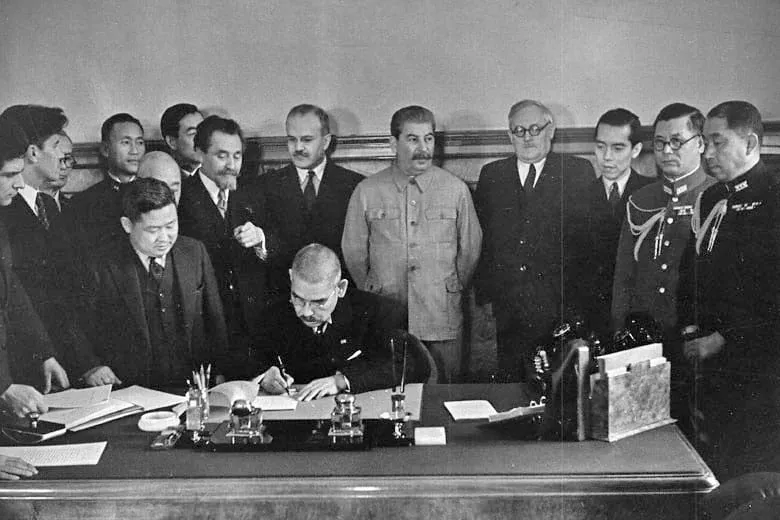
On the Sunday afternoon of 13 April 1941, in the office of the People’s Commissar for Foreign Affairs in the Kremlin, Vyacheslav Molotov, the Japanese foreign minister Yōsuke Matsuoka and Japan’s ambassador in Moscow, General Yoshitsugu Tatekawa, signed a neutrality pact between the Soviet Union and Japan. Both sides undertook to maintain peaceful and friendly relations, to respect each other’s territorial integrity and to remain neutral should either of them be attacked by a third power. The pact was concluded for five years. A declaration attached to it sealed the division of influence in the borderlands over which the two states had been fighting only eighteen months earlier: Moscow recognised the inviolability of Manchukuo, and Tokyo that of the Mongolian People’s Republic. The signing was watched by Joseph Stalin, who a few hours later did something he had never done before: he went to the railway station to see off a foreign minister in person.
The pact was Matsuoka’s greatest success and one of the most consequential agreements of the war. The Soviet Union, alarmed by the build-up of German troops on its western border, secured quiet in the Far East. Japan, mired in the war in China and in its dispute with the United States, made the Manchurian border safe and could think of expansion to the south. Neither side knew exactly what Hitler was planning, though both had reason to suspect it.
A long hostility
Japanese–Soviet relations had been mistrustful from the outset. After the Basic Convention of 1925 Japan withdrew its troops from northern Sakhalin, keeping its oil and coal concessions there. But after the Mukden Incident and the creation of Manchukuo in 1932 the two armies faced each other across a border several thousand kilometres long. Moscow then proposed a non-aggression pact, but Tokyo refused, and in 1936 concluded the Anti-Comintern Pact with Germany. In 1938 came the fighting at Lake Khasan, and in the summer of 1939 a full-scale border war on the Khalkhin Gol river on the frontier between Manchukuo and Mongolia. There the Kwantung Army suffered a heavy defeat, and a ceasefire agreed in Moscow came into force on 16 September 1939.
At the same time Japan was taken aback by the Molotov–Ribbentrop Pact. The government in Tokyo announced that it would not become involved in the war in Europe and began to seek an understanding with Moscow. The negotiations were conducted by Ambassador Shigenori Tōgō. According to an account by his family, later passed on to the American embassy in Tokyo, by the autumn of 1940 a non-aggression pact, a fisheries convention and a trade agreement were almost ready for signature. Matsuoka, foreign minister in the second Konoe cabinet, recalled Tōgō, however, and sent his friend General Tatekawa to Moscow instead. The talks stalled. According to the same account, the Soviet Union, convinced that its position was growing stronger, began to lay down territorial conditions, including the return of southern Sakhalin and part of the Kuril Islands, which Tokyo could not accept.
Matsuoka, moreover, had a more ambitious plan than his predecessors. The Tripartite Pact, concluded with Germany and Italy in September 1940, was for him the first step. The second was to be an agreement with the USSR, and a “Eurasian bloc” of four powers was to force the United States into concessions. Germany seemed to support the plan: in November 1940 Molotov came to Berlin to discuss the USSR joining the bloc, and Moscow replied with a list of conditions, among them that Japan give up its concessions in northern Sakhalin. Berlin did not reply, and on 18 December Hitler signed Directive No. 21, Barbarossa, ordering preparations for an attack on the USSR.
The journey to Europe
On 12 March 1941 Matsuoka set out from Tokyo on a journey to Europe. Officially it was to be a courtesy visit to Japan’s partners in the Tripartite Pact, which Japan had not yet paid. In Tokyo it was criticised as a venture serving the minister’s ambitions more than the state’s, but well-informed Japanese knew that Matsuoka wanted to come back with some kind of agreement with the USSR. He travelled on the Trans-Siberian Railway, and on 24 March, while passing through Moscow, he was received by Molotov and, at his own request, by Stalin as well. According to the account he gave the Germans, he set out the “fundamental problems” between the two countries, called the Japanese “moral communists” and the Anglo-Saxons the common enemy of Japan, Germany and the USSR, and asked for an answer on his way back. That same evening he left for Berlin.
In Berlin he was received with great pomp. On 27 March he had talks with the foreign minister, Joachim von Ribbentrop, and with Adolf Hitler; that same day in Belgrade officers overthrew the government that had joined the Tripartite Pact two days earlier. The Germans urged the Japanese minister to attack British Singapore as soon as possible, and spoke of the Soviet Union in terms that in hindsight sound like a warning. According to the German minutes, Ribbentrop declared on 28 March that closer cooperation with Russia was “absolutely impossible”, and that if Stalin’s policy did not accord with what the Führer considered right, Hitler would “crush Russia”. He also advised Matsuoka not to enter into any political discussions in Moscow. The next day he added that the greater part of the German army stood on the Reich’s eastern frontier, ready to attack at any moment, and that a conflict with Russia, though unlikely, was possible, so Matsuoka should not assure the Emperor that it was unthinkable. Matsuoka replied that in Moscow he would probably not be able to avoid discussing a non-aggression or neutrality pact. Nobody told him outright about the Barbarossa plan, and he himself did not convey these hints to Tokyo with due seriousness, continuing for a long time to insist that there would be no German–Soviet war.
In Rome Matsuoka had talks with Benito Mussolini, and on 2 April he was received by Pope Pius XII. On 4 April, back in Berlin, Hitler promised him help should Japan go to war with the United States.
A week in Moscow
When Matsuoka arrived in Moscow again on 7 April, the situation in Europe had changed fundamentally. During the night of 5–6 April the Soviet Union had signed a treaty of friendship and non-aggression with the new Yugoslav government, and a few hours later Germany attacked Yugoslavia and Greece. To the German ambassador, Friedrich-Werner von der Schulenburg, Molotov expressed nothing more than regret at the widening of the war, but in Moscow it was becoming ever clearer that the USSR might be next.
The talks with Molotov were not easy. The Japanese wanted a non-aggression pact and offered to buy northern Sakhalin. The Russians demanded that, in return for an agreement, Japan liquidate its concessions on the island. After a three-hour conversation on 9 April Matsuoka dropped his original demand and agreed to a more modest neutrality pact, but he would not commit himself on the concessions. On 10 April Matsuoka went to Leningrad for a day. On 11 April he told the American ambassador, Laurence Steinhardt, that the Russians were no longer demanding southern Sakhalin, only the surrender of the concessions in return for compensation, and that he feared the reaction at home. He added that he would leave on 13 April whatever the outcome.
On the evening of 12 April, during an interval at the Moscow Art Theatre, Steinhardt arranged an “accidental” meeting between Matsuoka and the British ambassador, Stafford Cripps. Cripps handed him a letter from Winston Churchill which, through a series of questions, invited the Japanese to consider whether Germany would really win the war. Matsuoka slipped it into his pocket unread. That same evening Matsuoka had a conversation with Stalin. According to the account he gave Schulenburg the next day, towards the end of the conversation Stalin dropped his demand for the liquidation of the concessions as a condition of the pact, saying, with an appropriate gesture, that Matsuoka was “strangling” him. In return the Japanese minister promised to do everything in Tokyo to bring the government and public opinion round to giving up the concessions.
Four articles and a declaration
Before noon on 13 April Matsuoka paid Schulenburg a farewell call and told him that agreement had been reached “at the last moment” and would be signed in the afternoon. He insisted that the pact in no way infringed the Tripartite Pact and that Ribbentrop had known such talks might take place in Moscow.
The ceremony took place in Molotov’s office. The signatures were those of Molotov, as Chairman of the Council of People’s Commissars and People’s Commissar for Foreign Affairs, and, on the Japanese side, of Matsuoka and Tatekawa. Stalin, in a grey tunic without decorations, strolled about the room with a cigarette. The pact was short. In Article 1 the parties undertook to maintain peaceful and friendly relations and mutually to respect each other’s territorial integrity and the inviolability of their borders. Article 2 provided that should one of the parties become “the object of hostilities” on the part of one or more third powers, the other would remain neutral throughout the conflict. Article 3 laid down that the pact would enter into force on the day of ratification and remain valid for five years, and that if neither party denounced it a year before that term expired, it would be automatically extended for a further five years. Article 4 provided for prompt ratification and an exchange of instruments in Tokyo.
The American ambassador in Tokyo, Joseph Grew, observed that the pact was more modest than the German–Soviet agreement of August 1939, since it did not forbid aid to the other party’s enemies, but that Article 2 repeated its wording. Grew surmised that the Japanese, like the Germans then, wished in this way to secure their partner’s neutrality even if they themselves started a war.
On the same day Molotov, Matsuoka and Tatekawa signed a declaration in which, “in the spirit of the pact”, the USSR undertook to respect the territorial integrity and inviolability of Manchukuo, and Japan those of the Mongolian People’s Republic. The two puppet states, one Japanese and the other Soviet, thus obtained recognition of their borders from the other power, although China regarded both territories as its own. An exchange of letters was attached to the pact. In it Matsuoka undertook in writing to try to liquidate the Japanese concessions in northern Sakhalin within a few months, and also promised a trade agreement and a fisheries convention. After the signing a reception was held in the Kremlin, at which there was no shortage of vodka and caviar.
Stalin at the station
Matsuoka’s train was due to leave in the evening from the Yaroslavsky station. The departure was delayed by an hour. To the surprise of the Japanese, and of the Russians too, Stalin and Molotov appeared on the platform. Stalin, who never saw off foreign visitors, embraced Matsuoka and, according to witnesses, told him that they were both Asiatics and that together they would solve all the problems of Asia. Matsuoka is said to have replied: all the problems of the world.
More important than the embraces with the Japanese, however, was what Stalin did next. As Schulenburg reported that same evening, Stalin asked loudly for the German ambassador and, when he found him, put an arm round his shoulders and said: “We must remain friends and you must now do everything to that end!” A moment later he went up to the acting German military attaché, Colonel Hans Krebs, made sure he was dealing with a German, and declared: “We will remain friends with you – in any event!” Schulenburg had no doubt that Stalin had done this deliberately and in full view of the many diplomats present. Western correspondents related that almost everyone except Stalin was distinctly the worse for drink, and attributed to Stalin the remark that now Japan would put the East in order, and the USSR and Germany Europe, and that later they would deal with the Americans together – which, according to Steinhardt, was confirmed by German embassy staff who had been at the station. Molotov recalled years later that the Japanese minister had been carried into his carriage, and that the farewell “was worth it”, since Japan did not go to war with the USSR.
Moscow’s calculation and Tokyo’s
Why did Stalin, who only a few months earlier had been demanding territory from Japan, settle in the end for a pact without any concessions? Steinhardt believed that in the three weeks between Matsuoka’s two visits the Soviet government had become convinced that Germany might attack it, and had given up a strong bargaining position in exchange for the certainty that in a war with Germany Japan would not strike from the east. Cripps took a similar view, adding that at the same time Moscow had ostensibly met the German wish for a rapprochement with Japan, and that the gesture at the station showed how anxious Stalin was about his eastern border. The embraces with Schulenburg and Krebs, for their part, were a signal to Berlin that the USSR still wanted to come to terms with Germany.
For Matsuoka the pact was above all a personal triumph and a move in the great game with America. He told Schulenburg that it would make a strong impression on Chiang Kai-shek and make negotiations with him easier, while also strengthening Japan’s position towards the United States and Britain. Since 1937 the Soviet Union had been the main supplier of arms to embattled China, and Japan hoped that Moscow would cut back that aid. But something else mattered more. Since the summer of 1940 Japan had been preparing to expand southwards, towards the European colonies in South-East Asia rich in oil, rubber and tin, and its troops had already entered northern Indochina. The drive south was possible only if the Kwantung Army had no need to fear a blow from the north. The pact gave that certainty, at least on paper.
Reactions
In Washington the Secretary of State, Cordell Hull, declared on 14 April that the significance of the pact “could be overestimated”, since it described a situation that had in effect existed for some time, and that United States policy remained unchanged. In reality Washington feared that Japan, now secure in the north, would strike south.
China felt the pact most painfully. On 14 April the foreign minister of the government in Chongqing, Wang Chonghui, announced that the four north-eastern provinces and Outer Mongolia were and would remain part of the Republic of China, and that the Soviet–Japanese declaration had no binding force whatever for China. Steinhardt noted that as early as 13 April the Soviet press had abandoned its pro-Chinese tone in reporting the war in China. Moscow assured Chiang Kai-shek that it did not intend to halt its aid, but the aid soon dwindled, and after the German attack on the USSR it practically ceased.
In Japan the pact was greeted with enthusiasm. The Prime Minister, Fumimaro Konoe, praised Matsuoka as an able man, and on 23 April the newspaper Asahi wrote that the minister had breathed new life into the Tripartite Pact and secured peace for Japan. Matsuoka returned to Tokyo on 22 April as a hero. The pact was ratified without delay and came into force on 25 April 1941.
Its place in the war
Less than ten weeks after the pact was signed, on 22 June 1941, Germany invaded the Soviet Union without warning Japan. Matsuoka, who in April had been embracing Stalin on the platform, now demanded an immediate attack on Siberia alongside Germany. The army and navy were unwilling to commit themselves to a date. On 2 July 1941 an Imperial Conference resolved to continue the advance south, to occupy southern Indochina and to attack the USSR only if the German–Soviet war developed favourably for Japan. Under the cover name of “Kwantung Army Special Manoeuvres” Japan reinforced its troops in Manchuria – to some 700,000 men, according to most studies – but the Red Army did not collapse as quickly as expected. In August the General Staff abandoned an attack in the north for 1941. Matsuoka lost his post as early as July, when Konoe resigned with his cabinet in order to form a new one without him.
The pact survived because it paid both sides. The Soviet Union, reassured also by reports from its agent in Tokyo, Richard Sorge, was able to transfer some divisions from the Far East to the west, which contributed to the defence of Moscow in the autumn and winter of 1941. Japan could turn all its forces against the United States, Britain and the Netherlands, and in December 1941 it attacked Pearl Harbor and the colonies of South-East Asia. For years the two states fought each other’s allies, but not each other. Ships under the Soviet flag carried American Lend-Lease aid through Japanese waters to Vladivostok. The Sakhalin concessions that Matsuoka had promised to liquidate within a few months were handed over by Japan to the USSR only in March 1944.
Once the tide of war had turned in the Allies’ favour, the pact became an obstacle for Moscow. At the Yalta Conference in February 1945 Stalin undertook in a secret agreement to enter the war against Japan within two to three months of Germany’s surrender, in return for southern Sakhalin and the Kuril Islands. On 5 April 1945 Molotov told the Japanese ambassador that the pact had “lost its meaning”, since Japan, Germany’s ally, was waging war on the USSR’s allies, and that the Soviet Union was denouncing it. Under Article 3, however, the pact formally remained in force until April 1946, as Molotov confirmed. In the summer of 1945 Japan was still seeking Soviet mediation in peace negotiations and was ready to send Prince Konoe to Moscow, but Moscow stalled. On 8 August 1945 Molotov handed the Japanese ambassador a declaration of war, and a few hours later the Red Army struck at Manchuria. In the Soviet–Japanese War the Soviet Union seized Manchuria, northern Korea, southern Sakhalin and the Kurils. Japan still regards the attack as a violation of a pact that was then still in force, and the dispute over the southern Kurils has meant that Moscow and Tokyo have never signed a peace treaty.
The pact of 13 April 1941 changed the course of the war more through what it prevented than through what it established. It freed the Soviet Union from the spectre of a two-front war in the worst year for it, and allowed Japan to turn south, towards war with America. Its author, Matsuoka, died in 1946 during the Tokyo trial, before a verdict was reached.
Sources
Meanwhile
(04)Elsewhere, within a week.
- 10 April 1941 · MediterraneanThe siege of Tobruk beginsOn 10–11 April 1941 Rommel’s forces encircled Tobruk. Morshead’s Australians repelled assaults on 14, 16–17 and 30 April, and a long siege began.
- 10 April 1941 · AtlanticThe United States takes Greenland under its protectionOn 10 April 1941 the US announced an agreement with Denmark's envoy Kauffmann, signed without Copenhagen's consent. Greenland joined US Atlantic defences.
- 16 April 1941 · Western FrontThe Belfast BlitzOn the night of 15–16 April 1941 Luftwaffe bombers devastated north Belfast. Several hundred died, the highest toll of any single raid outside London.
- 16 April 1941 · MediterraneanThe Battle of the Tarigo convoyOn the night of 15–16 April 1941 four British destroyers from Malta wiped out a convoy bound for Tripoli and its three Italian escorts off Kerkennah.
Related events
(04)The same battle, people or subject.
- 22 June 1941 · Eastern FrontGermany invades the Soviet UnionAt dawn on 22 June 1941 Germany and its allies attacked the USSR. Operation Barbarossa broke the pact of 1939 and opened the Eastern Front.
- 27 September 1940 · DiplomacyThe Tripartite PactOn 27 September 1940 in Berlin, Germany, Italy and Japan concluded a ten-year alliance aimed at the United States. It was meant to deter America from war.
- 27 March 1941 · PoliticsThe Yugoslav coup d’étatOn 27 March 1941 air force officers in Belgrade ousted Prince Paul’s regency and the government that signed the pact. Hitler resolved to destroy Yugoslavia.
- 12 May 1941 · DiplomacyThe USSR recognises Rashid Ali’s governmentOn 12 May 1941 the Soviet Union recognised Rashid Ali al-Gaylani’s government, then ten days into its war with Britain – a gesture by Stalin towards Berlin.