Equipment
The aircraft carrier USS Enterprise (CV-6)
The American carrier that fought in the Pacific from Pearl Harbor to Okinawa: at Midway, off Guadalcanal, at Leyte; the most decorated ship of the US Navy.
- Role:
- aircraft carrier
- State:
- United States
- Maker:
- Newport News Shipbuilding
- Launched:
- 3 October 1936
- Author:
- Natalia
- Updated:
- 1 November 2026
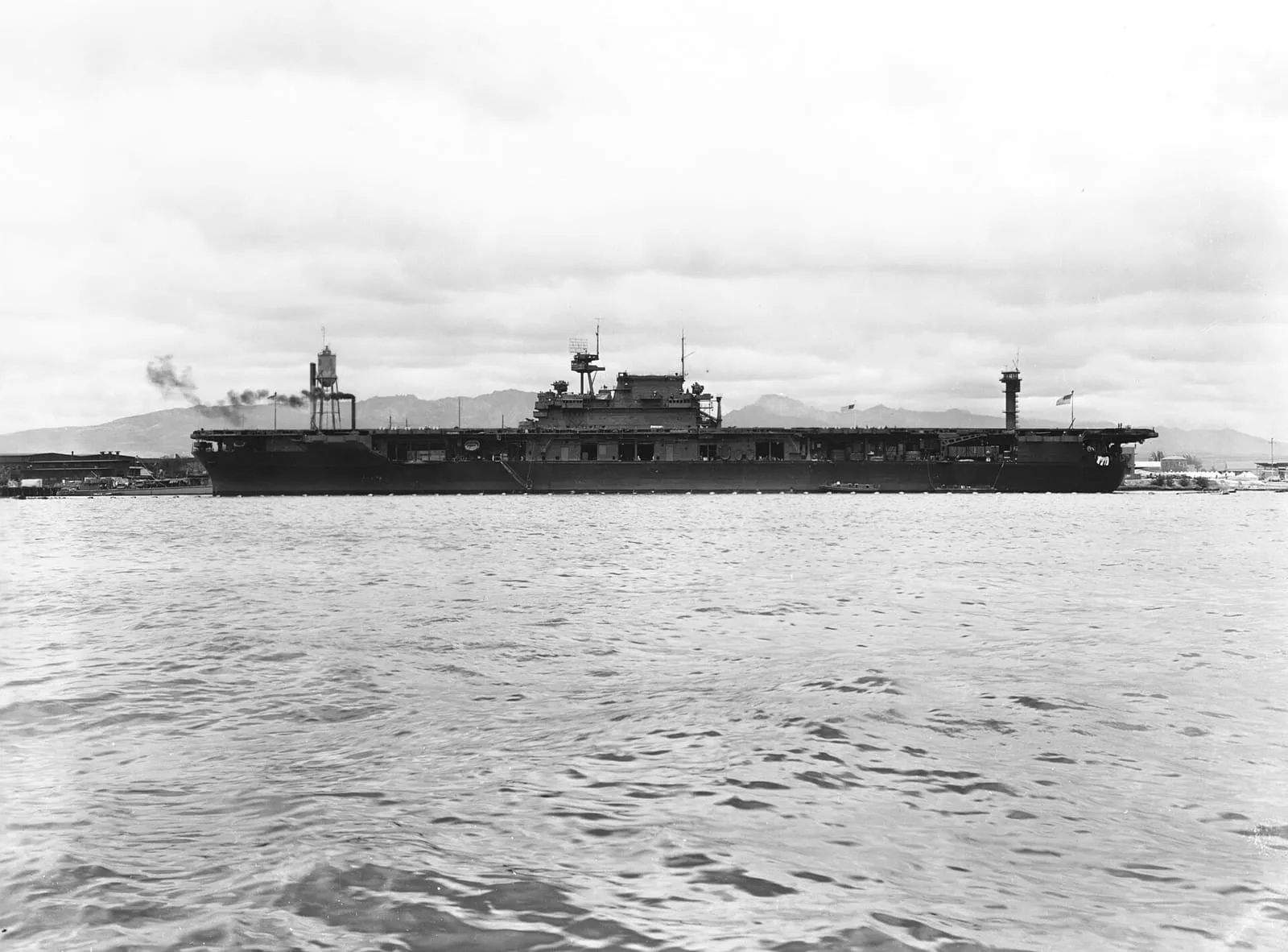
USS Enterprise fought in the Pacific from the first day of the war with Japan until the spring of 1945, and was one of the two pre-war carriers of the Pacific Fleet that survived the bloody year of 1942. Her aircraft sank or helped to sink four Japanese carriers at Midway and Leyte, a battleship off Guadalcanal and dozens of smaller vessels, and the ship herself came back to the fight several times after serious damage. Japanese propaganda announced her sinking three times, which earned her the nickname Grey Ghost; her sailors simply called her the “Big E”. With twenty battle stars she ended the war as the most decorated American ship.
A New Deal ship
The carriers Yorktown and Enterprise were paid for out of the public works money that the Roosevelt administration, under the New Deal, also put into the fleet. Her keel was laid in July 1934 at the Newport News yard in Virginia, she was launched on 3 October 1936, sponsored by the wife of the Navy Secretary Claude Swanson, and she was commissioned on 12 May 1938. She was the second of the three ships of the Yorktown class: she displaced about twenty thousand tons, made more than 32 knots and carried about ninety aircraft.
At the beginning of December 1941 Enterprise, flying the flag of Vice Admiral William Halsey, delivered twelve Wildcat fighters for the Marines to Wake. A storm delayed her return by a day, and on the morning of 7 December she was still about two hundred miles west of Oʻahu. Her dive bombers, sent ahead to Ford Island, flew straight into the middle of the Japanese attack on Pearl Harbor, and several of them were lost, shot down by the Japanese or by American anti-aircraft fire. The carrier herself survived, and with her the core around which the American fleet could rebuild its strength.
From the raids to Midway
In the first months of 1942, with the battleships on the bottom or in dock, the war at sea was fought by the carriers. On 1 February Halsey’s force with Enterprise struck the Japanese bases in the Marshall Islands, in February and March Wake and Marcus, and in April she covered Hornet, from which the bombers of the Doolittle Raid on Tokyo took off. The raids did little damage, but they taught the crews the work that would later decide battles.
At Midway Task Force 16 was commanded by Rear Admiral Raymond Spruance, because Halsey was in hospital. On the morning of 4 June 1942 the Enterprise torpedo squadron lost ten of its fourteen aircraft without scoring a single hit, but moments later two squadrons of dive bombers from the same ship, led by Lieutenant Commander Clarence McClusky, fell on Kaga and Akagi. Both Japanese carriers, turned into burning wrecks, went down or were scuttled. In the afternoon bombers from the deck of Enterprise, among them surviving aircraft from Yorktown, crippled Hiryū, and on 6 June they took part in sinking the cruiser Mikuma. Within five minutes the balance of power in the Pacific had changed.
Alone in the South Pacific
In the summer of 1942 Enterprise covered the landing on Guadalcanal. On 24 August, in the Battle of the Eastern Solomons, she was hit by three bombs that killed 74 men; thanks to skilful fire and flooding control she reached Pearl Harbor under her own power. After repairs she came back in mid-October, just in time for the Battle of the Santa Cruz Islands, in which Rear Admiral Thomas Kinkaid sailed in her. On 26 October two bombs killed 44 of her crew there, and Hornet was sunk. After that battle the Americans had no other working large carrier in the South Pacific: Saratoga was under repair and Wasp had been sunk in September.
That is why in November Halsey sent the damaged ship to sea with repair crews still on board. In the Naval Battle of Guadalcanal her airmen were one of several groups that attacked the damaged battleship Hiei, which the Japanese finally scuttled themselves, and on 14 November, together with the airmen from Henderson Field, they sank seven transports carrying reinforcements to the island. In May 1943 Admiral Chester Nimitz presented the ship with the Presidential Unit Citation for the first eleven months of the war; she was the first carrier to receive it.
The night ship
In the summer of 1943 Enterprise underwent a refit at the Puget Sound yard that gave her stronger anti-aircraft armament and extra underwater protection. She returned to a fleet in which dozens of new Essex-class carriers were now appearing, and from then on she was one of many, but not an ordinary one. In November, during the fighting for the Gilbert Islands, her pilots tried for the first time to intercept Japanese torpedo bombers at night with the help of radar; the famous ace Edward O’Hare was killed in one such action. In February 1944, during Operation Hailstone, twelve of her radar-equipped Avengers attacked ships in the Truk lagoon in the dark. It was the first night attack by American carrier aircraft on ships using radar.
In June Enterprise was the only veteran among the large carriers of Vice Admiral Marc Mitscher’s force in the Battle of the Philippine Sea; it was her Avenger that confirmed the position of the Japanese fleet. In October, in the Battle of Leyte Gulf, her aircraft attacked the battleship Musashi and took part in sinking the light carrier Zuihō. At the end of 1944 the ship received an air group trained to fight in the dark and, as a night carrier, covered the fast carrier force. During the Battle of Iwo Jima she kept her aircraft over the island without a break for 174 hours.
The end of the war and the scrapyard
In 1945 came attacks the ship could no longer avoid. In March, during the strike on Kure, she was hit by a bomb and then by shells from American anti-aircraft guns. On 11 April, in the Battle of Okinawa, kamikaze aircraft exploded right beside her hull. On 14 May, three days after the hit on the carrier Bunker Hill, from which Mitscher had moved his flag to her, a Japanese suicide pilot crashed into the deck by the forward lift. Fourteen men were killed and 68 wounded, and Enterprise went away for repairs and never returned to the fight.
After Japan’s surrender she carried more than ten thousand soldiers home from Europe in Operation Magic Carpet. She was decommissioned on 17 February 1947. There were attempts to keep her as a museum ship, but the money could not be raised; in 1958 she was sold for scrap and by 1960 she had been cut up at Kearny, New Jersey. According to American tallies her aircraft and guns shot down 911 aircraft and sank 71 ships during the war; such figures are hard to check, but no other US Navy ship fought in so many battles of this war.
Sources
Battles
(06)- 7 December 1941Attack on Pearl HarborOn 7 December 1941 aircraft from Nagumo's six carriers struck the Pacific Fleet at Pearl Harbor. 2,403 Americans were killed and four battleships sank.
- 8–23 December 1941Battle of Wake IslandOn 8–23 December 1941 the Wake Atoll garrison repulsed a first Japanese landing and sank two destroyers, but, with no relief, fell to a second landing.
- 3–7 June 1942Battle of MidwayOn 3–7 June 1942 off Midway Atoll American aircraft sank Nagumo's four carriers. Japan abandoned the operation; the United States lost Yorktown.
- 7 August 1942 – 9 February 1943Guadalcanal campaignFrom 7 August 1942 to 9 February 1943 the Americans held the airfield seized on Guadalcanal until, after six months of fighting, Japan evacuated the island.
- 12–15 November 1942Naval Battle of GuadalcanalFrom 12 to 15 November 1942, in two night actions and a series of air strikes, the Americans sank two Japanese battleships and most of a Guadalcanal convoy.
- 1 April – 22 June 1945The Battle of Okinawa1 April – 22 June 1945. The US took Okinawa in the bloodiest battle of the Pacific War – kamikaze, the Shuri Line and the tragedy of the island’s civilians.
In the chronicle
(17)1942
- 11 January 1942The torpedoing of USS Saratoga
- 24 January 1942Americans in Samoa
- 1 February 1942The Marshalls–Gilberts raids
- 18 April 1942The Doolittle Raid
- 3 June 1942The Battle of Midway begins
- 4 June 1942The sinking of Nagumo's carriers
- 7 August 1942The landing on Guadalcanal
- 24 August 1942The Battle of the Eastern Solomons
- 26 October 1942The Battle of the Santa Cruz Islands
- 13 November 1942The night battle off Guadalcanal
- 14 November 1942The battleship duel off Guadalcanal