United States
Thomas Kinkaid
Carrier task force commander (1942), commander of the North Pacific Force (1943), of the Seventh Fleet and Allied Naval Forces, Southwest Pacific Area (1943–1945)
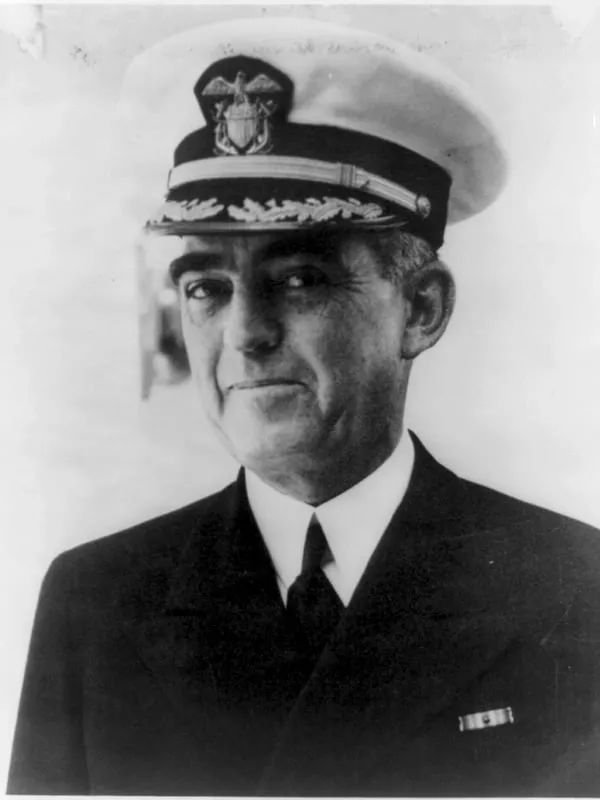
- Born:
- 3 April 1888, Hanover, New Hampshire (United States)
- Died:
- 17 November 1972, Bethesda, Maryland (United States)
- Author:
- Łukasz
- Photo:
- Library of Congress, domena publiczna, Wikimedia Commons

Thomas Kinkaid was one of the few American admirals who in this war commanded almost everything: a cruiser screen, a carrier task force, the forces in the cold waters of the Aleutians and finally the fleet that carried and covered General Douglas MacArthur’s army on its way from New Guinea to the Philippines. He was not an aviator, which the airmen held against him after the loss of Hornet, but he could work with the army and with the difficult MacArthur better than most of his colleagues. His name is linked above all with the Battle of Leyte Gulf, in which his ships fought the last battleship action in history and his escort carriers came close to destruction, because he did not know that no one was guarding the San Bernardino Strait any longer.
From a naval family
Thomas Cassin Kinkaid was born on 3 April 1888 in Hanover, New Hampshire, the only son of a naval officer, later Rear Admiral Thomas Wright Kinkaid. He graduated from the Naval Academy at Annapolis in June 1908, in the same class as Richmond Kelly Turner, in the lower half of the list. As a young officer he served in the battleships Nebraska and Minnesota. From 1913 he specialised in naval ordnance. During the First World War he was briefly attached to the British Admiralty, and in 1918 he became gunnery officer of the battleship Arizona. His sister Dorothy married a naval officer, Husband Kimmel.
Between the wars
From 1922 to 1924 he was assistant chief of staff of the US Naval Detachment in Turkish waters, in the turbulent years after the Greco-Turkish War. In 1924 he received his first command, the destroyer Isherwood. He went on to be fleet gunnery officer, attended the Naval War College, served as secretary of the navy’s General Board and as an adviser to the American delegation at the Geneva Disarmament Conference. In 1933, as executive officer of the battleship Colorado, he organised relief for the victims of the Long Beach earthquake. His promotion to captain came late, in 1937; Kinkaid then took command of the heavy cruiser Indianapolis.
In November 1938 he became naval attaché in Rome, and from 1939 in Belgrade as well. He rightly reported that Italy was not ready for war, and in 1940 he learned from the foreign minister, Galeazzo Ciano, when Mussolini would declare war on France and Britain. He also reported on the damage done by the British raid on Taranto. After his return in 1941 he commanded a destroyer squadron in the Atlantic, which gave him the sea command time he lacked and his promotion to rear admiral.
Cruisers and carriers
Kinkaid was to take over a cruiser division of the Pacific Fleet, but he reached Hawaii only after the attack on Pearl Harbor. His brother-in-law Kimmel then lost command of the fleet. In May 1942 his cruisers and destroyers screened the carriers in the Battle of the Coral Sea, where Lexington was sunk, and in June he was one of four American admirals present at the Battle of Midway, although his force saw no fighting.
In the summer of 1942, though not an aviator, he took over Task Force 16 with the carrier Enterprise. In August he covered the landing on Guadalcanal, and on 24 August he fought in the Battle of the Eastern Solomons, in which Enterprise was hit by three bombs. By October he commanded two carriers, Enterprise and Hornet, as Task Force 61. In the Battle of the Santa Cruz Islands on 26 October the Japanese sank Hornet and damaged Enterprise, although they themselves lost nearly 150 experienced airmen. In the morning Kinkaid sent out scouts rather than strike aircraft, and left the first blow to the enemy. The airmen, among them Rear Admiral George Murray and Vice Admiral John Towers, blamed him, the “non-aviator”, for the loss of Hornet. According to some writers he was the last officer from outside aviation to command carriers in battle in this war.
In November he was to take over the cruiser force off Guadalcanal and drew up a plan for night fighting for it, drawing lessons from earlier clashes. Before the force went into action Kinkaid was transferred north; in the Battle of Tassafaronga his plan was carried out by Rear Admiral Carleton Wright.
The Aleutians
On 4 January 1943 Kinkaid took over the North Pacific Force from Rear Admiral Robert Theobald, who had been criticised for passivity and for his poor relations with the army. Since June 1942 the Japanese had held Attu and Kiska. Kinkaid moved his headquarters to the island of Adak, next to the army and air staffs, and decided to cut off both garrisons from supplies. In March his cruisers and destroyers turned back a Japanese convoy in the Battle of the Komandorski Islands; after that the Japanese sent no more surface convoys to the Aleutians.
It was Kinkaid who proposed attacking the more weakly defended Attu first, rather than Kiska. The landing on Attu on 11 May 1943 turned into weeks of fighting in mud and fog. When the advance went slowly, Kinkaid and General Simon Buckner relieved the commander of the 7th Infantry Division, General Albert Brown, and replaced him with General Eugene Landrum; the decision remains disputed to this day. In 1943 Kinkaid was promoted to vice admiral. According to most accounts this happened in June, according to a short navy biography in November. In August his forces landed on Kiska, which the Japanese had secretly evacuated a few weeks earlier.
MacArthur’s navy
In November 1943 Admiral Ernest King appointed Kinkaid commander of the Seventh Fleet and of the Allied Naval Forces of the Southwest Pacific Area, in place of Vice Admiral Arthur Carpender, with whom MacArthur could not get along. King did not consult either MacArthur or the Australian government, which breached the agreement on joint command; their consent was obtained only after the fact. Kinkaid had two masters: as commander of the Seventh Fleet he answered to King, as commander of the Allied forces to MacArthur.
His fleet, known as “MacArthur’s navy”, carried and covered dozens of landings along the coast of New Guinea, usually conducted by the amphibious force of Rear Admiral Daniel Barbey. At the end of February 1944 Kinkaid sailed with MacArthur to the Admiralty Islands, and both went ashore on Los Negros a few hours after the first troops. In April his ships landed troops at Hollandia and Aitape, then on Wakde, Biak, Noemfoor and at Sansapor. Along the way Kinkaid struggled with a subordinate of his own, the submarine commander Rear Admiral Ralph Christie; in July 1944 he also lost his nephew, Manning Kimmel, who died aboard the submarine Robalo.
Leyte Gulf
In October 1944 the Seventh Fleet, reinforced with ships of the Pacific Fleet, numbered hundreds of vessels. On 20 October it landed General Walter Krueger’s Sixth Army on Leyte. The fast carriers and the new battleships, however, remained in the Third Fleet of Admiral William Halsey, who answered to Admiral Chester Nimitz, not to MacArthur. There was no common commander of both fleets on the spot.
When the Japanese fleet moved on the gulf from three directions, Kinkaid set almost all his fire support ships under Rear Admiral Jesse Oldendorf against the force approaching from the south. During the night of 24–25 October, in the Surigao Strait, PT boats, destroyers, cruisers and six old battleships destroyed Vice Admiral Shōji Nishimura’s force. It was the last battleship action in history.
From an intercepted dispatch of Halsey’s, Kinkaid concluded that a newly formed battleship force was covering him from the San Bernardino Strait to the north. During the night, however, Halsey took all his battleships and carriers north against the Japanese carriers, and the clarification that the force would be formed only on his order never reached Kinkaid. On the morning of 25 October Vice Admiral Takeo Kurita’s force attacked the Seventh Fleet’s escort carriers off Samar. From dawn Kinkaid called on Halsey for help, in the end in plain language. Kurita withdrew after sinking an escort carrier and three smaller ships. Halsey later argued that he had been carrying out his mission; Kinkaid replied that the key to what happened was not divided command but the mission, and that Nimitz’s orders had not envisaged the covering force leaving at the height of the battle.
The Philippines and the end of the war
Kinkaid long resisted plans to send landing ships into the narrow waters of the central Philippines without reliable air cover, and together with other admirals persuaded MacArthur to postpone the landing on Mindoro to 15 December. His forces, under heavy kamikaze attack, landed troops in Lingayen Gulf on Luzon on 9 January 1945. On 3 April 1945 Kinkaid was promoted to admiral; as Turner’s biographer notes, he thereby got ahead of his classmate. His fleet also supported the landings on Borneo. After Japan’s surrender it carried American troops to Korea and northern China. On 9 September 1945 in Seoul Kinkaid, together with General John Hodge, accepted the surrender of the Japanese forces in Korea south of the 38th parallel.
After the war
After returning home Kinkaid commanded the Eastern Sea Frontier and the Atlantic Reserve Fleet. He retired in 1950. Later he sat on the government’s National Security Training Commission and for fifteen years on the American Battle Monuments Commission, with which he dedicated war cemeteries in Europe and in Manila. He died on 17 November 1972 in the naval hospital at Bethesda and was buried in Arlington National Cemetery.
Kinkaid remains in the shadow of Halsey, Spruance and Nimitz. The loss of Hornet was a blot on his reputation, and in the dispute over Leyte it was Halsey, defending his decisions in his memoirs, who was heard more loudly. Historians nevertheless stress that as commander of the Seventh Fleet he carried out dozens of landings, kept up harmonious cooperation with MacArthur and the army, and that the trap he set in the Surigao Strait all but annihilated Nishimura’s force. His name was borne by the destroyer Kinkaid, launched in 1974.
Sources
Commanded in battles
(02)Mentioned in battles
(05)Often appears with
People who appear in the same events.