France
Jean de Lattre de Tassigny
Commander of the 14th Infantry Division (1940), commander of troops in Tunisia (1941–1942), commander of Army B and the French First Army (1943–1945), France’s representative at the German surrender in Berlin (1945)
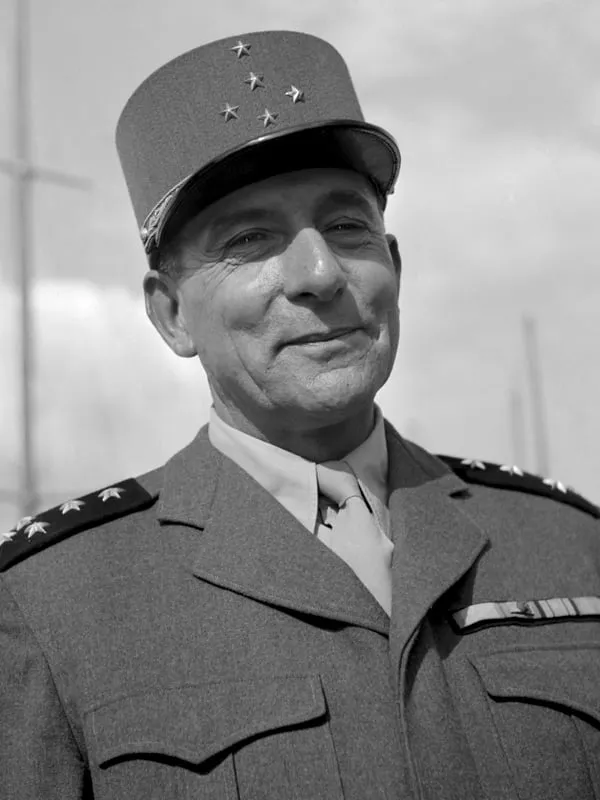
- Born:
- 2 February 1889, Mouilleron-en-Pareds (France)
- Died:
- 11 January 1952, Neuilly-sur-Seine (France)
- Author:
- Natalia
- Photo:
- Willem van de Poll, CC BY-SA 3.0 NL, Wikimedia Commons

Jean de Lattre de Tassigny commanded the army that landed in Provence in August 1944 and in nine months went from the Mediterranean through the Rhône valley, the Vosges and Alsace to the Danube and into Austria. For France it was the first large army since 1940 to fight the Germans on its own account, and de Lattre made sure that everyone knew it. Ambitious, theatrical, demanding to the point of tyranny, nicknamed “King John” by his subordinates, he could fire his soldiers with enthusiasm and force the allies to reckon with France. Before that, however, he had served for two years in the army of Vichy, and he reached de Gaulle’s camp only after arrest, trial and escape from prison.
The cavalryman from Pont-à-Mousson
Jean-Marie de Lattre de Tassigny was born on 2 February 1889 in Mouilleron-en-Pareds in the Vendée, into an old family from French Flanders. The same small town was the birthplace of Georges Clemenceau, who, according to a family story, predicted on seeing the young lieutenant that he would go very far. De Lattre was educated at the Collège Saint-Joseph in Poitiers and in Paris, passed into Saint-Cyr in 1908 and, after the cavalry school at Saumur, joined the 12th Dragoons at Pont-à-Mousson as a second lieutenant.
The First World War began for him with wounds. In August 1914 he was hit by a shell splinter, and in mid-September, as he led his troop in a charge, a Bavarian uhlan wounded him badly with a lance; to escape capture he had to hide in the cellar of a house occupied by the Germans. When the cavalry lost its importance he transferred to the infantry and, as a captain of the 93rd Infantry Regiment, fought for many months at Verdun and then on the Chemin des Dames. He ended the war with several wounds, eight mentions in dispatches and the British Military Cross.
Morocco and Weygand’s staff
From 1921 to 1926 de Lattre served in Morocco. During the Rif War he was chief of staff in the Taza region, was wounded again and was promoted to major. On the staff at Fez he worked alongside Alphonse Juin, with whom he formed a friendship; Juin was best man at his wedding to Simonne Calary de Lamazière in 1927. A year later their only son, Bernard, was born. After the École Supérieure de Guerre de Lattre joined the staff of General Maxime Weygand, vice-president of the Supreme War Council, where his work included relations with the USSR and the army budget. In 1935, as a colonel, he took over the 151st Infantry Regiment at Metz, and in 1938 he became chief of staff to the military governor of Strasbourg.
1940: Rethel
In March 1939 de Lattre was made a brigadier general, then the youngest in France. After the outbreak of war he was chief of staff of the Fifth Army, and on 1 January 1940 he took over the 14th Infantry Division. During the French campaign his division held the line of the Aisne at Rethel for several weeks, repulsing German attacks and taking prisoners. When the Germans broke through the front on 9 June, it fell back fighting to the Marne and then to the Loire. It lost a large part of its strength but kept its cohesion until the day of the armistice. In an army that was then falling apart before the eyes of the whole country, this was an achievement that was remembered.
In the Vichy army
After the defeat de Lattre stayed in the Armistice Army. At the time he believed that Marshal Pétain’s government was defending the country’s interests. He was deputy commander of the military region at Clermont-Ferrand and set up schools for leaders, in which he meant to train the cadre of a future army. In September 1941 Weygand sent him to Tunisia to command the troops there. After a few months, in February 1942, he was recalled to France; according to French sources the Germans demanded it because he would not help supply the Afrika Korps (PL), and a dispute over how to defend the protectorate set him at odds with Juin. As a corps general he took over the military region at Montpellier. In the summer of 1942 he turned down Jean Moulin’s offer of the command of the resistance’s secret army.
On 11 November 1942, three days after the Allied landings in North Africa, the Germans marched into the unoccupied zone of France (Operation Anton). The war minister, General Eugène Bridoux, ordered the troops to stay in barracks. De Lattre was the only general on active service who disobeyed: he tried to lead some of his units into the hills to resist there. No one followed him. On 12 November he was detained by French gendarmes, and on 9 January 1943 the State Tribunal in Lyon sentenced him to ten years in prison for abandoning his post. On the night of 2–3 September 1943, with the help of his wife, his son and the resistance, he escaped from the prison at Riom down a rope ladder. He hid for a month in the Auvergne, and in October an aircraft flew him from a secret landing ground to London.
Army B: Elba and Provence
De Gaulle promoted him to full general, and in December 1943 de Lattre arrived in Algiers, where he took command of the troops intended to land in France, soon named Army B. It was an army drawn from different worlds: the Free French, the former Army of Africa, which had obeyed Vichy until recently, and volunteers, while a large part of the rank and file were Algerians, Moroccans, Tunisians and soldiers from West Africa. The best divisions went first to Italy, to Juin’s corps. De Lattre’s own first operation was the landing on Elba on 17–19 June 1944, carried out by the 9th Colonial Infantry Division and assault units.
On 15 August 1944 Operation Dragoon began. The first wave consisted of Americans of General Alexander Patch’s Seventh Army, and the French divisions came ashore from 16 August. The plans assumed that the French would take Toulon first and only then Marseille, which was expected to take several weeks. De Lattre, seeing the German defence falling apart, did not wait for his whole army to be landed and struck at both ports almost simultaneously. By 28 August both garrisons had surrendered (the surrender of Toulon and Marseille), giving the Allies two major ports several weeks earlier than planned. Army B then went north up the Rhône valley; on 3 September the French and Americans entered Lyon, and on 10–12 September near Dijon they linked up with the forces coming from Normandy (the meeting of the armies near Dijon). On 25 September Army B took the name of the French First Army.
Alsace
In the autumn de Lattre’s army, placed under the American 6th Army Group of General Jacob Devers, absorbed thousands of volunteers from the resistance, while at the same time sending some of its African soldiers to the rear, officially because of the winter and, in the view of many historians, also so that the army of liberated France would look “French”. In mid-November it attacked through the Belfort Gap and on 19 November became the first Allied army to reach the Rhine. It soon took Mulhouse and Belfort, and on 23 November Leclerc’s division, operating in the neighbouring American army, liberated Strasbourg. Between them, however, around Colmar, the Germans held on to a large bridgehead on the left bank of the Rhine.
In January 1945, when the Germans launched Operation Nordwind, Eisenhower wanted to shorten the front and withdraw from northern Alsace, giving up Strasbourg. De Gaulle declared that France would not surrender the city and ordered de Lattre to defend it even without the Americans; on 3 January Eisenhower gave way (the dispute over Strasbourg). Then came the turn of the Colmar Pocket. The fighting took place in what de Lattre called “Siberian” conditions: frosts down to –20°C and snow a metre deep. When the attack went slowly, Devers placed the American XXI Corps under the French. De Lattre thus commanded several American divisions, something no other French general of this war did. On 2 February Allied troops entered Colmar, and by 9 February the whole bridgehead had been eliminated.
The Rhine, the Danube and Berlin
At the end of March 1945 de Gaulle, wanting France to enter Germany with its own forces and to have a strong position in the talks on occupation zones, urged de Lattre to cross the Rhine without regard for American plans. On 31 March the French crossed at Speyer and Germersheim without waiting for bridging equipment (the crossing of the Rhine). The First Army went through the Black Forest, took Karlsruhe and Stuttgart, and on 22 April crossed the Danube. On de Gaulle’s orders de Lattre would not hand Stuttgart over to the Americans, although it lay in their zone of operations, which caused a sharp dispute with Devers and Eisenhower that was settled only by President Truman. The “Rhine and Danube” campaign ended with the First Army reaching the Swiss border on Lake Constance and the Arlberg Pass in Austria.
On 8 May 1945 de Lattre flew to Berlin for the signing of the surrender at Karlshorst. Nobody there was expecting him, a French flag had to be sewn on the spot, and when he demanded that France sign the act on an equal footing with the great powers, the Americans replied that in that case their signature could not be missing either. In the end the surrender was accepted by Georgy Zhukov and Arthur Tedder, while de Lattre and the American General Carl Spaatz signed as witnesses. On 5 June in Berlin de Lattre signed on behalf of France, together with Eisenhower, Zhukov and Montgomery, the Berlin Declaration, under which the four powers assumed authority over Germany.
Indochina and a posthumous baton
After the war de Lattre was chief of the general staff and inspector general of the army, and from 1948 to 1950 he was the first commander of the land forces of the Western Union at Fontainebleau, where Montgomery chaired the commanders-in-chief committee. In December 1950, after a series of defeats in the Indochina War, he became High Commissioner and commander-in-chief in Indochina. In 1951 he halted the offensives of the Viet Minh in the Red River delta, among other places at Vĩnh Yên, and began to build a Vietnamese army. At the end of May that year his only son Bernard was killed in the delta. Ill with cancer, de Lattre returned to France in the autumn and died on 11 January 1952 in a clinic at Neuilly-sur-Seine near Paris. On the day of his state funeral, 15 January, President Vincent Auriol posthumously raised him to the dignity of Marshal of France. He was buried beside his son in his native Mouilleron-en-Pareds.
De Lattre’s memory in France today is unambiguously positive: he was a Companion of the Liberation, and his First Army is seen as a symbol of the rebirth of the French army. Historians, while acknowledging his talent as an organiser and the boldness of decisions such as the simultaneous attack on Toulon and Marseille, also recall his vanity and taste for theatrical gestures, his less flattering period in the Vichy army, and the fact that the First Army owed its successes largely to soldiers from North and West Africa.
Sources
Commanded in battles
(03)Mentioned in battles
(01)Often appears with
People who appear in the same events.