Japan
Mineichi Koga
Commander of the Second Fleet (1939–1941), the China Area Fleet (1941–1942) and Yokosuka Naval District (1942–1943), commander-in-chief of the Combined Fleet (1943–1944)
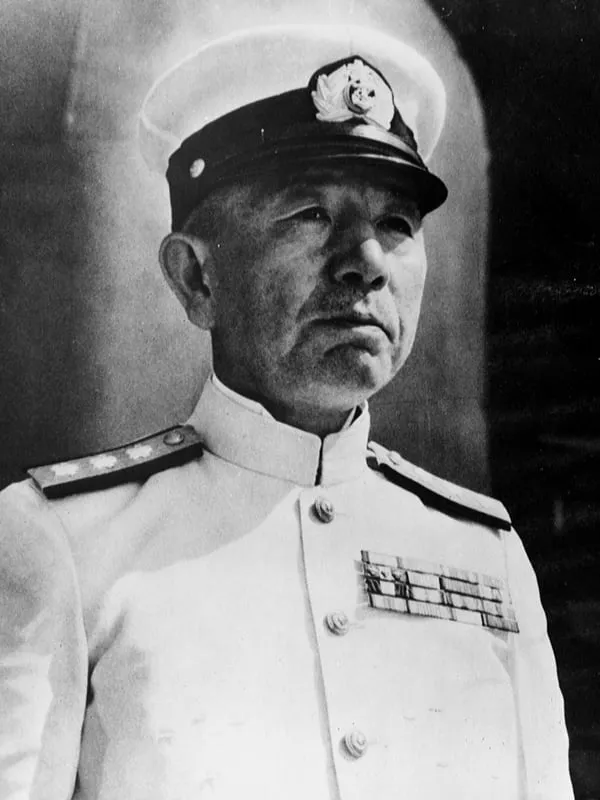
- Born:
- 25 September 1885, Arita, Saga Prefecture (Japan)
- Died:
- 31 March 1944, The sea between Palau and Mindanao (Philippines)
- Author:
- Łukasz
- Photo:
- US Navy, domena publiczna, Wikimedia Commons

Mineichi Koga took command of the Japanese Combined Fleet in April 1943, after American airmen shot down the aircraft of Isoroku Yamamoto. He inherited a fleet that, after Midway and Guadalcanal, could no longer win the war, and he knew it: he told his officers openly that Japan’s chances were less than one in three. For eleven months he looked for a way to lure the Americans into a single decisive battle, while losing his carrier air groups in the defence of Rabaul and of the base at Truk. He was killed on 31 March 1944, when his flying boat disappeared in a storm on the way from Palau to the Philippines. The plans he had been working on fell into enemy hands, and his successor fought the battle they described without him.
From Arita to Paris
Koga was born on 25 September 1885 in Arita in Saga Prefecture on Kyushu, a town famous for its porcelain. At middle school in Saga he belonged to a circle of friends that also included the future admiral Zengo Yoshida. In 1903 he entered the Naval Academy at Etajima and graduated in 1906, fourteenth of the 175 graduates of the 34th class. After a training cruise in the cruiser Matsushima to Hawaii, Australia and South-East Asia he served in battleships and cruisers, and in 1917 he graduated fourth in his class from the Naval Staff College. He saw no action in the First World War.
He spent most of his career on staffs and in diplomatic posts. In 1920–1922 he was an officer attached to the embassy in Paris; in 1926 he returned there as a captain and naval attaché, and in 1927 he was a member of the Japanese delegation to the naval disarmament conference in Geneva.
An admiral from the moderate camp
In 1930, during the dispute over the London Naval Treaty limiting naval armaments, Koga was senior adjutant at the navy ministry and belonged to the group of officers who, against the radicals of the Navy General Staff, helped to bring about its signature. He was counted among the so-called treaty faction, alongside Mitsumasa Yonai, Yamamoto and Shigeyoshi Inoue, who praised him for the soundness of his judgement. He then commanded the heavy cruiser Aoba and the battleship Ise, and in December 1932 he became a rear admiral and headed in turn the intelligence and armaments sections of the Navy General Staff. In December 1936 he was promoted to vice admiral, and in 1937 he led the training squadron on a cruise to Europe.
From December 1937 to October 1939 Koga was vice chief of the Navy General Staff, during the war with China and the growing tension with the United States. He shared Yamamoto’s fears of war with America, but in naval matters he remained a traditionalist: he believed in battleships and their guns more than in aircraft carriers, and changed his mind only under the impact of events in the Pacific.
From China to Yokosuka
In October 1939 Koga took over the Second Fleet, the main cruiser force intended for night fighting ahead of the decisive clash of the battleships. In September 1941 he became commander of the China Area Fleet. In December 1941 his ships supported the army in the Battle of Hong Kong, which ended with the surrender of the British colony on Christmas Day. On 1 May 1942 Koga was promoted to full admiral, and in November he took command of the Yokosuka Naval District, one of the most important posts at home.
Yamamoto’s successor
On 21 April 1943, three days after Yamamoto’s death, Koga was appointed commander-in-chief of the Combined Fleet. On 25 April he flew in to Truk, officially on an inspection tour, and his appointment was announced only in May. His flagship was the battleship Musashi, which in May carried his predecessor’s ashes to Japan. At a conference on 8 May Koga told his officers that the navy had less than half the strength of the American fleet and that the chances of victory were less than one in three, and that the only way out was a decisive fleet battle in the Marshall or Gilbert Islands, even at the cost of sacrificing their garrisons.
The admiral was not as passive as he has sometimes been described. After the American landing on Attu in May 1943 he planned a strike in the Aleutians, which was thwarted by an explosion of ammunition in the battleship Mutsu in June, probably caused by careless handling, and by an American submarine’s crippling of the carrier Hiyō. He began to reorganise the Combined Fleet on the American pattern, into task forces built around carriers, and to create a land-based naval air fleet to work with them. In October he took the main force out of Truk to meet American carriers expected to strike Wake, but no battle took place.
The defence of Rabaul cost him dearest. At the turn of October and November 1943, in Operation Ro, Koga transferred to Rabaul the air groups of the carriers Zuikaku, Shōkaku and Zuihō, 173 aircraft with the best pilots the navy still had. They were to strike Allied bases and convoys in the Solomon Islands and help in the defence of Bougainville. After the lost Battle of Empress Augusta Bay he also sent there the heavy cruisers of Vice Admiral Takeo Kurita. On 5 and 11 November American carrier aircraft struck Rabaul: they damaged the cruisers and destroyed a large part of the aircraft, which were also losing many men in the air battles over the beachhead. On 12 November Koga ended the operation, and the remnants of the air groups returned to Truk. When a few days later the Americans landed on Tarawa, the Combined Fleet had nothing with which to defend the Gilbert Islands. A few months earlier Koga himself had announced that it was there that he would fight the decisive battle.
Withdrawal from Truk
After the defeats of the autumn of 1943 Koga adopted a more cautious strategy. He wanted to husband the fleet for a battle on the inner defence line, in the Marianas, the Western Carolines and the Philippines, where it could fight within range of land airfields. This was the origin of the “Z Plan”. When at the beginning of 1944 the Americans took the Marshall Islands and on 4 February one of their reconnaissance aircraft flew over the Truk lagoon, Koga took this as a sign of an impending attack. On 10 February he sailed for Japan in Musashi, and sent most of the ships to Palau and Singapore. As a result the American raid on Truk on 17 and 18 February (Operation Hailstone) sank two light cruisers, several destroyers and dozens of merchant ships, but not a single battleship or carrier.
At the end of March Koga moved his headquarters to Palau. When American aircraft struck that base too on 30 and 31 March, he decided to move his staff further, to Davao on Mindanao. On the evening of 31 March he took off from Palau in a Kawanishi H8K flying boat, while his chief of staff, Vice Admiral Shigeru Fukudome, flew in a second one. Both aircraft ran into a typhoon. Koga’s aircraft vanished without trace, and neither the wreck nor the bodies were ever found. Fukudome’s aircraft crashed off Cebu. The admiral survived and fell into the hands of Filipino guerrillas, and the case of “Z Plan” documents passed from the guerrillas on Cebu to the intelligence staff of General Douglas MacArthur. In the Japanese navy the affair was called the “B incident” (otsu), to distinguish it from the “A incident” (kō), the death of Yamamoto.
Koga’s death was announced only on 5 May 1944. Until then the fleet was directed by the most senior admiral, Shirō Takasu, and on 3 May Soemu Toyoda became its commander. The plan for Operation A-Go, which Toyoda approved, broadly repeated Koga’s concept. In June its execution ended in defeat in the Battle of the Philippine Sea.
Memory and assessment
The Emperor posthumously conferred on Koga the title of Marshal Admiral (gensui) and the highest orders, and Germany awarded him the Knight’s Cross of the Iron Cross with Oak Leaves. His grave is in Tama Cemetery in Tokyo, in the section of honour next to the graves of Admiral Heihachirō Tōgō and Yamamoto. In his native Arita there is a memorial to the admiral.
Koga has gone down in history as a transitional commander in Yamamoto’s shadow. He took over the fleet at the moment when the superiority of American industry was beginning to show in full, and he had neither his predecessor’s authority nor experience of commanding air forces. Some historians describe him as a cautious conservative. Others, like the American researcher Kent Budge, point out that the plans he was working on were bold and modern, but that he ran out of time and aircraft. Japanese studies note that Operation Ro, which he devised himself on the model of Yamamoto’s Operation I in April, destroyed the carrier aviation he needed for the decisive battle. When a few months later the Japanese fleet finally sailed out to fight that battle, its pilots were too poorly trained to stand up to the Americans.
Sources
Mentioned in battles
(04)Often appears with
People who appear in the same events.