Japan
Soemu Toyoda
Commander of the Kure (1941–1942) and Yokosuka (1943–1944) naval districts, Commander-in-Chief of the Combined Fleet (1944–1945), Chief of the Navy General Staff (1945), admiral
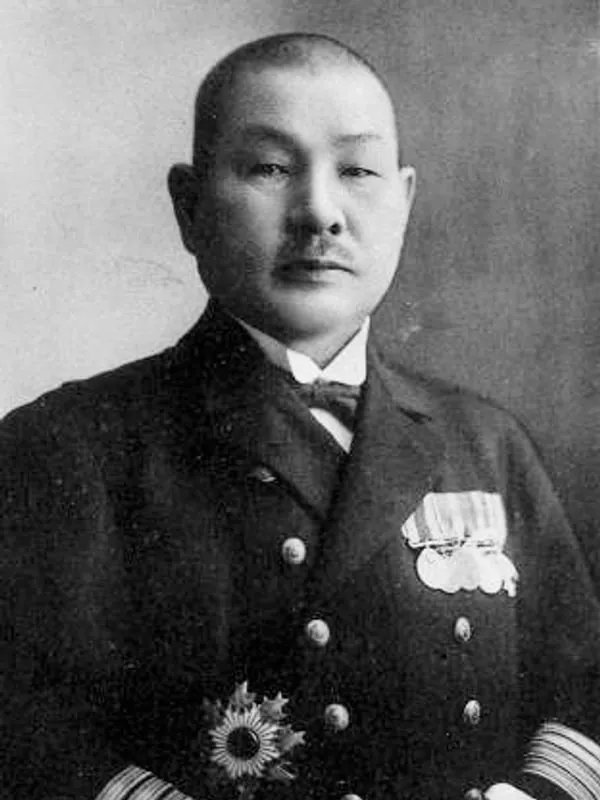
- Born:
- 22 May 1885, Kitsuki, Ōita Prefecture (Japan)
- Died:
- 22 September 1957, Tokyo (Japan)
- Author:
- Łukasz
- Photo:
- Ministerstwo Marynarki Japonii, domena publiczna, Wikimedia Commons

Soemu Toyoda took command of Japan’s battle fleet when the Pacific War was already lost in all but name, and led it through its last three great operations. The plans drawn up by his staff – A-Go in the Marianas, Shō-Gō in the Philippines and Ten-gō off Okinawa – had one thing in common: each staked everything the fleet had left on a single battle. Each ended in defeat. In the summer of 1945, by then Chief of the Navy General Staff, Toyoda sided in the government’s deliberations with the generals who wanted to fight on, although the Navy Minister had counted on him to support the advocates of peace. After the war he was tried by an Allied court and acquitted.
Gunner and staff officer
Toyoda was born on 22 May 1885 in Kitsuki (PL) in Ōita Prefecture on the island of Kyushu. In the autumn of 1905, just after the war with Russia, he graduated from the naval academy at Etajima. He specialised in naval gunnery, and in 1917 he graduated from the Naval War College at the top of his class. From 1919 to 1922 he served in the naval attaché’s office in Britain, still Japan’s ally at the time. After his return he passed through the posts typical of a future admiral: he was executive officer of a cruiser, commanded the cruiser Yura and the battleship Hyūga, and worked in the Navy Ministry and on the Navy General Staff. In 1931 he became a rear admiral.
From 1933 to 1935 he was chief of staff of the Combined Fleet, and in November 1935 he was promoted to vice admiral and took over the Navy Ministry’s Naval Affairs Bureau, one of the navy’s most important political offices. After the outbreak of war with China, in October 1937, he became commander of the 4th Fleet, and a year later of the 2nd Fleet, which supported the army’s operations on the Chinese coast. From 1939 he headed the office responsible for building warships.
A war he did not want
In September 1941 Toyoda was promoted to full admiral and took over the Kure Naval District, the fleet’s main base on the Inland Sea. He was one of the naval officers who regarded war with the United States as hopeless, and he made no secret of his dislike of the army. According to Japanese sources, in October 1941 he was earmarked to become Navy Minister in the new government, but refused when he learned that the prime minister would be General Hideki Tōjō; Tōjō did not want him either.
He spent the first years of the Pacific War far from the front. In November 1942 he joined the Supreme War Council, where he pressed, with little success, for a larger share of industry to be devoted to naval aviation, and in the spring of 1943 he took over the Yokosuka Naval District near Tokyo. Meanwhile, in April 1943, Admiral Isoroku Yamamoto was killed over Bougainville, and his successor, Admiral Mineichi Koga, disappeared in an air crash on 31 March 1944. Toyoda, one year senior to Koga and, as he saw it, unfairly passed over when Yamamoto’s successor was chosen, took command of the Combined Fleet on 3 May 1944.
The Marianas: Plan A-Go
The new commander at first directed the fleet from the cruiser Ōyodo, and later moved his headquarters ashore, to buildings of Keiō University at Hiyoshi near Yokohama. His Plan A-Go envisaged a single decisive battle with the American fleet, preferably around Palau and the western Carolines, where Japanese ships could be supported by land-based aircraft. When the Americans landed on Biak at the end of May, the Japanese tried to ship reinforcements there, hoping to draw the enemy into a fight at a place of their own choosing.
The Americans, however, struck elsewhere. After the carrier raids on the Marianas Toyoda put the fleet on alert on 13 June, and on 15 June, as the Marines were landing on Saipan, he ordered the plan carried out. His order echoed the signal Admiral Heihachirō Tōgō had made before Tsushima: the fate of the Empire rests on this one battle. Vice Admiral Jisaburō Ozawa’s Mobile Fleet lost the Battle of the Philippine Sea on 19–20 June, along with three carriers and most of its aircraft. On the evening of 20 June Toyoda ordered it to withdraw. He refused to accept the resignation Ozawa tendered. The loss of the Marianas opened the way for American bombers to reach Japan and led to the fall of the Tōjō government.
Formosa and Leyte Gulf
After this defeat Japan’s carriers had almost no trained aircrew. Over the summer Toyoda’s staff prepared four variants of Plan Shō-Gō (“Victory”), depending on where the Americans struck: the Philippines, Formosa and the Ryukyus, the Japanese home islands, or the Kurils and Hokkaido. In the air battle the leading role was to be played by land-based aircraft.
When Admiral William Halsey’s carriers attacked Formosa in October, Toyoda happened to be inspecting units on the island and was stranded there for several days, because a flight back to Japan through the area where the American fleet was operating was too dangerous. Operations were directed from Japan by his chief of staff, Vice Admiral Ryūnosuke Kusaka, who threw into battle the aircraft gathered for Shō. Japanese airmen reported sinking many carriers; in reality they disabled two cruisers and lost a great many aircraft, which were sorely missed a few days later.
On 17 October, when American Rangers began landing on the islets at the entrance to Leyte Gulf, Toyoda declared an alert, and on 18 October he activated Shō-1. Ozawa’s carriers, almost without aircraft, were to lure Halsey’s fleet north, while two surface forces, including the main force of Vice Admiral Takeo Kurita, broke into the gulf from two directions and destroyed the landing ships. Toyoda explained after the war that the loss of the Philippines would have cut the fleet off from fuel from the Dutch East Indies, so there was no point in preserving it. The Battle of Leyte Gulf was the largest naval battle in history. When on 24 October Kurita, under air attack in the Sibuyan Sea, turned back, Toyoda ordered all forces that evening to press on, “trusting in divine assistance”. Ozawa’s decoy worked, but on 25 October Kurita, although his way into the gulf was open, turned back. The Combined Fleet lost four carriers, three battleships and many cruisers and destroyers, and ceased to exist as a force capable of conducting operations.
In those same days airmen of Vice Admiral Takijirō Ōnishi carried out the first organised suicide attacks in the Philippines. In the months that followed, the kamikaze became the Japanese navy’s main weapon, and Toyoda’s command formed one special attack unit after another: aircraft, piloted bombs and motor boats.
The Yamato and the last months
When the Americans landed on Okinawa on 1 April 1945, the navy responded with mass suicide attacks. Toyoda also approved a plan to send the battleship Yamato to Okinawa with a light cruiser and eight destroyers. The force was to fight its way through to the island, beach itself and fight to the end as a shore battery. The plan was drawn up by one of the staff officers, and Toyoda approved it over the head of his own chief of staff. The force commander, Vice Admiral Seiichi Itō, considered it a senseless waste of men and fuel. On 7 April American carrier aircraft sank the Yamato and most of her escort before the force reached its objective. Several thousand sailors were killed.
In April 1945 Toyoda also took over a new supreme command of all naval forces, and on 29 May he became Chief of the Navy General Staff. Ozawa succeeded him at the head of the Combined Fleet. According to Japanese accounts, Emperor Hirohito objected to the appointment, but the Navy Minister, Admiral Mitsumasa Yonai, pushed it through, hoping that Toyoda, who enjoyed the confidence of the younger, radical officers, would be able to restrain them, and would also influence the army chief of staff, General Yoshijirō Umezu, who came from the same prefecture.
Against surrender
Yonai’s calculations proved wrong. When the Allies issued the Potsdam Declaration on 26 July, Toyoda, together with Umezu and the War Minister, Korechika Anami, demanded that it be rejected. He was not opposed to ending the war as such, but wanted to secure better terms. After the atomic bombing of Nagasaki, at the meeting of the Supreme Council for the Direction of the War on 9 August, the three military men demanded that, besides the inviolability of the throne, Japan should disarm its own forces, try its own war criminals and prevent the occupation of the country or limit it. The council split evenly, three votes to three, and the decision fell to the Emperor, who accepted the declaration with a single reservation.
On 12 August, after the American reply, Toyoda and Umezu presented the Emperor with their objection to accepting the terms, without consulting Yonai. The minister then summoned him and sharply rebuked him for acting behind the ministry’s back. At the conference in the Emperor’s presence on 14 August Toyoda and Umezu once again set out their objections, but Hirohito upheld the decision to surrender. According to Japanese accounts, Toyoda refused to take part in the surrender ceremony aboard the Missouri on 2 September, and the navy was represented there by Rear Admiral Sadatoshi Tomioka.
Trial and assessment
In the autumn of 1945 Toyoda was interrogated by the Americans studying the effects of strategic bombing. His interrogators remembered him as an intelligent and well-informed man, a sharp critic of the army’s political influence. In December 1945 the occupation authorities ordered his arrest and he was held in Sugamo Prison. He was not among the defendants before the International Military Tribunal for the Far East, but in October 1948 he was brought before a separate Allied military tribunal in Tokyo, one of two international proceedings held after the great Tokyo trial.
The prosecution charged that as a commander he had permitted, and failed to prevent, the abuse, torture, rape and killing of prisoners and civilians by sailors and troops of units under his command. The trial rested on the principle, then being developed, of a commander’s responsibility for the acts of his subordinates. Toyoda pleaded not guilty. He was defended by a team led by the American Ben Bruce Blakeney, formerly one of the defence counsel at the Tokyo trial, and the closing speech for the defence was delivered in August 1949 to an almost empty courtroom. Before the end of 1949 the tribunal acquitted the admiral on all charges.
Toyoda was then subject to the purge that barred former commanders from public life. In 1950 he published his memoirs, The Last Imperial Navy, in which he argued that his hard line in the last days of the war had allowed him to keep the radicals in the fleet from mutiny. Many Japanese naval officers did not accept this explanation: Rear Admiral Sōkichi Takagi, one of Yonai’s men preparing the end of the war, wrote that a chief of staff who should have been looking at the fate of the whole state had let himself be carried along by events. Toyoda died on 22 September 1957 at his home in Tokyo.
He is usually judged harshly as a commander as well. His plans showed a sober awareness that a fleet without fuel and aircrew was doomed anyway, but the solution he chose was each time a single all-or-nothing battle, and in the end the sacrifice of ships and men in attacks that could not possibly change the outcome of the war.
Sources
Commanded in battles
(01)Mentioned in battles
(03)Often appears with
People who appear in the same events.