Soviet Union
Andrey Yeryomenko
Commander of the Western Front (1941), Bryansk Front (1941), Stalingrad Front (1942), Kalinin Front (1943), Separate Coastal Army (1944), 2nd Baltic Front (1944–1945) and 4th Ukrainian Front (1945)
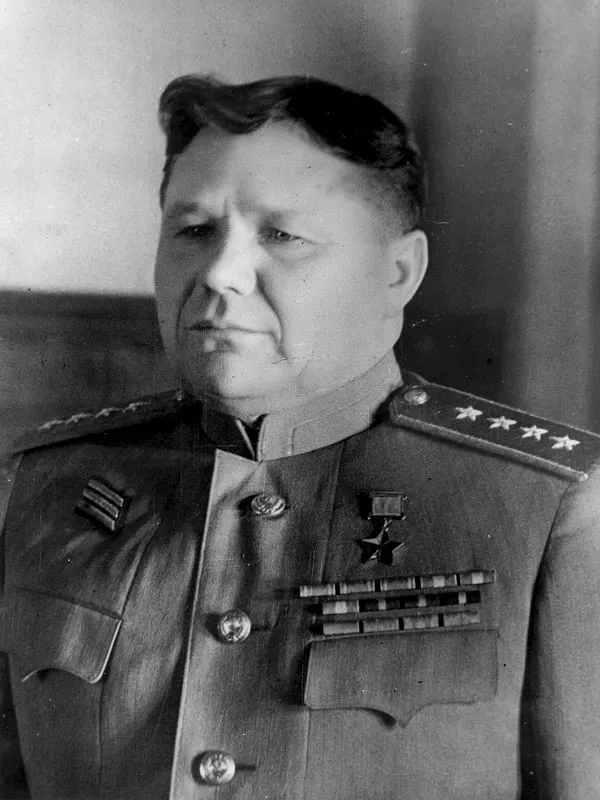
- Born:
- 14 October 1892, Markovka, Kharkov Governorate (Ukraine; then the Russian Empire)
- Died:
- 19 November 1970, Moscow (Soviet Union)
- Author:
- Natalia
- Photo:
- G. Shirokov for TASS, domena publiczna, Wikimedia Commons

Andrey Yeryomenko was a Soviet commander whose name is linked above all with the defence of Stalingrad. A cavalryman from Semyon Budyonny’s Cavalry Army, in 1939 he rode into Grodno at the head of a corps, and in 1941 Joseph Stalin threw him in wherever the front was collapsing: Belorussia, Smolensk and Bryansk, where he promised to smash Heinz Guderian’s tanks and ended up encircled himself. Three times badly wounded, in the summer of 1942 he was given the front that was to defend Stalingrad, and in November his troops closed the ring around the German 6th Army from the south. He was a brave and stubborn commander, but hot-headed and quick to claim credit, and his voluminous memoirs must be read with caution.
From Markovka to the Cavalry Army
He was born on 14 October 1892 in the village of Markovka in the Kharkov Governorate, today in the Luhansk region of Ukraine, into a poor peasant family. From the age of ten he worked as a herdsman and hired labourer and received practically no schooling. In November 1913 he was called up. In the First World War he fought as a private on the Southwestern Front, was badly wounded in the Battle of Galicia, then fought in the Carpathians and at Przemyśl, and from 1916 on the Romanian front as a mounted scout. He rose to lance corporal and then to junior NCO.
At the beginning of 1918 he returned with his rifle to his home village, and in the autumn he formed a partisan detachment there, which was incorporated into the Red Army in January 1919. In December 1918 he joined the Bolshevik party. In the Civil War he rose in the cavalry from trooper to regimental chief of staff in the 14th Cavalry Division of the First Cavalry Army.
A cavalryman in the years of the purges
After the Civil War he spent a long time on cavalry courses, in 1929 took command of a cavalry regiment, and in 1935 graduated from the Frunze Military Academy. In August 1937, at the height of the Great Purge, he took over the division in which he had fought in the Civil War, and in June 1938 the 6th Cavalry Corps in Belorussia. Like many commanders of his generation he was promoted quickly, because the purge had emptied hundreds of posts.
In September 1939 his corps, reinforced with tanks and motorised units, became part of the Belorussian Front’s cavalry-mechanised group, which marched into Poland. Yeryomenko personally led the advance detachment that took Nowogródek and Wołkowysk and then fought for Grodno. When crossing the border he reportedly had a Soviet border post dug up and carried on a lorry, to be planted wherever Stalin would say. The march was badly organised and the corps had to ask for fuel to be flown in, but its speed earned its commander the nickname “the Russian Guderian”. In June 1940 he took part in the occupation of Lithuania, then commanded a mechanised corps, and in January 1941 he was sent to the Far East at the head of the 1st Red Banner Army.
Belorussia, Smolensk, Bryansk
After the German attack he was summoned to Moscow, and on 30 June 1941, after the dismissal of Dmitry Pavlov, he took over the Western Front, shattered in the Battle of Białystok–Minsk. As early as 2 July Marshal Semyon Timoshenko took command, and Yeryomenko became his deputy. During the Battle of Smolensk he tried to save the front’s northern wing and organised the crossings over the Dnieper through which the troops encircled at Smolensk were supplied.
On 14 August he was put at the head of the new Bryansk Front, which was to cover Moscow from the south-west. In a conversation with Stalin he personally promised to smash “that scoundrel Guderian”. But when the 2nd Panzer Group turned south, it passed by his troops and closed the encirclement of the Southwestern Front from the north in the Battle of Kiev. The Bryansk Front’s counter-attacks at the end of August and in September failed to stop it. On 11 September Yeryomenko was nevertheless made a colonel general.
At the beginning of October the Germans launched Operation Typhoon, and Guderian’s troops struck the rear of the Bryansk Front. Three of its armies were encircled, and a German armoured column unexpectedly ran into the front headquarters. Yeryomenko tried to lead his troops out of the pocket. According to the memoirs of the head of the 50th Army’s political department, he ordered that army by cipher telegram, under threat of execution, to change its line of retreat, which broke up its formation and contributed to its destruction. On 13 October he was badly wounded and flown out to Moscow.
Toropets
Not yet fully recovered, in December 1941 he took over the 4th Shock Army. In January 1942, during the counter-offensive from Moscow, his army broke through the German defences, advanced more than 200 kilometres in a month and on 21 January took Toropets. The deep breach enveloped the German forces at Rzhev from the north. On 20 January, during an air raid, Yeryomenko was again badly wounded in the leg. For several weeks he commanded in a plaster cast before going into hospital in mid-February.
Stalingrad
In August 1942, as the Germans drove towards the Volga, Stalin entrusted him with the Southeastern Front and a few days later with the Stalingrad Front as well. The member of the military council was Nikita Khrushchev. Yeryomenko gathered the divisions falling back from the Don and the reserves, and with counter-attacks slowed the 4th Panzer Army’s advance from the south-west. He could not, however, prevent the Germans from reaching the Volga north of the city at the end of August and breaking into Stalingrad in September. Stalin and the Chief of the General Staff, Aleksandr Vasilevsky, sharply criticised him more than once. On 11 September Yeryomenko and Khrushchev gave command of the 62nd Army, fighting in the city, to Vasily Chuikov, which proved one of the best personnel decisions of the battle.
On 28 September the Southeastern Front was renamed the Stalingrad Front, while the former Stalingrad Front, henceforth the Don Front, was taken over by Konstantin Rokossovsky. For two months Yeryomenko’s troops held the bridgehead in the city, supplying it across the Volga under fire. On 20 November they went over to the attack south of Stalingrad as part of Operation Uranus, broke through the Romanian positions, and on 23 November met the troops of the Southwestern Front near Kalach and closed the ring around Friedrich Paulus’s 6th Army. In December, as the German relief force advanced from Kotelnikovo, Rodion Malinovsky’s 2nd Guards Army, which stopped it, was placed under Yeryomenko’s command.
On 1 January 1943 his front became the Southern Front and was given the task of advancing on Rostov, while the destruction of the pocket was entrusted to Rokossovsky. Yeryomenko took it very hard that he had been kept from finishing off the 6th Army. His troops advanced more than 200 kilometres but could not cut off the German line of retreat from the Caucasus. On 2 February 1943, the day the last units at Stalingrad surrendered, he was relieved on health grounds, as his old wounds had reopened.
Smolensk, the Crimea and Latvia
In April 1943 he took over the Kalinin Front. In August and September its left wing took part in the offensive that liberated Smolensk, and on 27 August he himself became a general of the army. At the beginning of October his troops took Nevel, an important junction at the boundary between two German army groups. On 20 October the front was renamed the 1st Baltic Front, and in November Yeryomenko was back in hospital.
In February 1944 he commanded the Separate Coastal Army, which held the bridgehead at Kerch. In April, during the Crimean offensive, his army took Kerch and Yalta, working with Fyodor Tolbukhin’s 4th Ukrainian Front. From there he was moved north, where from April 1944 to February 1945 he commanded the 2nd Baltic Front. In the summer his troops attacked in Latgale in the Rezekne–Daugavpils operation, and in the autumn they took part in the Baltic offensive, which brought the capture of Riga and cut off the German forces in Courland. On 29 July 1944 he was made a Hero of the Soviet Union.
Ostrava and Prague
On 26 March 1945 he took over the 4th Ukrainian Front on the borderland of Poland and Czechoslovakia. His troops fought the hard Moravian–Ostrava operation and on 30 April took the Ostrava industrial district, and in May they took part in the Prague offensive.
After the war
After the war he commanded the Carpathian Military District, from which he was removed in 1946 for shortcomings in training and discipline, and then for many years the West Siberian and North Caucasus Military Districts. On 11 March 1955, in a group of commanders promoted under Khrushchev, he received the rank of Marshal of the Soviet Union. From 1958 he was an inspector general in the Ministry of Defence, which in practice meant honourable retirement. He was among the first Soviet marshals to publish memoirs, and during the war, against the rules, he kept a diary. Both are rich in detail but clearly exaggerate the author’s role. He died in Moscow on 19 November 1970, and the urn with his ashes was placed in the Kremlin Wall.
Assessment
Yeryomenko was no great strategist. In 1941 his self-confidence ran into German superiority in command and mobility, and the defeat at Bryansk opened the road to Orel and Tula for the Germans. Years later Zhukov recalled Stalin’s opinion of him: a commander inferior to Rokossovsky, immodest and boastful, and disliked by the troops. Yet Yeryomenko did not lose his head in the worst situations and, wound after wound, kept returning to the front. At Stalingrad he held the front in the hardest weeks, chose the right man to defend the city and carried out the southern arm of the encirclement. In Polish literature his name often appears in the form “Jeremienko”.
Sources
Commanded in battles
(07)- 10 July – 10 September 1941Battle of Smolensk (1941)Eastern Front
- 23 August 1942 – 2 February 1943Battle of StalingradEastern Front
- 19–23 November 1942Operation UranusEastern Front
- 12–23 December 1942Operation Winter StormEastern Front
- 8 April – 12 May 1944Crimean offensive (1944)Eastern Front
- 14 September – 24 November 1944Baltic offensive (1944)Eastern Front
- 6–11 May 1945The Prague offensiveEastern Front
Mentioned in battles
(04)Often appears with
People who appear in the same events.