United States
Robert Ghormley
Director of the Navy War Plans Division (1939–1940), naval observer in London (1940–1942), Commander South Pacific Area (June–October 1942), Commandant 14th Naval District in Hawaii (1943–1944), Commander US Naval Forces Germany (1944–1945)
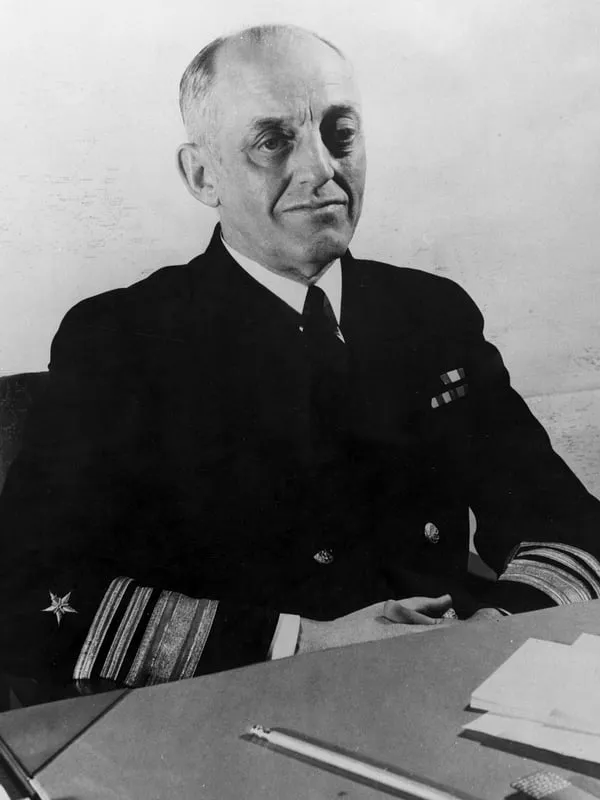
- Born:
- 15 October 1883, Portland, Oregon (United States)
- Died:
- 21 June 1958, Bethesda, Maryland (United States)
- Author:
- Natalia
- Photo:
- autor nieznany, domena publiczna, Wikimedia Commons

Robert Ghormley was the American admiral who was given the task of leading the first United States offensive in the Pacific. As commander of the South Pacific Area in the summer of 1942 he prepared, in a few weeks, and carried out the landing on Guadalcanal, and for the next two months he was responsible for the struggle for an island whose fate hung by a thread. In mid-October Admiral Chester Nimitz concluded that his old friend was too exhausted and too pessimistic to command at the decisive moment, and handed his post to William Halsey. Ghormley went down in history as the cautious admiral who had to be replaced so that Guadalcanal could be held. Some historians today, however, see him rather as a commander set a task beyond his strength, with resources that were never enough.
From Oregon to Annapolis
Robert Lee Ghormley was born on 15 October 1883 in Portland, Oregon, the eldest of the six children of a Presbyterian missionary. He was studying at the University of Idaho in Moscow when in 1902 he received an appointment to the Naval Academy at Annapolis. He graduated in 1906, twelfth in his class. His classmates included Frank Jack Fletcher, John McCain senior and John Towers, all of whom he would meet again in the war against Japan.
He spent his first years in cruisers, and from 1911 to 1913 he was aide to the commander of the Pacific Fleet, taking part in the intervention in Nicaragua in 1912. After a few years teaching at Annapolis he joined the battleship Nevada in 1916, in which he spent most of the First World War. Towards its end he worked in the Naval Overseas Transportation Service, which organised the shipment of troops and supplies to Europe, and for this he received the Army Distinguished Service Medal.
Staff officer and diplomat in uniform
The interwar years showed where Ghormley was at his best. He did command a patrol vessel and a destroyer, he was executive officer of the battleship Oklahoma, and in 1935–1936 he commanded the Nevada, but his real domain was the staff. He was aide to the Assistant Secretary of the Navy, secretary of the Navy’s General Board, and chief of staff to the commanders of the Battle Force and the fleet. After a course at the Naval War College he was promoted to rear admiral in 1938, and then took over the War Plans Division and the post of Assistant Chief of Naval Operations. From August 1939 his superior was Admiral Harold Stark.
In August 1940, in the most intense weeks of the Battle of Britain, President Franklin Delano Roosevelt sent him to London as special naval observer. Ghormley quickly grew close to the British; he later recalled that with every day in London he became more convinced that not only England but civilisation itself was in danger, and that only the United States could turn the tide. Roosevelt used him as a channel to the British Admiralty that bypassed Ambassador Joseph Kennedy and the State Department. Ghormley took part in the secret staff talks from which, early in 1941, grew the American-British plan ABC-1, which assumed that in a war with the Axis powers Germany had to be defeated first. Formally, the United States was still neutral. After the attack on Pearl Harbor Ghormley commanded US naval forces in Europe from London for a few more months, by now as a vice admiral.
The South Pacific
In the spring of 1942 the Americans divided the Pacific into areas of command. The South Pacific, with New Zealand, New Caledonia, the New Hebrides and Samoa, came under Nimitz, who needed a separate commander for it. His first choice was Vice Admiral William Pye, but Washington had not forgiven Pye for recalling the expedition to relieve Wake. In April Admiral Ernest King therefore summoned Ghormley from London. The choice had weaknesses that would later make themselves felt: Ghormley had been a staff officer for years, had last commanded a ship in 1936, and had never commanded a carrier or a force in action.
In May Ghormley discussed his tasks with Nimitz at Pearl Harbor, and on 19 June he formally assumed command, with headquarters in Auckland. Before that, when reconnaissance discovered that the Japanese were building an airfield on Guadalcanal, King had decided to strike at the southern Solomon Islands that same summer. On 26 June Ghormley summoned General Alexander Vandegrift to Auckland and told him that his 1st Marine Division, part of which was still on its way to New Zealand, was to land on Tulagi and Guadalcanal in little more than a month. The operation was codenamed Watchtower, and among the marines it soon earned the nickname Shoestring.
Ghormley did not believe it could be properly prepared with such means. At the beginning of July he flew to Melbourne to see General Douglas MacArthur, and together they proposed postponing the landing until there were enough forces for a single continuous attack on the whole of the Solomons and on Rabaul. The Joint Chiefs of Staff rejected the proposal. So Ghormley had to act: on 16 July, because of delays in loading the ships in rainy Wellington, he moved the landing date to 7 August. His intelligence put the Japanese forces in the target area at about 3,000–3,500 men; the marines and Admiral Richmond Turner assumed figures twice as high, but after the war it turned out that Ghormley had been closer to the truth.
Guadalcanal
Fletcher commanded the invasion force, with three carriers under him; Turner commanded the amphibious force, and Rear Admiral John McCain the land-based aircraft. Although King and Nimitz expected Ghormley to direct the operation in person, he left command at sea to Fletcher and did not attend the commanders’ conference off Fiji at the end of July. The landing on 7 August succeeded, but on the evening of 8 August Fletcher, citing his losses in fighters, his shortage of fuel and the threat from Japanese torpedo bombers, asked for permission to withdraw the carriers. Ghormley gave it. That same night Japanese cruisers smashed the force covering the transports in the Battle of Savo Island, and Turner had to withdraw his ships before they had unloaded all their supplies. The marines were left alone on the island with stores for a few weeks.
For the next two months Ghormley fought a war of attrition with too few warships, aircraft and transports. His headquarters was in the ship Argonne, anchored in the harbour of Nouméa, because the French colonial authorities, divided between supporters of Vichy and the Free French, would not give him premises ashore, and he himself did not want to force the issue. Swamped by questions of supply, ports and airfield construction, he rarely left his ship and never once visited Guadalcanal, although Nimitz flew there at the end of September. Every loss weighed heavily on his decisions: in the Battle of the Eastern Solomons on 24 August the carriers protected the island from a Japanese convoy, but on 31 August a submarine torpedoed the Saratoga, and on 15 September the carrier Wasp was sunk. Ghormley knew that if he lost his last carriers and transports, nothing would be left in the South Pacific that could stop the Japanese.
His caution was justified, but his reports to Pearl Harbor sounded more and more doubtful. One of Vandegrift’s staff officers, Merrill Twining, claimed after the war that in mid-September Ghormley had sent the marine commander a very gloomy assessment of the situation, and that in a handwritten note he had even authorised him to surrender if he thought it necessary. Other accounts also mention the first message, but no one apart from Twining confirmed the note about surrender, and the historian Richard Frank, who looked into the matter, considered it merely plausible.
At the beginning of October Ghormley sent the first army units to Guadalcanal, the 164th Infantry Regiment. To cover them he sent Rear Admiral Norman Scott’s cruiser force, which on the night of 11–12 October won the Battle of Cape Esperance. A few dozen hours later Japanese battleships bombarded Henderson Field, destroying most of the aircraft on the airfield, and Japanese transports landed reinforcements for General Harukichi Hyakutake in broad daylight. Everything suggested that a decisive Japanese attack on the airfield was coming, and the area commander had nothing left with which to repel it.
Relieved
On 15 October Nimitz conferred with his staff and concluded that Ghormley was too immersed in detail and not bold enough when action was needed. According to research by the historian James Hornfischer, Nimitz also feared that his friend was on the verge of a nervous breakdown. Halsey was just on his way to the South Pacific to take command of a carrier force. King gave his consent, and on 18 October, when Halsey’s flying boat landed at Nouméa, an order was waiting for him to take over the entire area at once. Ghormley accepted the decision with dignity; the two had known each other since their days in the Annapolis football team, and they handed over command without public recrimination.
The change worked like a tonic. Halsey moved his staff ashore, demanding premises from the French without ceremony, cancelled the occupation of Ndeni in the Santa Cruz Islands planned by Ghormley, which the army had long regarded as a dispersion of forces, and staked everything on the defence of the airfield. Ghormley thought above all about what must not be lost; Halsey about where he could strike. Nimitz’s biographer, Elmer Potter, noted that Ghormley was soon found to be suffering from abscessed teeth, which may have been one of the causes of his exhaustion and of his weakness in command.
Hawaii, Germany and assessment
After a few months on King’s staff in Washington, Ghormley took over the 14th Naval District in February 1943, that is, the command of the bases in Hawaii, Midway and Johnston, and held it until October 1944, while Hawaii became the rear base of the great offensive in the central Pacific. In December 1944 he went to Europe again, this time as commander of US naval forces in Germany. After the surrender of the Third Reich, as a member of the Allied Control Council, he supervised the disarmament of the Kriegsmarine and the seizure of its records. In December 1945 he returned home and sat on the Navy’s General Board, and on 1 August 1946, after forty years of service, he retired. He died on 21 June 1958 at the naval hospital in Bethesda after an operation. He was buried at Arlington National Cemetery.
For decades naval historians saw him above all as a negative example: a commander who stayed in Nouméa when he should have been closer to the front, who failed to settle the dispute between Fletcher and Turner over carrier cover, and who passed more worries than ideas to Pearl Harbor. More recent work, including an article by Jeff Reardon in 2022, weighs this verdict differently. It points out that Ghormley assessed the enemy’s strength correctly, that his caution with the last American carriers in the Pacific was sensible, and that much of what Halsey changed became possible thanks to reinforcements that Ghormley had sought in vain. He was a well-educated, well-liked, somewhat colourless officer, excellent at staff work and in dealings with allies. In 1942 the war demanded something else of him: a commander who, in a desperate situation, could convince his men that they could win.
Sources
Commanded in battles
(01)Often appears with
People who appear in the same events.