Germany
Sepp Dietrich
Commander of the Leibstandarte SS Adolf Hitler (1933–1943), I SS Panzer Corps (1943–1944) and Sixth SS Panzer Army (1944–1945)
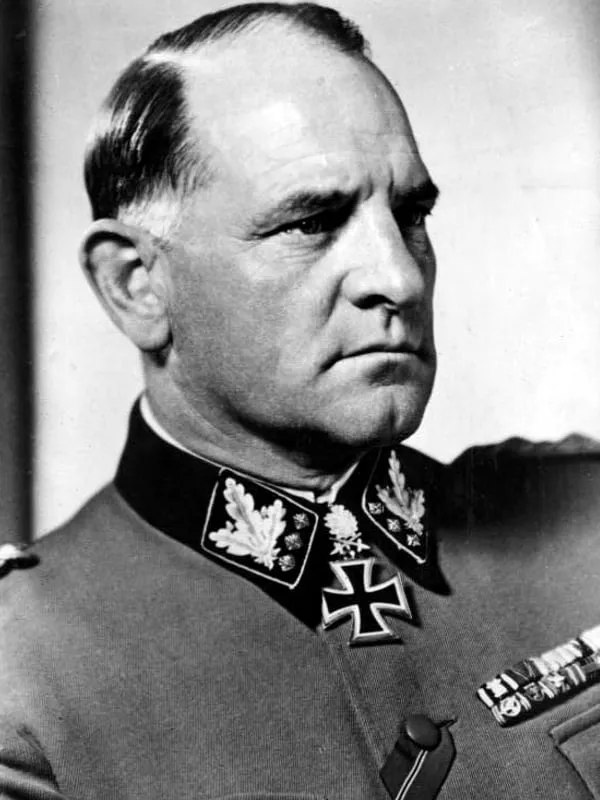
- Born:
- 28 May 1892, Hawangen near Memmingen, Bavaria (German Empire)
- Died:
- 21 April 1966, Ludwigsburg (West Germany)
- Author:
- Łukasz
- Photo:
- autor nieznany, CC BY-SA 3.0 DE, Wikimedia Commons

Josef “Sepp” Dietrich was a Bavarian NCO of the First World War who, thanks to his personal loyalty to Adolf Hitler, rose higher than anyone else in the Waffen-SS. From the Führer’s bodyguard detachment he built the Leibstandarte SS Adolf Hitler, led it through Poland, France, Greece and Russia, and in the last year of the war commanded a panzer army in the Ardennes and in Hungary. His soldiers liked him, staff officers doubted his abilities, and units under his orders committed a series of war crimes: from the executions in Stadelheim prison in 1934 to the murder of American prisoners at Malmedy.
From the Allgäu to tanks and the police
Josef Dietrich was born on 28 May 1892 in Hawangen near Memmingen, into a Catholic rural family. After elementary school he trained in the hotel trade in Zurich and took odd jobs. In August 1914 he went to war as an artilleryman and fought on the Western Front, where he was wounded several times. In 1918 he joined a Bavarian tank unit that used captured British Mark IV tanks; he ended the war as an NCO with the Iron Cross.
After the war he served in the Bavarian state police, then worked among other things at a petrol station owned by Christian Weber, one of Hitler’s oldest comrades. Dietrich’s later stories of fighting with the Freikorps Oberland in Upper Silesia in 1921 and of taking part in the Munich Putsch of 1923 find no confirmation in the documents; the German biographical dictionary NDB judges his accounts of those years to be partly false and partly heavily embellished.
Hitler’s bodyguard
In 1928 Dietrich joined the NSDAP and the SS, and he soon found himself in Hitler’s closest circle as bodyguard and driver on his travels. In September 1930 he was elected to the Reichstag, where he sat until 1945. In March 1933, after the seizure of power, Hitler had him form a guard unit for the Reich Chancellery in Berlin, which in September was named the Leibstandarte SS Adolf Hitler. It was a formation answerable to the Führer personally, and in time the nucleus of the Waffen-SS.
On 30 June 1934, during the Night of the Long Knives, a Leibstandarte firing squad under Dietrich’s command shot six SA leaders chosen by Hitler in Munich’s Stadelheim prison, and his men also killed at the barracks in Berlin-Lichterfelde. The next day Dietrich was made an SS-Obergruppenführer. In 1938 the Leibstandarte marched into Austria and the Sudetenland, and in March 1939 into Prague.
The Leibstandarte at war
In September 1939 the motorised Leibstandarte regiment fought in Poland; even then its soldiers were accused of burning villages and killing civilians. In May 1940 it fought in the Netherlands and France. On 24 May, despite the halt order, it crossed the canal at Watten, and on 28 May its soldiers murdered around eighty captured British and French soldiers at Wormhout. In July Dietrich received the Knight’s Cross.
In the spring of 1941 the Leibstandarte, expanded to a brigade, went through Yugoslav Macedonia into Greece and broke through the Klidi Pass near Vevi. On 20 April it was to Dietrich that General Georgios Tsolakoglou, without the consent of his own government, surrendered the Greek Army of Epirus. In Operation Barbarossa the brigade fought with Army Group South at Uman, on the Sea of Azov and in the Crimea, and on 21 November it took Rostov-on-Don. When the Red Army retook the city a week later, and Field Marshal Gerd von Rundstedt withdrew his troops behind the Mius against Hitler’s wishes and was dismissed, Dietrich, questioned by the Führer on the spot, defended Rundstedt’s decision. At the end of the year he received the Oak Leaves.
In 1942 the Leibstandarte, reorganised in France as a panzergrenadier division, was equipped with tanks. In the spring of 1943, as part of Paul Hausser’s SS Panzer Corps, it took part in the Third Battle of Kharkov and in March recaptured the city; Dietrich received the Swords to the Knight’s Cross. In the summer he handed over the division and took command of I SS Panzer Corps “Leibstandarte”, although he had never had any staff training.
Normandy and the Ardennes
After the Allied landings in June 1944, Dietrich’s corps, with the “Leibstandarte” and “Hitlerjugend” divisions, held out for two months around Caen against the British and Canadians in the Battle of Normandy. In August Dietrich received the Diamonds to the Knight’s Cross and the highest rank in the Waffen-SS, SS-Oberst-Gruppenführer and Colonel General of Panzer Troops of the Waffen-SS (according to some sources with seniority from April 1942). In the same month he took command of the Fifth Panzer Army, which he led out of the Falaise pocket and back across the Seine.
In the autumn of 1944 Hitler gave him the newly formed Sixth Panzer Army, with four SS panzer divisions. In the Ardennes offensive, launched on 16 December, Dietrich’s army was to deliver the main blow: break through the American front, reach the Meuse near Liège and drive on Antwerp. Its attack, however, stalled on the Elsenborn ridge, and its most advanced battle group, under Joachim Peiper, was surrounded and destroyed. It was Peiper’s men who on 17 December murdered dozens of American prisoners near Malmedy. In the Ardennes Dietrich was overwhelmed by the scale of the task; the paratroop commander Friedrich August von der Heydte recalled that the army commander did not even know the details of the plan.
Hungary and Vienna
In January 1945 Hitler moved the Sixth SS Panzer Army to Hungary to defend the last oilfields still available to the Reich. Operation Frühlingserwachen, launched on 6 March by Lake Balaton, bogged down after ten days in mud and deep Soviet defences. A furious Hitler ordered the SS divisions to remove the cuff titles bearing their names from their sleeves, which the veterans regarded as a disgrace; according to accounts from Dietrich’s circle, he did not pass the order on. The army fell back into Austria and in April defended Vienna, where Dietrich argued with the city commandant about how to conduct the defence, the two agreeing only that it had no chance. On 8 May 1945 he surrendered to the Americans with the remnants of his army.
Trials and last years
In 1946 Dietrich sat in the dock of an American military tribunal at Dachau together with Peiper and his soldiers. On 16 July he was sentenced to life imprisonment for the crime at Malmedy committed by soldiers under his command. In 1951, after a review of sentences that had been challenged in part because of interrogation methods, his sentence was reduced to 25 years, and in October 1955 Dietrich was released on parole from Landsberg prison. Soon afterwards he stood trial before a German court in Munich for his part in the killings of 1934; in May 1957 he was sentenced to 18 months for aiding and abetting manslaughter, of which he served six months. He was on the leadership of HIAG, an organisation of former Waffen-SS soldiers campaigning for their rehabilitation in society. He died of a heart attack in Ludwigsburg on 21 April 1966 (the NDB gives 22 April). Several thousand SS veterans came to his funeral.
The verdict on Dietrich as a commander is unanimous and unflattering. Rundstedt is said to have called him “decent but stupid”, and historians stress that he made up for his lack of military knowledge with daring and personal courage, which won his soldiers over. He was promoted not for his talents but because of Hitler’s trust, and he carried out Hitler’s orders without question. Biographers note that to the end of his life he never recognised his own complicity in the regime’s crimes, and the NDB lists war crimes by his units in Poland, France, Belgium, Italy and the Soviet Union.
Sources
Commanded in battles
(03)Mentioned in battles
(02)Often appears with
People who appear in the same events.