Germany
Ludwig Beck
Chief of the Truppenamt (1933–1935) and of the Army General Staff (1935–1938), leader of the military opposition, designated head of state after the 20 July 1944 plot
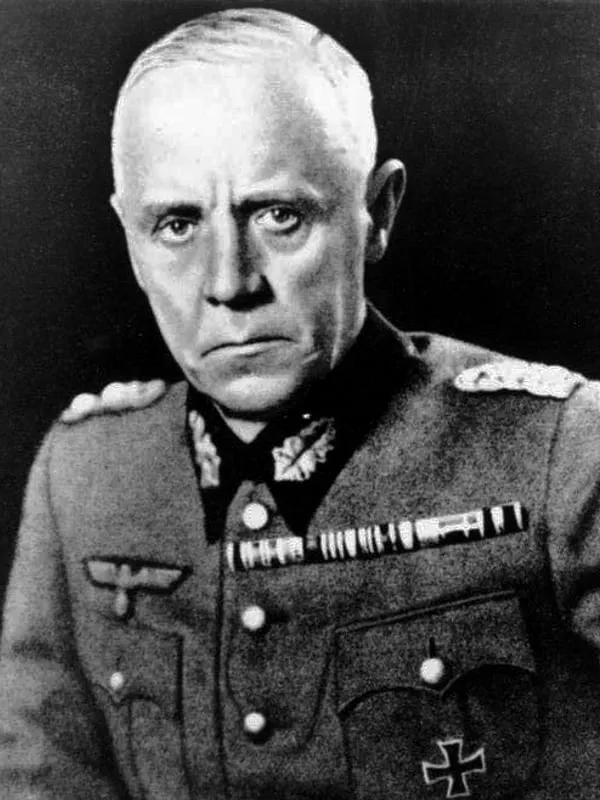
- Born:
- 29 June 1880, Biebrich, now Wiesbaden (Hesse-Nassau, Kingdom of Prussia)
- Died:
- 20 July 1944, Berlin (Germany)
- Author:
- Natalia
- Photo:
- autor nieznany, CC BY-SA 3.0 DE, Wikimedia Commons

From 1933 to 1938 Ludwig Beck was the German army’s chief planner, the man who prepared its rebuilding after Versailles and wrote the manuals on which a generation of Wehrmacht commanders was brought up. In the summer of 1938, convinced that an attack on Czechoslovakia would drag Germany into a war with the Western powers that it could not win, he tried to persuade the generals to resign together, and when he failed, he resigned alone. From then on his Berlin flat became one of the centres of the conservative opposition. The conspirators saw him as the future head of state. He died on the evening of 20 July 1944 in the army headquarters building in Berlin, when the attempt on Hitler’s life had failed. He is an ambiguous figure: he opposed a premature war that Germany would lose, while for a long time not opposing the aims of conquest themselves.
Artilleryman and staff officer
Ludwig August Theodor Beck was born on 29 June 1880 in Biebrich on the Rhine, a small town incorporated into Wiesbaden in 1926. His father, also Ludwig, was an industrialist and metallurgist; his mother Bertha came from the Hessian Draudt family. After his school-leaving examinations in Wiesbaden, Beck joined a Prussian field artillery regiment stationed in Strasbourg as an officer cadet in March 1898, and in August 1899 he received his first commission. From 1908 to 1911 he studied at the War Academy in Berlin, and in 1913, as a captain, he was posted to the Great General Staff.
He spent the First World War in staff posts on the Western Front: with a reserve corps, then with two divisions, and finally, from the end of 1916, at the headquarters of the Crown Prince’s army group. In April 1918 he was promoted to major. In May 1916 he married Amalie Pagenstecher in Bremen; she died in November 1917, a few months after the birth of their daughter Gertrud. Beck never remarried. He experienced the defeat of 1918 and the revolution as a catastrophe, and rebuilding the army became his life’s work.
In the Reichswehr
After the war Beck stayed on in the 100,000-man Reichswehr of General Hans von Seeckt. He commanded an artillery battalion in Münster, ran the camouflaged training of staff officers that replaced the war academy banned by the Treaty of Versailles, served as chief of staff of a division in Dresden and from 1929, by then a colonel, commanded the 5th Artillery Regiment.
In 1930 his name appeared in the newspapers. Three young officers of his regiment, Richard Scheringer, Hanns Ludin and Hans Friedrich Wendt, were charged before the Reich Court in Leipzig with forming a Nazi Party cell in the army, although soldiers were not allowed to belong to any party. Beck testified in their favour and argued that since the army was constantly told it was to be an army of leaders, young officers had every right to understand it in that way. Historians point out that he was twisting Seeckt’s principle, which was to train officers as future commanders of a larger army, not as political activists. Adolf Hitler himself remembered this testimony with gratitude.
In February 1931 Beck became a major general. From 1931 to 1933 he led the team that drew up the manual “Truppenführung” (“Command of Troops”), the basis of the tactics of the future Wehrmacht. In the autumn of 1932 he took over the 1st Cavalry Division in Frankfurt an der Oder and was promoted to lieutenant general.
Builder of Hitler’s general staff
Beck welcomed the Nazi seizure of power with relief. He wrote that he had wished for a political revolution for years and that this was the first ray of hope since 1918. In October 1933 he became head of the Truppenamt, the general staff hidden under that name, and when in 1935 Germany openly broke with the Versailles limits, he became Chief of the General Staff of the Army, and in the autumn of that year a general of artillery. Together with Werner von Fritsch he directed the expansion of the army to 36 divisions, and then beyond.
The first cracks appeared early. On 2 August 1934 the armed forces swore an oath of loyalty to Hitler personally; according to later accounts Beck called it the blackest day of his life, but he did not leave the army. He was hard-working and meticulous and was respected by the officer corps, but many felt he got lost in details. He believed that the chief of staff should advise the country’s leadership directly on matters of war, which led to disputes with the War Minister, Werner von Blomberg. He was cautious about new weapons: he supported building armoured forces, but not at the pace and on the scale that Heinz Guderian demanded. His deputy and protégé was Erich von Manstein, who was regarded as his successor.
Beck was no pacifist. He believed that Germany should regain its position as the leading power in Europe and bring Central Europe under its control, by force if need be. His quarrel with Hitler was not about whether to wage war but about when and at what risk. In May 1937 he refused to prepare orders for an invasion of Austria because he feared intervention by the great powers, but when in March 1938 he became sure that there would be no war, he drew up the orders for the Anschluss without delay. When Hitler set out his plans for an early reckoning with Austria and Czechoslovakia at the secret conference of 5 November 1937, Beck, after reading Hossbach’s memorandum of the meeting, wrote down critical comments: he did not question the aims but accused the plans of recklessness.
The crisis of 1938
At the beginning of 1938 Hitler got rid of Blomberg and Fritsch in the Blomberg–Fritsch affair and took command of the Wehrmacht himself. Beck saw this as a threat to the army’s position, and the new commander of the army, Walther von Brauchitsch, had neither the strength nor the will to stand up to Hitler. When in the spring Hitler announced that he would smash Czechoslovakia that very year, Beck began writing memoranda. In the first, of 5 May, he argued that France had the strongest army in Europe, that Britain would stand by her, and that Germany’s economic position was worse than in 1917–1918. In the following ones, at the end of May, he conceded that the existence of Czechoslovakia was intolerable for Germany and that it would have to be removed, by war if necessary, but a war in 1938 would be premature and would end in defeat. Hitler called his calculations childish.
In the summer Beck understood that it was not bad advice from his entourage but Hitler himself who was pushing the country towards war. On 16 July he presented Brauchitsch with a plan for a joint stand by the entire generals’ corps. He wrote that a soldier’s obedience ends where knowledge, conscience and responsibility forbid carrying out an order, and that if advice and warnings go unheeded, the highest commanders have the right and the duty to resign. At a meeting of generals on 4 August most shared his fears, but only Busch and Reichenau openly opposed him, and no collective protest followed. A few days later Hitler himself addressed senior officers and won many of them over.
On 18 August 1938 Beck asked to be relieved. He handed over his duties to Franz Halder. At Hitler’s request he agreed that his resignation should not be announced, which stripped it of its meaning as a protest. At the end of October he left the service with the honorary rank of colonel general. In his last weeks before leaving, his criticism was already turning into the idea of a coup. Halder, Colonel Hans Oster of the Abwehr and their associates were preparing to arrest Hitler the moment he gave the order to attack; Beck was in touch with them. Through their emissaries the conspirators asked London for a firm warning to Berlin. Instead came the Munich Agreement, which handed the Sudetenland to Hitler without a war and took the conspirators’ arguments away.
In opposition
For the next six years Beck lived in Berlin-Lichterfelde, without a post and without influence on the army. Former colleagues avoided him and the Gestapo watched his house, but it was to him that people who wanted to overthrow the regime came: the former mayor of Leipzig Carl Friedrich Goerdeler, the diplomat Ulrich von Hassell, and men of Admiral Wilhelm Canaris. He was a member of the Wednesday Society, a club of Berlin intellectuals, to which he gave talks.
In the autumn of 1939, after the conquest of Poland, Beck and Goerdeler urged Halder that the army had a last chance to prevent war in the West and the offensive that Hitler had already ordered. In the winter of 1939–1940 the conspirators, through the Munich lawyer Josef Müller and Pope Pius XII, sounded out the British on the terms on which they would make peace with Germany after Hitler’s overthrow. Under their plans Beck was to head a council of regency. Their ideas of the future, however, were far from giving up conquest: they assumed that Germany would keep Austria, western Poland and the Czech lands. The victory over France in 1940 deprived the opposition of any ground for a long time.
In those years Beck wrote memoranda on the war situation, convinced that Germany was heading for defeat. His papers, notes of conversations and records of the regime’s crimes were kept in a safe at army headquarters in Zossen. In 1942 he fell ill with cancer; at the beginning of 1943 he was operated on at the Charité hospital in Berlin by the surgeon Ferdinand Sauerbruch (PL), also a member of the Wednesday Society. On 8 January 1943, in the flat of Peter Yorck von Wartenburg, Beck chaired a meeting at which the older conservatives of Goerdeler’s circle and the younger members of the Kreisau Circle tried to agree on a programme. Goerdeler was to become chancellor and Beck regent, that is head of state. When in 1943 younger officers took matters into their own hands, led by Claus von Stauffenberg, Beck remained the figure of authority whose name was meant to win over hesitant generals. According to some historians, in 1944 Erwin Rommel, too, linked any support for a coup to Beck’s becoming head of state.
20 July 1944
When Stauffenberg’s bomb exploded at the Wolf’s Lair on 20 July 1944, Beck arrived in the afternoon, in civilian clothes, at the Bendlerblock, the headquarters building on Bendlerstraße. He declared that for him Hitler was dead and made his next steps depend on that, but he had no troops at his disposal and could do little when news began to arrive from Hitler’s headquarters that the dictator had survived. The plot collapsed within hours. In the evening officers loyal to the regime arrested the conspirators, and the freed General Friedrich Fromm, commander of the Replacement Army, who himself knew more about the plot than he wished to admit, ordered the witnesses to be eliminated at once. He allowed Beck, his former superior, to use a pistol. Two suicide attempts failed, and the gravely wounded man was finished off by a sergeant on Fromm’s orders. This happened shortly before midnight. A few minutes later Stauffenberg and three of his companions were shot in the courtyard.
Beck’s body was buried secretly that same night in the St Matthew’s churchyard in Schöneberg. Soon afterwards the SS exhumed the remains, burned them in a crematorium and scattered the ashes on the sewage fields outside Berlin. His daughter Gertrud, the widow of an officer killed near Leningrad, was detained by the Gestapo a few days after the plot and taken to Munich, but after a short time she was allowed to return home.
Assessment
In the Federal Republic Beck became one of the patrons of the Bundeswehr’s tradition: barracks were named after him, Wiesbaden awards a prize for civil courage in his name, and plaques commemorate him at the Bendlerblock and on his house in Lichterfelde. Historians, above all his biographer Klaus-Jürgen Müller, describe him without pathos, however. Beck belonged to the national-conservative elite that for years worked with Hitler because it wanted the same things: a break with Versailles, a large army and hegemony in Central Europe. In 1938 he opposed not aggression but a war that in his view Germany was unable to win, and his resignation, accepted quietly, stopped nothing. At the same time he was one of the few generals who understood what the regime was and drew conclusions from it: he gave up his career, risked his life for six years and did not run away when everything collapsed. His words on the limits of a soldier’s obedience became after the war one of the foundations of the ethics of the German officer.
Sources
Often appears with
People who appear in the same events.