Soviet Union
Boris Shaposhnikov
Chief of the Red Army General Staff (1937–1940 and 1941–1942), Deputy People's Commissar of Defence (1940–1943), commandant of the General Staff Academy (1943–1945), Marshal of the Soviet Union (from 1940)
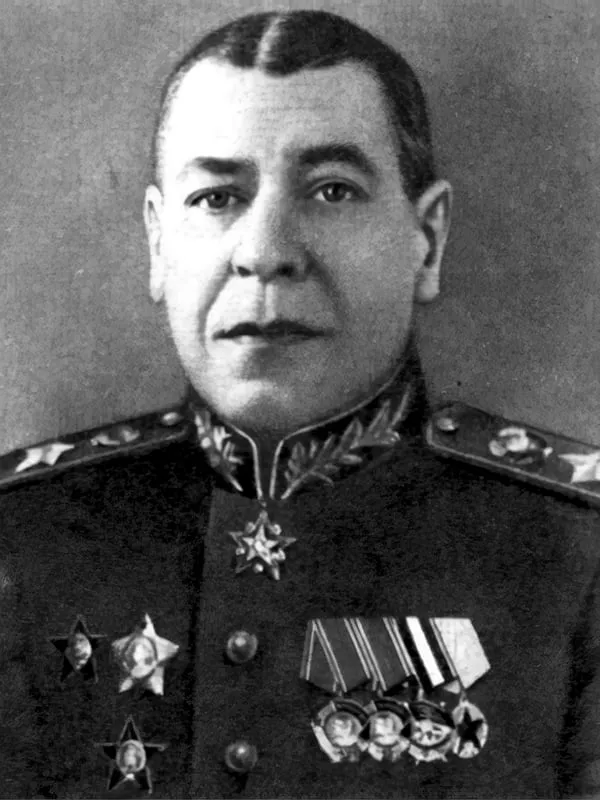
- Born:
- 2 October 1882, Zlatoust, Ufa Governorate (Russian Empire)
- Died:
- 26 March 1945, Moscow (Soviet Union)
- Author:
- Natalia
- Photo:
- autor nieznany, CC BY 4.0, Wikimedia Commons

Boris Shaposhnikov was the most important of the former officers of the Tsarist General Staff who went over to the Bolsheviks and taught the Red Army how to plan wars. He did not command any great operation of the Second World War in the field, but for years he sat at the table where Joseph Stalin took his military decisions. As Chief of the General Staff he signed the directives for the march into Poland in September 1939 and settled the line of the new border with the Germans, and in the darkest period of the war, from July 1941 to May 1942, he headed the staff again. Stalin, who trusted almost no one, addressed him, alone among the soldiers, by his first name and patronymic. Shaposhnikov died of tuberculosis six weeks before victory.
An officer of the Tsarist staff
He was born on 2 October 1882 (20 September in the Julian calendar) in Zlatoust in the Urals, into the family of an office worker with Cossack roots. In 1903 he graduated from the Alexeyevsky Military School in Moscow and began his service in a battalion of Turkestan riflemen in Tashkent. From 1907 to 1910 he studied at the Nicholas General Staff Academy in St Petersburg, in the same group as the future White leader Pyotr Wrangel, and graduated with distinction. In 1912 he was transferred to the staff of the 14th Cavalry Division in Częstochowa (PL), in the Kingdom of Poland.
With this division he went to the front in 1914, and in October he suffered a head contusion. Throughout the war he held staff posts, among others on the staff of the 12th Army and as chief of staff of a Cossack brigade and division. In September 1917, as a colonel, he took command of a grenadier regiment, and in November a soldiers’ congress elected him commander of the Caucasian Grenadier Division.
On the staff of the revolution
In May 1918 he volunteered for the Red Army. He worked in the Republic’s command bodies, and from October 1919 he headed the Operations Directorate of the Field Staff, in other words the planning of every front of the Civil War. Under the commander-in-chief Sergei Kamenev he prepared the plans for the defeat of Denikin and for the campaigns of 1920, including the war with Poland. He described the experience of that summer in his book “On the Vistula” (1924), one of the more important Soviet studies of the defeat at Warsaw.
In the 1920s he was deputy chief of staff of the Red Army and commanded the Leningrad and Moscow military districts, and in 1928 he succeeded Mikhail Tukhachevsky as chief of staff. The two men disliked each other, and Shaposhnikov stood for a different approach: instead of bold visions of revolutionary war, he relied on solid organisational work. In 1927–1929 he published the three-volume “The Brain of the Army”, a study of the general staff as the body through which the supreme command directs the armed forces as a whole. According to Russian scholars he borrowed the title from the British writer Spenser Wilkinson. Stalin is said to have kept the book on his desk.
Surviving the purge
In 1931, according to some biographers after a denunciation by an arrested officer, he was sidelined to command the Volga Military District, but soon became commandant of the Frunze Military Academy, and in 1935 again commander of the Leningrad Military District and a komandarm 1st rank. According to the Soviet encyclopaedia he joined the party in 1930; some Western works give 1939.
On 10 May 1937, on the eve of the Great Purge in the army, he became Chief of the General Staff. A few weeks later he sat on the special court which on 11 June sentenced Tukhachevsky, Ieronim Uborevich, Iona Yakir and other commanders to death. The NKVD also collected testimony against him, but Stalin spared him. The price of survival was complicity in the destruction of his colleagues, and yet, as historians stress, he then helped to rebuild the cadres of the decimated army.
Poland and Finland
In September 1939, while covert mobilisation was under way in the western districts, Shaposhnikov and the People’s Commissar of Defence Kliment Voroshilov prepared the directives for the Belorussian and Ukrainian Fronts, which on 17 September marched into Poland. On 20 September, together with Voroshilov, he began talks with the German military attaché Ernst Köstring on the demarcation line between the armies, and at the end of the month, with his participation, the course of the border was agreed in the Boundary and Friendship Treaty.
In the autumn of 1939 he proposed that the war with Finland should be fought with a carefully prepared blow by the best forces on the Karelian Isthmus, and he did not believe in a quick victory. Stalin chose the faster plan of Kirill Meretskov’s Leningrad Military District, which reckoned on two weeks. After the defeats of December 1939 the Winter War was taken over by a headquarters in Moscow on which Shaposhnikov sat, and the second, successful assault on the Mannerheim Line was prepared in the spirit of his original proposals. On 7 May 1940 he was made a Marshal of the Soviet Union, but in August, officially because of illness, he handed the staff over to Meretskov and, as Deputy People’s Commissar of Defence, directed the building of fortifications on the new western border. In June 1940, together with Semyon Timoshenko, he signed the directive that prepared the Red Army’s entry into Latvia and Estonia.
Head of the staff again
After the German invasion he became a member of the Stavka; at the end of July he was briefly chief of staff of the Western Direction during the Battle of Smolensk, and on 29 July 1941 he replaced Georgy Zhukov as Chief of the General Staff. Zhukov had lost the post because he advised giving up Kiev. Shaposhnikov did not oppose Stalin so openly. When in September the chief of staff of the South-Western Front, Vasily Tupikov, cabled that a catastrophe would come within days, Shaposhnikov replied that this was panic and demanded that Stalin’s order be carried out. He passed on permission to abandon Kiev only on the night of 17–18 September, when the encirclement had already closed.
In the autumn of 1941 the staff under his direction, with his deputy Aleksandr Vasilevsky, prepared the defence and counter-offensive in the Battle of Moscow. According to Zhukov’s memoirs, when at a conference on 5 January 1942 he argued with Stalin against a general offensive on all fronts, Shaposhnikov told him afterwards that he had argued in vain, because the directives had already been sent out. In the spring of 1942 he advised a strategic defence and warned against an attack from the Barvenkovo salient, but Stalin approved the offensive at Kharkov, which ended in disaster. Increasingly ill, and more and more often replaced by Vasilevsky, he handed the staff over to him in May 1942. In August of that year he still held talks at the Kremlin with British generals when Winston Churchill flew to Moscow.
The last years
Until June 1943 he was Deputy People’s Commissar of Defence, and then commandant of the Voroshilov Higher Military Academy, which trained general staff officers. In February 1944 he received the Order of Suvorov, 1st Class, for planning the operations of 1941 and 1942. He died of pulmonary tuberculosis on 26 March 1945 in Moscow. He was the only Marshal of the Soviet Union to die during the war. Moscow bade him farewell with a salute from 124 guns, and the urn with his ashes was placed in the Kremlin Wall.
Assessment
Shaposhnikov was not a field commander but an organiser and a teacher. He brought up his successors, above all Vasilevsky, and shaped the General Staff that planned the Red Army’s great operations in the second half of the war. Courteous, impeccably polite and calm, he addressed his subordinates as “golubchik”, “my dear fellow”. Yet the same caution that allowed him to survive the purge meant that he rarely stood up to Stalin, even when he thought his decisions wrong. His signature stands under the orders by which the Soviet Union occupied eastern Poland and the Baltic states in 1939 and 1940.
Sources
Mentioned in battles
(06)Often appears with
People who appear in the same events.