Germany
Ferdinand Schörner
Commander of the 6th Mountain Division (1940–1942) and XIX Mountain Corps (1942–1943), commander of Army Groups South Ukraine, North and Centre (1944–1945), Commander-in-Chief of the Army (April–May 1945)
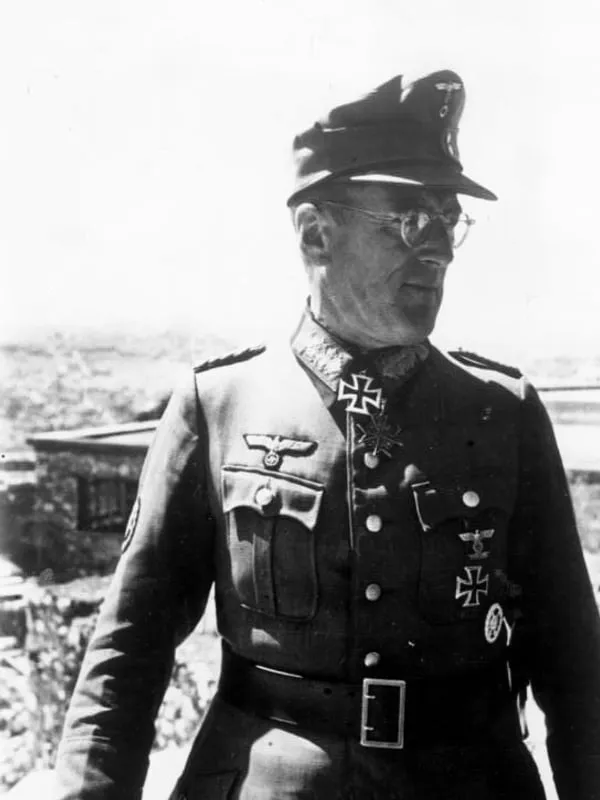
- Born:
- 12 June 1892, Munich, Kingdom of Bavaria (German Empire)
- Died:
- 2 July 1973, Munich (West Germany)
- Author:
- Natalia
- Photo:
- Scheerer, CC BY-SA 3.0 DE, Wikimedia Commons

Ferdinand Schörner was Hitler’s last field marshal and one of the Wehrmacht commanders most hated by his own soldiers. The son of a Munich policeman who had started out in the army as a one-year volunteer, in the last fifteen months of the war he commanded four army groups in succession on the Eastern Front: in southern Ukraine and the Crimea, on the Baltic and in Courland, and finally in Silesia and Bohemia. Adolf Hitler valued him for his fanatical faith in victory and his ruthlessness, and in his testament appointed him Commander-in-Chief of the Army. The soldiers called him “Bloody Ferdinand”, because in his forces drumhead courts hanged and shot alleged deserters. In May 1945, while his army group was still fighting in Bohemia, he himself flew off to the Alps in civilian clothes. After the war he spent years in Soviet labour camps, and in West Germany he was convicted of killing his own soldiers.
The one-year volunteer of Caporetto
Johann Ferdinand Schörner was born in Munich on 12 June 1892. After leaving school, from October 1911, he did a year’s volunteer service in the Bavarian Infantry Life Regiment (Infanterie-Leib-Regiment) and left the army as an NCO. He had no intention of becoming a professional soldier: he wanted to teach, and so studied philosophy and Romance languages in Munich, and also in Lausanne and Grenoble. His Italian would come in useful more than once.
In August 1914 he returned to his regiment; in November he was commissioned as a reserve second lieutenant and given a company. He fought in France, was badly wounded in the attack on Fleury at Verdun in August 1916, and also served in the Tyrol, in Romania and in Italy. In the autumn of 1917, during the Battle of Caporetto, his 12th Company took Hill 1114 on the Kolovrat ridge, one of the pillars of the Italian defence. For this he received the Pour le Mérite. The same order was awarded for taking the nearby Mount Matajur to a Württemberg lieutenant, Erwin Rommel, who disputed the Bavarian’s achievement; the two argued for the rest of their lives over who had really broken the Italian line. At the end of 1917 Schörner transferred to the regular army, in the summer of 1918 he was promoted to lieutenant, and just before the armistice he was badly wounded again.
Between the wars
In the spring of 1919 he joined Franz von Epp’s volunteer Freikorps (PL) and, as a company commander, fought against the Bavarian Soviet Republic, and in 1920 against the workers’ militias in the Ruhr. Taken into the Reichswehr, in November 1923 he was serving on the staff of General Otto von Lossow’s Bavarian 7th Division and took part in putting down the Munich putsch. The man who then stood on the side of order against Hitler would twenty years later be regarded as the general most devoted to him.
His career in the small Weimar army advanced slowly. Schörner commanded companies in Bavaria, spent some time in Italy as a liaison officer and interpreter with the Alpini mountain troops, and from 1931 taught tactics at the infantry school in Dresden. In 1934 he became a major, and in the mid-1930s he moved to the foreign armies department of the Army General Staff, where he dealt with south-eastern Europe and military cooperation with Mussolini’s Italy. On 12 October 1937 he took command of the 98th Mountain Infantry Regiment, with which he took part in the Anschluss of Austria in March 1938.
From Lwów to the Arctic
In September 1939 his regiment fought in the September Campaign as part of the 1st Mountain Division. On 12 September Schörner’s battle group, pushed far ahead of the main body, reached Lwów and tried to break into the city on the march. The Polish defenders stopped it, and Lwów held out for more than another week, until on 22 September it surrendered to the Red Army.
In the spring of 1940 Schörner formed the 6th Mountain Division, with which he broke through the front in the Vosges during the French campaign; in August he was promoted to major general. In April 1941 the division attacked Greece from Bulgaria. His mountain troops crossed the Belasica range, where there were no permanent forts, and broke through the Metaxas Line; then, in the German invasion of Greece, they pursued the British and Australians as far as Thermopylae. On 20 April Schörner received the Knight’s Cross of the Iron Cross. Seven days later the division’s advance guard entered Athens and raised the German war flag on the Acropolis, and its commander became commandant of the city.
In the autumn of 1941 the division was moved to the Arctic front, where the Germans and Finns tried in vain to reach Murmansk. In January 1942 Schörner succeeded Eduard Dietl in command of Mountain Corps Norway, later renamed XIX Mountain Corps, and in June he was promoted to General of Mountain Troops. For almost two years he held the front in the tundra, covering the nickel mines around Petsamo, which the Red Army took only in the autumn of 1944.
Nikopol and the Crimea
In the autumn of 1943 Schörner was sent to Ukraine, where after the Battle of the Dnieper the Red Army was pushing towards Krivoy Rog. He took over XXXX Panzer Corps, and soon a grouping of three corps, known as Group Schörner, which held the bridgehead on the left bank of the Dnieper at Nikopol. In February 1944, when a Soviet attack threatened to encircle it, he withdrew his troops across the river. Opinions of this retreat differ: the Neue Deutsche Biographie stresses that Schörner abandoned untenable positions against orders and saved the wounded, while other authors point out that he authorised the withdrawal so late that his troops lost almost all their vehicles. On 17 February he received the Oak Leaves.
By then he was already regarded as a Party general. Although soldiers were not allowed to belong to the NSDAP, in 1943 he was given the Golden Party Badge and a membership card. At the beginning of 1944 he spent a few weeks at the head of the new National Socialist Leadership Staff of the Army, which was supposed to educate the army in the spirit of Nazism; according to German biographers, he left after a clash with Martin Bormann.
In March Schörner briefly took over the Seventeenth Army in the Crimea, and when at the end of the month Hitler dismissed Field Marshal Ewald von Kleist, he inherited his Army Group A, renamed Army Group South Ukraine on 5 April. As late as 7 April he gave assurances that the defence of the Crimea was secure for a long time; the next day the Crimean offensive began, and within a few days the front fell apart. Schörner changed his mind and began to press for evacuation, but Hitler agreed to it only on 9 May, when Soviet troops were breaking into Sevastopol. Thousands of German and Romanian soldiers waiting on the quays for ships were killed or captured; the Neue Deutsche Biographie speaks of nearly 30,000 men lost. In May Schörner was promoted to colonel general.
Courland
At the end of July 1944, after the destruction of Army Group Centre in Operation Bagration, Hitler swapped commanders: Johannes Frießner went from Army Group North to Romania, and Schörner took his place on the Baltic. On the Narva front he immediately demanded “fanatical” resistance and the recapture of the lost hills. The situation was desperate: Soviet troops had reached the Gulf of Riga and cut the army group off from the rest of the front. In August a German counter-attack reopened a narrow corridor along the coast, for which Schörner received the Swords to the Knight’s Cross on 28 August.
In September, when the Baltic offensive began, he wrung from Hitler permission to abandon mainland Estonia and pulled his troops back into Latvia. In October the 1st Baltic Front of Ivan Bagramyan reached the sea near Memel and shut the Sixteenth and Eighteenth Armies into Courland. Schörner tried to break through to the south, without success, and in November, against an earlier prohibition by Hitler, he evacuated by sea the defenders of the Sworbe peninsula on Saaremaa. Successive Soviet assaults on Courland broke down; on 1 January 1945 Schörner received the Diamonds to the Knight’s Cross. The historians Karl-Heinz Frieser and Howard Grier believe that in these months he showed an astonishing talent for organisation and, when he considered it necessary, acted on his own authority, even against Hitler.
Silesia and Bohemia
After the front on the Vistula was broken in the Vistula–Oder offensive, Hitler made General Josef Harpe the scapegoat and on 20 January 1945 gave Army Group A to Schörner; a few days later it was renamed Army Group Centre. Although the Führer had ordered the industrial region to be held at all costs, on the night of 27–28 January Schörner allowed the troops to withdraw from the pocket taking shape around Katowice and gave up Upper Silesia, reporting it only after the event. At the beginning of February he replaced the commandant of Fortress Breslau.
In the spring of 1945 he became a byword for terror against his own soldiers. Anyone caught behind the lines without written orders could be brought before a drumhead court; those condemned were hanged by the roadside with placards reading “I am a deserter”. Joseph Goebbels noted admiringly in March that deserters could expect no mercy from Schörner, and that every one of his soldiers knew he might die at the front but would certainly die in the rear. Schörner himself is credited with saying that a soldier should fear what lay behind him more than what lay in front. In March he wanted to have General Hanns von Rohr shot for refusing to execute soldiers who had fled from tanks; the Army High Command commuted the sentence to demotion. On 5 April Hitler made him a field marshal.
When the Berlin offensive began on 16 April, it was Schörner’s front on the Lusatian Neisse that Ivan Konev’s 1st Ukrainian Front broke through. The field marshal confirmed Hitler in his belief that the Russians’ main objective was Prague rather than Berlin, which led the Führer to weaken the already thin defences in front of the capital. From 21 April his troops counter-attacked at Bautzen, inflicting heavy losses on the Polish Second Army. In his political testament of 29 April Hitler named him Commander-in-Chief of the Army, but Schörner had neither a staff nor any real authority beyond his own army group.
In May he commanded the last large concentration of the Wehrmacht, according to Soviet figures some 900,000 men in Bohemia and Moravia. When the Prague uprising broke out on 5 May, he ordered it to be crushed. As late as 8 May he was telling his soldiers that the news of the surrender was false. On the night of 8–9 May he abandoned his command and flew to Austria in a Fieseler Storch liaison aircraft, in civilian clothes and with money from the headquarters cash box. Most of his soldiers, trying to break through to the west, ended up in Soviet captivity in the Prague offensive. Schörner himself was detained by the Americans in the second half of May, and they handed him over to the Soviets.
Sentences and verdict
In February 1952 the Military Collegium of the Supreme Court of the USSR sentenced Schörner to 25 years’ imprisonment for war crimes; later that same year the sentence was reduced to 12½ years. In January 1955, seriously ill, he was handed over to East Germany and released, after which he moved to Munich. In West Germany his return caused an uproar. Franz Josef Strauß, later defence minister, called him a “monster in uniform”, and the Bundestag changed the law in order to strip him of his pension. In October 1957 the Munich regional court sentenced him to four and a half years in prison for manslaughter and attempted manslaughter in connection with executions of his own soldiers in 1945. On health grounds he was released on 4 August 1960. He died in Munich on 2 July 1973, the last surviving field marshal of the Third Reich. He was buried in Mittenwald; soldiers of the Bundeswehr were forbidden to attend the funeral in uniform.
His biographers agree that he was an energetic and able commander who could extract from his superiors decisions to retreat that others were refused. The German historian Klaus Schönherr called him “the ideal type of Nazi general”, and the British Hitler biographer Ian Kershaw described him as a fanatical loyalist and an extraordinarily brutal man. What has stuck to his legend above all is May 1945: the commander who hanged soldiers for running away from the front ran away from his own army.
Sources
Commanded in battles
(03)Mentioned in battles
(05)Often appears with
People who appear in the same events.
On the timeline
(27)1941
1944
1945
January
February
March
April
May
- 08
- The surrender of CourlandOn 8 May 1945, on Dönitz's orders, General Carl Hilpert's Army Group Courland surrendered to the Leningrad Front. Some 190,000 men went into captivity.
- Key eventThe surrender at KarlshorstOn 8 May 1945 in Berlin-Karlshorst, Keitel, Friedeburg and Stumpff signed Germany's final act of unconditional surrender before Zhukov and Tedder.
- 09
- Victory Day in the USSRA decree of 8 May 1945 made 9 May Victory Day in the USSR. That evening Stalin announced the end of the war with Germany, and Moscow fired a 30-salvo salute.
- The Red Army in PragueOn the morning of 9 May 1945 Konev's tanks entered Prague. By 11 May Army Group Centre had surrendered, while the Americans halted on a line near Plzeň.