United States
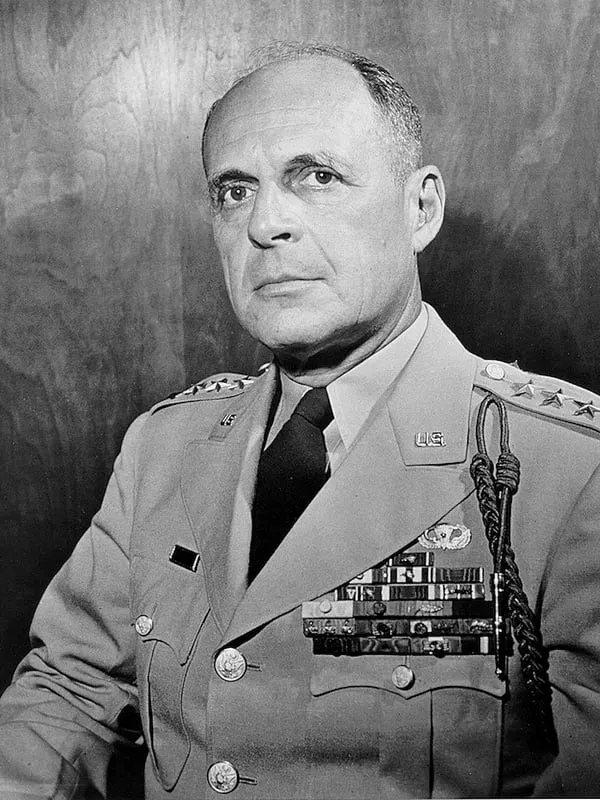
Matthew Ridgway
Commander of the 82nd Airborne Division (1942–1944) and of the XVIII Airborne Corps (1944–1945)
- Born:
- 3 March 1895, Fort Monroe, Virginia (United States)
- Died:
- 26 July 1993, Fox Chapel, Pennsylvania (United States)
- Author:
- Łukasz
- Photo:
- United States Army Japan, domena publiczna, Wikimedia Commons

Matthew Ridgway was one of the fathers of the American airborne forces. In 1942 he took over an infantry division that was to become the first American parachute division, and led it in three great airborne operations: in Sicily, at Salerno and in Normandy. From August 1944 he commanded the XVIII Airborne Corps, which held the northern shoulder in the Ardennes, landed beyond the Rhine in Operation Varsity and closed the Ruhr pocket. He was known as a commander who led from the front line and was not afraid to tell his superiors uncomfortable things. That quality later made him the most famous American commander of the Korean War.
A gunner’s son
Matthew Bunker Ridgway was born on 3 March 1895 at Fort Monroe in Virginia, the son of Colonel Thomas Ridgway, an artillery officer. He spent his childhood moving from garrison to garrison and went to the Military Academy at West Point above all to please his father. He failed the mathematics examination the first time and got in at the second attempt. He graduated in April 1917, a couple of weeks after the United States entered the war, in the same class as Mark Clark and Joseph Lawton Collins. He never reached the front, however: he served on the Mexican border and then taught Spanish at West Point, which he regarded as a professional failure.
Between the wars
The interwar years took him round the world in the way typical of an American infantry officer. He commanded a company of the 15th Infantry Regiment in Tianjin in China, in 1927 helped to supervise elections in Nicaragua, and in 1930 advised the American Governor-General of the Philippines. He passed through the staff school at Fort Leavenworth and the Army War College. In China he met George Marshall, who became his patron. When Marshall became Army Chief of Staff in September 1939, he brought Ridgway to the War Plans Division in Washington.
The 82nd Division
In January 1942 Ridgway received his brigadier general’s star, and in February he joined the newly re-formed 82nd Infantry Division as deputy to its commander, Omar Bradley. When Bradley left for another division in the summer, Ridgway, by now a major general, took command (sources give either June or August 1942). On 15 August 1942 the unit was redesignated the 82nd Airborne Division. It was an experience without precedent in the American army: an entire infantry division had to be trained to jump by parachute and to land by glider. Ridgway had not done the parachute course beforehand, but earned his jump wings together with his men. He gave up some of his regiments to the new 101st Division and received instead Reuben Tucker’s 504th Parachute Infantry Regiment and the 505th of James Gavin. In April 1943 the division, which in Ridgway’s view had had barely a third of the training it needed, sailed for North Africa.
Sicily and Italy
On the night of 9–10 July 1943 the division’s first drop, Gavin’s 505th reinforced with a battalion of the 504th, was scattered over a wide area of southern Sicily. Ridgway had to report to George Patton that out of more than five thousand paratroopers he had only a few hundred to hand. The second drop went worse. Ridgway had warned in advance that the flight path led over the invasion fleet, but when the transports carrying the 504th arrived over Gela late in the evening of 11 July, just after a German air raid, they were fired on by their own ships and anti-aircraft guns. The friendly fire brought down 23 aircraft, and dozens of paratroopers and airmen were killed, among them the assistant division commander, Brigadier General Charles Keerans. Ridgway called off the planned glider landing. Later his division advanced as infantry along the western coast of the island in the march on Palermo.
In September 1943 the 82nd was to be dropped on the airfields near Rome, where the Italian army, which was just concluding an armistice, was to secure its landing. Ridgway thought Operation Giant II suicidal, because his men would have come down among German divisions. It was called off at the last moment, with the paratroopers already sitting in their aircraft, after the division’s artillery commander, Maxwell Taylor, sent secretly to Rome, judged it hopeless; the announcement of Italy’s surrender went ahead without it. A few days later the division proved useful elsewhere. On the evening of 13 September, at the critical moment of the fighting at Salerno, Mark Clark, commander of the Fifth Army, asked Ridgway for immediate help. That same night two battalions of the 504th jumped over the beachhead and were in the line before dawn, and more units followed on the next nights. On 1 October Ridgway’s paratroopers entered Naples and took over garrison duty there. Clark called Ridgway an outstanding fighting soldier and was reluctant to give up his division, which in November sailed for Northern Ireland to prepare for the invasion of France.
Normandy
In the planning of Operation Overlord Ridgway pushed through the strengthening of both American airborne divisions to three parachute regiments and a full glider regiment. On the night before the invasion the 82nd jumped west of Utah Beach to take Sainte-Mère-Église and the crossings of the Merderet. Ridgway jumped with his men. The division fought without a break for more than a month, through the Merderet marshes as far as Saint-Sauveur-le-Vicomte on the Cotentin peninsula. At the beginning of July, in the battle of the hedgerows, its regiments took Hill 131 and the Poterie ridge near La Haye-du-Puits. When the division was withdrawn to England, its losses had reached 46 per cent of its strength.
XVIII Airborne Corps
In August 1944 Ridgway took command of the new XVIII Airborne Corps, part of the First Allied Airborne Army, and handed the 82nd over to Gavin. Paradoxically, in the first great operation the corps did not command: in Operation Market Garden both American divisions served under the British I Airborne Corps.
In December 1944, when the Germans struck in the Ardennes, Ridgway’s headquarters took command on the northern shoulder of the breach. Under his orders came the 82nd Division, the 7th Armored Division and the remnants of the 106th Infantry Division defending the road junction at Sankt Vith. The defenders of Sankt Vith withdrew behind the river Salm on 22–23 December, and on Christmas Eve the 82nd too had to pull back to a shorter line. Ridgway, by nature inclined to hold every position, was against it, but the decision lay with Bernard Montgomery, who was then commanding the northern part of the front. Even so, Ridgway later spoke of the British field marshal with appreciation: he said that under his command he had complete freedom of action and full support. From 3 January 1945 Ridgway’s corps, together with Collins’s VII Corps, attacked from the north towards Houffalize, and on 23 January his troops retook the ruins of Sankt Vith.
On 24 March 1945 the XVIII Corps carried out Operation Varsity, the landing of the British 6th and American 17th Airborne Divisions beyond the Rhine near Wesel, which completed Montgomery’s Rhine crossing. That same day Ridgway was wounded in the shoulder by fragments of a German grenade. In his report he stressed that the two divisions had destroyed within a few hours defences whose breaching from the ground might have taken days.
In April the corps, transferred to the First Army, attacked from the south the Army Group B forces encircled in the Ruhr. Ridgway sent an officer with a white flag to its commander, Field Marshal Walter Model, carrying a letter reminding him that General Robert E. Lee had surrendered with honour in 1865 to spare his men. Model refused, citing his oath to Hitler, and a few days later shot himself. At the beginning of May Ridgway’s corps, once again under Montgomery, crossed the Elbe and reached the Baltic, which according to American sources closed the Red Army’s road to Denmark. On 4 June 1945 Ridgway was promoted to lieutenant general, and the end of the war found him on his way to the Pacific.
Korea and assessment
After the war Ridgway commanded the American forces in the Mediterranean, represented the army on the United Nations Military Staff Committee and headed the Caribbean Command. In December 1950, after the death of General Walton Walker, he took over the Eighth Army in Korea, which was retreating before a Chinese offensive. Within a few weeks he restored its will to fight, halted the Chinese and went over to the counter-offensive. When in April 1951 Harry Truman dismissed Douglas MacArthur, Ridgway replaced him as supreme commander of the UN forces in the Korean War and of the Allied occupation authorities in Japan. Bradley called his command in Korea the greatest feat of personal leadership in the history of the American army.
In May 1952 Ridgway succeeded Dwight Eisenhower as Supreme Allied Commander Europe. According to surviving documents, he pressed the Allied High Commissioners in Germany at that time to pardon German officers convicted of crimes committed on the Eastern Front, arguing that he himself had given orders in Korea similar to those for which they were in prison. In August 1953 he became Army Chief of Staff. In 1954 he argued to President Eisenhower that rescuing the French at Dien Bien Phu would require sending many divisions to Indochina and a war with China, which helped to sink the plan for intervention. A dispute with the administration over cuts to the ground forces ended his career: he retired on 30 June 1955. In 1968, as one of the so-called Wise Men advising President Johnson, he argued for seeking a political settlement in Vietnam.
He died on 26 July 1993 at his home in Fox Chapel near Pittsburgh, aged 98, and was buried in Arlington National Cemetery. Historians regard him as one of the best American commanders of his generation: a creator of the airborne forces who jumped with his men in Normandy, and the general who in Korea turned round a campaign that was being lost. His efforts to free German war criminals remain the least remembered and most ambiguous part of that record.
Sources
Commanded in battles
(01)Mentioned in battles
(03)Often appears with
People who appear in the same events.