Soviet Union
Mikhail Katukov
Commander of the 4th (1st Guards) Tank Brigade (1941–1942), the 1st Tank Corps and the 3rd Mechanised Corps (1942), the 1st Tank Army, from 1944 the 1st Guards Tank Army (1943–1945)
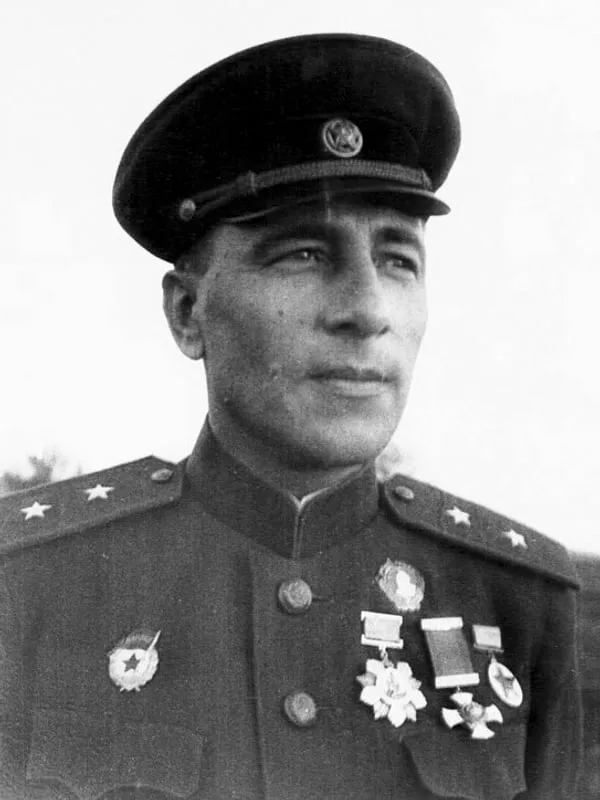
- Born:
- 17 September 1900, Bolshoye Uvarovo, Moscow Governorate (Russian Empire)
- Died:
- 8 June 1976, Moscow (Soviet Union)
- Author:
- Łukasz
- Photo:
- Arkadij Chodow, domena publiczna, Wikimedia Commons

Mikhail Katukov was one of those Soviet commanders who learned armoured warfare at the worst possible moment, in the summer of 1941, and learned it better than most. In June 1941 his division lost its light tanks in its first engagement near Dubno. In October his brigade, equipped with T-34s, used ambushes at Mtsensk to stop the armoured spearhead of Heinz Guderian, and became the first armoured unit of the Red Army to be given the title of Guards. From January 1943 to the end of the war Katukov commanded a single army, the 1st Tank Army, later renamed the 1st Guards. He led it in the defensive battle in the Kursk salient, across Ukraine, to the Vistula at Sandomierz, across Poland to Poznań and the Baltic, and finally through the streets of Berlin. Twice a Hero of the Soviet Union and after the war a Marshal of Armoured Troops, he was among the best armoured commanders on the Soviet side of the front.
A boy from Uvarovo
He was born on 17 September 1900 (4 September by the Julian calendar; the parish register gives a day later) in the village of Bolshoye Uvarovo in the Kolomna district of Moscow Governorate, into a poor peasant family with many children. After four years at the village school he worked on the estate of a local landowner, and in 1912 he went to relatives in St Petersburg, where he was an errand boy in a dairy shop. In 1917 he took part in the Bolshevik seizure of power in Petrograd, and then returned to his village, where his mother had died.
In March 1919 he was called up into the Red Army. As a private he fought against the uprising of the Don Cossacks, survived typhus, and in 1920, as a mounted scout of the 57th Rifle Division, fought in the Polish–Soviet War. After infantry courses in Mogilev he served for ten years in the 27th Rifle Division in Belarus: he commanded a platoon and a company, ran the regimental school and was a regimental chief of staff. In 1927 he completed the “Vystrel” officers’ improvement courses, and in 1932 he joined the party.
In the armoured troops
In May 1932 Katukov moved to the newly forming mechanised forces, to the 5th Independent Mechanised Brigade at Borisov. There he served in turn as chief of staff, head of reconnaissance and commander of the training battalion. In 1935 he completed courses at the Academy of Mechanisation and Motorisation, and then served on the staffs of the 45th Mechanised Corps in the Kiev Military District. In October 1938 he took over the 5th Light Tank Brigade. The Great Purge took many of his superiors in those years but passed him by. In September 1939 he took part in the Soviet invasion of Poland. In November 1940 he became commander of the 20th Tank Division at Shepetivka, part of the 9th Mechanised Corps commanded by Konstantin Rokossovsky.
1941: from Dubno to Mtsensk
At the start of the war the 20th Tank Division was a division in name only: it had a few dozen old light tanks and lacked transport. In the great tank battle of Dubno, Lutsk and Brody the division attacked Mlyniv on 27 June. According to Katukov’s memoirs, all 33 of his BT tanks were destroyed in the first clash. For the following weeks the remnants of the division, by then in effect infantry, covered the retreat of the Fifth Army towards the old border and Kiev. Katukov came out of this fighting convinced that tanks thrown into frontal counter-attacks without reconnaissance or support die to no purpose.
At the end of August he was given the new 4th Tank Brigade, equipped with T-34 and KV tanks. At the beginning of October, in the first days of Operation Typhoon, Guderian’s tanks took Oryol and opened the road to Tula. Katukov’s brigade joined the hastily assembled corps of General Dmitry Lelyushenko and from 4 to 11 October fought the German 4th Panzer Division at Mtsensk. Katukov did not deploy his tanks in the open. He hid them in woods and behind buildings, let the Germans come close, struck from the flank at short range and changed position before the enemy could respond. The brigade’s most successful tank commander was Dmitry Lavrinenko, later regarded as the Soviet tank ace with the highest number of kills. Order No. 337 of the People’s Commissar of Defence of 11 November credited the brigade with destroying 133 enemy tanks for negligible losses of its own. Research in German documents has shown that these figures were inflated and that the two sides’ tank losses were similar. What mattered more, however, was that weaker forces had held up the drive on Tula for a week, and Guderian himself admitted after the war that the superiority of the T-34 had shown itself there for the first time in all its sharpness.
By the same order the brigade became the first armoured unit of the Red Army to receive the title of Guards, together with a new number: the 1st Guards Tank Brigade. The day before, Katukov had been made a major general. In November the brigade defended the Volokolamsk highway outside Moscow, and during the December counter-offensive Katukov commanded a mobile group of several brigades that took part in recapturing Volokolamsk.
1942: Voronezh and Operation Mars
In the spring of 1942 Katukov took over the 1st Tank Corps, which in the summer fought on the Bryansk Front in the Voronezh area against the German offensive in the south. In September he was given the 3rd Mechanised Corps on the Kalinin Front. At the end of November the corps took part in Operation Mars, the failed offensive of Georgy Zhukov against the German salient at Rzhev. Thrown at a deeply echeloned defence in wooded, roadless country, without proper support from infantry and artillery, it lost most of its tanks within a few days. The Stavka concluded, however, that the blame lay with the front command, which had chosen a poor sector for the corps, and not with Katukov himself.
In January 1943 Katukov became a lieutenant general and commander of the new 1st Tank Army. He remained in this post until the end of the war, something rare in the Red Army.
Kursk, Ukraine and Sandomierz
In the summer of 1943 Katukov’s army stood in the second echelon of the Voronezh Front of General Nikolai Vatutin, on the Oboyan axis, that is, in the path of the strongest German armoured grouping on the southern wing of Operation Citadel. After the Battle of Kursk began on 5 July, his army took the blow of the II SS Panzer Corps and the Fourth Panzer Army of Hermann Hoth. Katukov believed that tank counter-attacks against the heavy Tigers and Panthers would end as they had in 1941. According to his memoirs, backed by Stalin in a telephone conversation, he dug in part of his tanks and waited for the Germans in ambush positions, supplementing the defence with short counter-strokes. His army suffered heavy losses and was one of the two hardest hit on the southern sector, but it inflicted serious losses on the attackers and slowed their advance. In August it took part in the counter-offensive towards Belgorod and Kharkov.
In the winter and spring of 1944 Katukov’s army fought in right-bank Ukraine, in the Zhitomir–Berdichev and Proskurov–Chernovtsy operations. On 29 March it took Chernivtsi. In April it was renamed the 1st Guards Tank Army, and Katukov was promoted to colonel general. In July, as part of the 1st Ukrainian Front of Marshal Ivan Konev, it entered the breach on 17 July in the Lvov–Sandomierz operation, helped to cut off the German forces at Brody and at the end of the month reached the Vistula. On 31 July its main forces crossed at Baranów, and throughout August they defended the Sandomierz bridgehead against German counter-attacks. For this operation Katukov received his first Gold Star of a Hero of the Soviet Union on 23 September 1944.
1945: from the Vistula to Berlin
In January 1945 the army, transferred to Zhukov’s 1st Belorussian Front, went into action in the Vistula–Oder operation on 15 January, the second day of the attack from the Magnuszew bridgehead. On 17 January it forced the Pilica, and its spearheads were soon in Łódź and Gniezno. Zhukov ordered Poznań to be taken on the move, but once the tanks had crossed the Warta and cut the city off, Katukov and Vasily Chuikov persuaded him to leave the fortress to the infantry and push the tank armies on. The Battle of Poznań was then fought mainly by Chuikov’s Eighth Guards Army, while Katukov’s tanks passed through the Międzyrzecz Fortified Region and reached the Oder.
In the Pomeranian operation his army attacked from Recz on 1 March, stood before Kołobrzeg on 4 March and on 5 March reached the sea at Mrzeżyno, splitting the German forces in Pomerania. It was then handed over to Rokossovsky’s 2nd Belorussian Front, with which it fought towards Gdynia. On 6 April Katukov received his second Gold Star.
In the Berlin operation Katukov’s tanks were to enter the breach once the defences on the Seelow Heights had been broken. Zhukov, irritated by the slow progress of the infantry, committed them as early as the first day, on a crowded bridgehead, and for two days the army advanced a few kilometres a day. On 17 April the marshal named Katukov in an order among the commanders who were acting “unskilfully and indecisively” and directing their troops from far behind the battlefield. After breaking through the third defensive belt the army reached the outskirts of Berlin on 22 April, crossed the Spree at Köpenick together with Chuikov, and then fought in the city centre, including for Tempelhof airfield, until the city surrendered on 2 May.
After the war
Katukov commanded the 1st Guards Tank Army in Germany until 1948, for a time also heading the Soviet military administration in Saxony, and then commanded all the armoured and mechanised forces of the Soviet group in Germany. After a course at the General Staff Academy he commanded the 5th Guards Mechanised Army at Babruysk from 1951, and from 1955 held inspectorate posts in the ministry of defence. On 5 October 1959 he was promoted to Marshal of Armoured Troops. He wrote a memoir, “At the Spearhead of the Main Blow”, published in Polish as “Pancerny grot” (“The Armoured Spearhead”). He died on 8 June 1976 in Moscow (one biographical database gives 8 September) and was buried in the Novodevichy Cemetery. In 1965 he was made an honorary citizen of Berlin, a distinction that the authorities of the reunified city withdrew in 1992.
Katukov is regarded as one of the most gifted Soviet armoured commanders. His chief merit was that he understood early on how tanks could fight a technically stronger enemy: from ambush, in mobile defence, protected by infantry and artillery. At Mtsensk and in the Kursk salient this method cost the Germans many tanks. In 1944 and 1945 he also proved able to conduct rapid operations in depth, although at Seelow, against his own convictions, he had to carry out an order that threw his tanks against fortified heights. Soviet propaganda inflated his successes of 1941, but even once they are corrected he remains a commander who was in the front line from the first weeks of the war to its last day.
Sources
Mentioned in battles
(05)Often appears with
People who appear in the same events.