United Kingdom
Oliver Leese
Commander of XXX Corps (1942–1943), the Eighth Army in Italy (1944) and Allied Land Forces South East Asia (1944–1945)
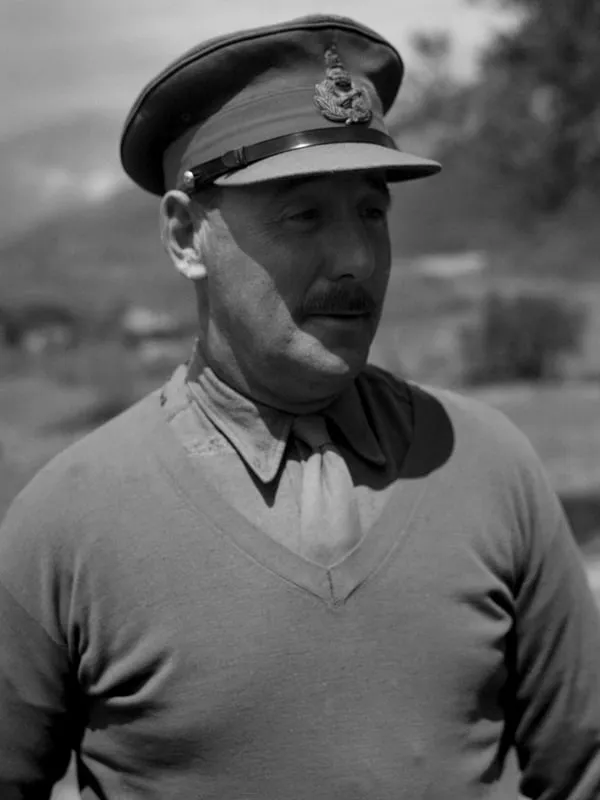
- Born:
- 27 October 1894, London (United Kingdom)
- Died:
- 22 January 1978, Llanrhaeadr-ym-Mochnant (United Kingdom)
- Author:
- Łukasz
- Photo:
- Tanner (Capt), War Office official photographer, domena publiczna, Wikimedia Commons

Oliver Leese was one of the generals whom Bernard Montgomery picked personally and whose careers rose with his own. At El Alamein it was his XXX Corps that broke through Rommel’s minefields, and when Montgomery left to prepare the invasion of France, Leese took over the Eighth Army in Italy from him. For Polish readers he is above all the commander who in the spring of 1944 entrusted the Polish II Corps with taking Monte Cassino. A year later, in Burma, one badly handled conversation with General William Slim ended his wartime career.
A Guardsman from Eton
Oliver William Hargreaves Leese was born on 27 October 1894 in Westminster, London, the eldest of the four children of William Hargreaves Leese, a barrister and later a baronet, and Violet Mary, née Sandeman. He was educated at Eton, where cricket absorbed him more than his studies. In the autumn of 1914, after barely a few weeks of training, he went to Flanders as a second lieutenant in the Coldstream Guards. Near Ypres, on 20 October, a shell splinter hit him in the back. He returned to the front in 1915, was wounded in the face in July, and in September his battalion fought at Loos. He received his third wound on the Somme in September 1916, when he led an attack on a strongly held stretch of the German line that had stopped the whole advance. For this he was awarded the Distinguished Service Order (DSO).
A staff officer’s career
After the war Leese stayed in the Guards. He served as a battalion adjutant and as adjutant of the Officers’ Training Corps at Eton, and in 1927–1928 he attended the Staff College at Camberley. One of his instructors there was Major Montgomery, who remembered the energetic Guardsman. In 1933 Leese married Margaret Alice Leicester-Warren; the marriage was childless. In 1937, on his father’s death, he inherited the baronetcy, and from December 1936 to the autumn of 1938 he commanded the 1st Battalion, Coldstream Guards. He then went to India as chief instructor at the Staff College at Quetta. The outbreak of war found him there.
Dunkirk and the Guards Armoured Division
Leese pressed to be sent back to Europe and in March 1940 he was in England. He was to command a Guards brigade intended for Norway, but on 10 May the Germans struck in the west and the next day he became deputy chief of staff of the British Expeditionary Force under Lord Gort, with the acting rank of major-general. As early as 18 May, while the British were falling back from Belgium, he drew up an emergency plan for a withdrawal to the coast. Politically it could not be put into effect at the time, but when evacuation became unavoidable a few days later, the staff worked largely along his lines. Leese himself left the beaches at Dunkirk on 31 May. British historians give him much of the credit for keeping the retreat from turning into chaos.
In England he raised and trained the 29th Infantry Brigade, then commanded the West Sussex County Division and the 15th (Scottish) Infantry Division. In June 1941 he was given a task that brought him particular satisfaction: forming the Guards Armoured Division. Guards infantry battalions had to be retrained as tank crews, with too little equipment and under entirely new rules of combat. Leese, a forceful personality, extracted what he needed from the War Office and in little more than a year turned the Guardsmen into an efficient armoured division.
XXX Corps: from El Alamein to Sicily
In September 1942 Montgomery, who had commanded the Eighth Army for a month, brought him out to Egypt. On 12 September Leese took over XXX Corps as an acting lieutenant-general. The appointment disappointed the Australian general Leslie Morshead, who had hoped for the post. In the Second Battle of El Alamein Leese’s corps played the main role in the first phase: on the night of 23–24 October four infantry divisions – the 9th Australian, the 51st Highland, the 2nd New Zealand and the 1st South African – were to cross the minefields in a single night and open the way for the tanks of X Corps. The attack went more slowly than planned and Montgomery had to change his plan several times, but after twelve days of fighting the Axis front gave way.
Leese commanded XXX Corps throughout the pursuit across Libya. In January 1943 his divisions advanced on Tripoli, and in March they stood before the Mareth Line in Tunisia. XXX Corps’ frontal attack along the coast, across the Wadi Zigzaou, stalled: the 50th Division won a bridgehead, but a German counter-attack threw it back. Before dawn on 23 March Leese woke Montgomery to report the failure. Montgomery then shifted the weight of the attack to the outflanking move in the west, through the Tebaga Gap, carried out by the New Zealanders and by Brian Horrocks’s X Corps. In April Leese’s corps also fought at the Wadi Akarit. In July 1943 XXX Corps landed on Sicily at the island’s south-eastern tip, near Pachino, and advanced through the interior. In the autumn the corps headquarters returned to England to prepare for the invasion of France.
Commander of the Eighth Army
These plans were changed by a signal of 24 December 1943: Montgomery was to command the land forces of the invasion, and Leese was to replace him in Italy. At the turn of the year he took over the Eighth Army, then held up before the German Gustav Line. The Eighth Army and General Mark Clark’s US Fifth Army formed General Harold Alexander’s 15th Army Group. In the first months of 1944 Leese’s army stood on the Adriatic, while Americans, British, Indians and New Zealanders bled at Cassino and Anzio.
For the fourth battle of Cassino, Operation Diadem, most of the Eighth Army was moved in secret from the Adriatic to the Liri valley. On 24 March 1944 Leese proposed to General Władysław Anders that the Polish corps should take the Monte Cassino massif and Piedimonte; Anders, aware of the cost, accepted. The attack began on the night of 11–12 May, after a bombardment along the whole front. The first Polish assault broke down, and XIII Corps in the valley was advancing more slowly than planned. Leese agreed that Anders should pull back his exhausted battalions and postponed the second attack until the British in the valley could threaten the Germans from the rear. On 18 May the Poles raised their flag over the ruins of the abbey (more in Battle of Monte Cassino).
After the breaking of the Gustav and Hitler Lines Leese’s army advanced up the Liri valley towards Rome, but on 4 June the city was entered by the Americans of Clark, who had earlier switched the direction of his attack in order to take the capital before the British. Leese found working with Clark hard to bear and did not hide it. In the summer the Eighth Army took Perugia and reached Florence. In August Leese persuaded Alexander that, instead of attacking through the mountains towards Bologna, the Eighth Army should be moved back to the Adriatic and strike along the coast. Several divisions were shifted in secret across the Apennines, and on the night of 25–26 August Operation Olive began against the Gothic Line. Surprise was complete: Field Marshal Albert Kesselring realised that this was the main offensive only when Leese’s order of the day fell into his hands. The line was broken, but heavy fighting at Coriano and the rains halted the advance. Rimini fell on 21 September, and the hope of breaking out into the Po plain that autumn proved illusory. Leese himself called the fighting one of the hardest battles in the Eighth Army’s history. At the end of September he handed over command to General Richard McCreery. In December 1944 he received the Polish Virtuti Militari.
Burma and the Slim affair
Leese was appointed to command the 11th Army Group in India, which in November 1944, when he took it over, was renamed Allied Land Forces South East Asia (ALFSEA). He served under Lord Louis Mountbatten, the Allied Supreme Commander in the region. He judged the staff he found there to be inefficient and filled key posts with his own officers from the Eighth Army. The Burma veterans resented them; General William Slim, commander of the Fourteenth Army, later wrote that Leese’s people had a good deal of desert sand in their shoes and were determined to force the ways of the Eighth Army down everyone’s throats. The 1945 campaign was nevertheless a success: the Fourteenth Army routed the Japanese at Mandalay and Meiktila, and at the beginning of May Rangoon was recovered.
In May Leese decided that Slim, three years in the field, was worn out, and that General Philip Christison, experienced in amphibious operations, would be better suited to the planned landing in Malaya. For Slim he intended the new Twelfth Army, which was merely to clear Burma of the remnants of the Japanese forces. He left their conversation believing that Slim had agreed. Slim, meanwhile, told his officers that he had been sacked, and announced in letters to Leese and to General Claude Auchinleck that he would rather leave the army than accept the new post. The news spread through the Fourteenth Army and caused an uproar. Mountbatten, who had earlier accepted Leese’s ideas, withdrew his support, and the Chief of the Imperial General Staff, Alan Brooke, had long doubted whether Leese was right for the post. Leese had to reinstate Slim and then lost his own command; in July 1945 he was succeeded by none other than Slim. The historian Richard Mead judged that nobody came out of the episode well: Leese proved naive, Slim petulant and Mountbatten devious.
Cacti and cricket
Back in England Leese took over Eastern Command, a clear demotion for a former army group commander. He was not promoted to full general – because of Mountbatten’s opposition, it is believed – and in January 1947 he left the army. He settled at Worfield in Shropshire and became a respected gardener and an authority on cacti and succulents, on which he wrote several books. He was High Sheriff of Shropshire, president of the British Legion and, in 1965–1966, of the prestigious Marylebone Cricket Club. After the amputation of a leg in 1973 he moved to Wales, to Llanrhaeadr-ym-Mochnant, where he died on 22 January 1978.
Assessment
Leese was an excellent organiser and staff officer, and in the field a conscientious practitioner of Montgomery’s methods: carefully prepared attacks in which superior firepower decided the outcome. At El Alamein and on Sicily he proved himself as a corps commander. In Italy he had at his disposal an army of British, Poles, Canadians, New Zealanders, Indians and South Africans, and he managed to hold it together, although Operation Olive, for all its ingenious opening, did not bring the decision he had hoped for. In Poland he is remembered as the commander under whom the Poles took Monte Cassino. In the history of the British Army, however, he remains above all the general who, at the peak of his career, misread the people around him and tried to remove the victor of Burma.
Sources
Commanded in battles
(03)Often appears with
People who appear in the same events.