United Kingdom
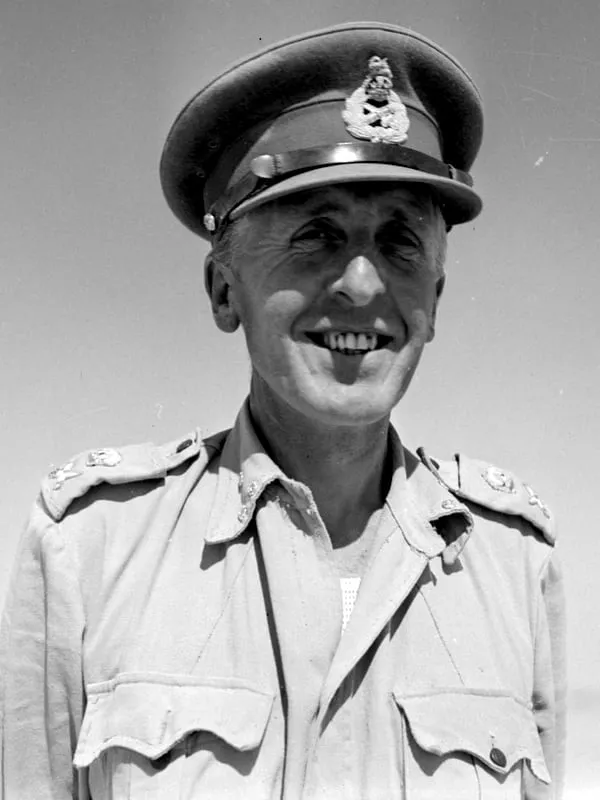
Brian Horrocks
Commander of XIII, X and IX Corps in North Africa (1942–1943) and of XXX Corps in North-West Europe (1944–1945)
- Born:
- 7 September 1895, Ranikhet (British India, now India)
- Died:
- 4 January 1985, Fishbourne near Chichester (United Kingdom)
- Author:
- Natalia
- Photo:
- Geoffrey Keating, domena publiczna, Wikimedia Commons

Brian Horrocks was one of the best-liked British generals of the Second World War. He could talk to any soldier and make him feel part of the plan. Bernard Montgomery considered him one of his ablest subordinates and gave him corps on two continents: at Alam Halfa, on the Mareth Line and in Tunisia, and later in France, Belgium, the Netherlands and Germany. His name, however, is linked for ever with Operation Market Garden, in which XXX Corps failed to reach the paratroopers fighting at Arnhem in time.
Prisoner of two wars
Brian Gwynne Horrocks was born on 7 September 1895 at Ranikhet (PL) in India, the only son of an army doctor, later Colonel Sir William Horrocks, and his Irish wife Minna. He spent part of his childhood on Gibraltar, where his father was researching Malta fever, and was then educated at Uppingham. He entered the Royal Military College at Sandhurst in 1912 with one of the weakest results; he later admitted that he had been idle and scruffy, and interested mainly in sport.
The outbreak of war saved his career. On 8 August 1914 he was commissioned as a second lieutenant in the Middlesex Regiment and in the autumn he went to Flanders. On 21 October, in the fighting near Armentières, his platoon was surrounded and Horrocks, shot through the abdomen and thigh, was taken prisoner. He spent four years in German camps and escaped several times – once getting within a few hundred metres of the Dutch border – and as a punishment he was placed among Russian officers. He used this to learn Russian. For his conduct in captivity he was awarded the Military Cross after the war.
His knowledge of the language took him to Siberia in 1919, with the British mission supporting the White armies of Admiral Alexander Kolchak in the Russian Civil War. He escorted an ammunition train from Vladivostok to Omsk and trained NCOs in Yekaterinburg, and when the British withdrew he stayed with the retreating White forces. On 7 January 1920 he was captured by the Bolsheviks at Krasnoyarsk (PL). For ten months he survived severe typhus and prisons, until in October 1920 the British government negotiated his release.
The interwar years
He then served with a battalion of the Middlesex Regiment in the occupied Rhineland, in Ireland during the War of Independence and briefly also in Upper Silesia, where Allied troops kept the peace between Poles and Germans. A keen sportsman, he won a place in the British modern pentathlon team and at the Paris Olympics in 1924 finished 19th. In 1928 he married Nancy Kitchin; they had one daughter. He spent 1926–1930 as adjutant of a battalion of the volunteer Territorial Army, an experience he later came to value: the part-time soldiers he worked with there formed the core of the British Army in the next war. He attended the Staff College at Camberley, served in the War Office and as a brigade major, and from 1938 taught at Camberley.
From Dunkirk to the desert
In May 1940 he took over the 2nd Battalion, Middlesex Regiment, a machine-gun battalion in General Montgomery’s 3rd Infantry Division, and joined it during the retreat to Dunkirk. After a couple of weeks, when Montgomery took over a corps and the commanders each moved up a level, Horrocks was given the 11th Brigade. Montgomery remembered him and from then on watched over his career: in England Horrocks commanded the 9th Brigade, in June 1941 the 44th Infantry Division and in March 1942, although an infantryman with no experience of tanks, the newly formed 9th Armoured Division.
When Montgomery took over the Eighth Army in Egypt in August 1942, he immediately asked for Horrocks. In mid-August Horrocks took command of XIII Corps on the southern sector of the El Alamein front. Two weeks later, in the Battle of Alam Halfa, it was his corps that took the blow of Erwin Rommel’s attack. Montgomery ordered him to repel the Germans without heavy losses, because the tanks were needed for his own offensive. Horrocks dug his tanks in on the ridge so that they would fire from where they stood instead of charging the German anti-tank guns. From 30 August the Afrika Korps attacked his positions for several days without success, under fire from artillery and aircraft, and then withdrew. It was Montgomery’s first victory and the beginning of Horrocks’s reputation as one of the best corps commanders in the British Army.
In the Second Battle of El Alamein Horrocks declined the command of the armoured X Corps, judging that a cavalryman would lead it better, and his XIII Corps made diversionary attacks in the south to pin down the German armoured divisions. In December, however, he took over X Corps from the dismissed General Herbert Lumsden. In March 1943, in the Battle of the Mareth Line, when the frontal attack stalled, Montgomery sent his corps with the 1st Armoured Division on a long detour through the desert after General Bernard Freyberg’s New Zealanders. On 26 March, after massive air attacks, the tanks broke through the Tebaga Gap by night and threatened the rear of the whole defence. The Mareth Line became untenable. Working with Freyberg, older and more experienced, was not easy, but the manoeuvre was regarded as one of Horrocks’s finest achievements.
At the end of April he moved to the First Army and took over IX Corps from the wounded General John Crocker. With divisions transferred from the Eighth Army he led the final attack in the Medjerda valley, which in May 1943 gave the Allies Tunis. In June, back with X Corps, he was watching a landing rehearsal for Salerno at Bizerte when a German aircraft strafed the area. A bullet passed through his chest, lungs, stomach and intestines. He underwent five operations and needed more than a year to recover. In that time his contemporaries from the desert, Oliver Leese and Miles Dempsey, rose to command armies.
XXX Corps
In August 1944, barely recovered, he arrived in Normandy and took over XXX Corps from General Gerard Bucknall, with whom Montgomery had been dissatisfied. He went into action while the Falaise Pocket was being closed, and then led one of the fastest pursuits in the British Army’s history: in six days his divisions covered some 400 kilometres. On 3 September the Guards Armoured Division drove into Brussels, and on 4 September the 11th Armoured Division took Antwerp with its port intact. Then the corps halted for three days to refuel, and Horrocks did not order a crossing of the Albert Canal north of the city. The Germans had time to occupy the banks of the Scheldt, and the port, without which the Allies could not supply their armies, was opened only after the bloody Battle of the Scheldt. Horrocks admitted after the war that this had been his mistake: he had eyes only for the Rhine.
On 17 September Operation Market Garden began. XXX Corps, led by the Guards Armoured Division, was to advance along a “carpet” of bridges seized by the airborne troops, on a single road through Eindhoven, Grave and Nijmegen to Arnhem, in two or at most four days. The road ran along an embankment through waterlogged country, the Germans cut it again and again from the flanks, and the bridge at Nijmegen had to be taken together with the US 82nd Airborne Division, which cost a day and a half. When on 20 September the Americans crossed the Waal in boats and the Guards drove over the bridge, the resistance of the British paratroopers at the Arnhem bridge was already coming to an end. On 24 September, at a conference at Valburg, Horrocks and the commander of the 43rd Division decided to send a battalion of the Dorset Regiment and General Stanisław Sosabowski’s Polish paratroopers across the Rhine; Sosabowski protested at the choice of crossing place, and most of the Dorsets who got across were killed or captured. On the night of 25–26 September the remnants of the 1st Airborne Division were withdrawn across the river (end of the Battle of Arnhem). Horrocks later wrote that if his corps had been too slow, the fault was his, but he also maintained that nobody could have fought better, and that the main cause of the defeat was the astonishingly quick recovery of the German forces after Normandy. Historians are divided: some blame XXX Corps for a lack of urgency, others point to the flawed plan and the underestimation of the SS panzer divisions around Arnhem. The American General James Gavin, commander of the 82nd Division, considered Horrocks the finest corps commander he met in the war.
To Bremen
In the autumn XXX Corps fought at Geilenkirchen on the German border. During the Ardennes offensive the corps guarded the Meuse crossings and took part in pushing the Germans back from the western tip of the salient, but according to his biographers Montgomery judged Horrocks himself to be overtired and sent him to England to rest for a few weeks. In February 1945, in Operation Veritable, the corps, placed under the First Canadian Army and at times nine divisions strong, fought its way through the Reichswald towards the Rhine. Before the attack Horrocks agreed that RAF heavy bombers should destroy the town of Kleve (PL); he later called it the most terrible decision of his life. On 23 March his divisions crossed the Rhine at Rees as part of Operation Plunder, and in April the corps reached Bremen, taken on 26 April, and the mouth of the Elbe at Cuxhaven. On 12 April Horrocks was present at the talks in which the Germans agreed to a no-fighting zone around the Bergen-Belsen camp; after the British went in he organised food, water and medical help for the prisoners.
Black Rod and television
After the war he commanded Western Command and, in 1948, briefly the British Army of the Rhine, but the effects of his Bizerte wound forced him to leave the army in January 1949 with the rank of lieutenant-general. That same year he became Black Rod, the ceremonial officer of the House of Lords, and held the post until 1963. When he left, the peers recalled the prisoner who had learned Russian in captivity and the general who had commanded corps on two fronts. Horrocks wrote for newspapers, and in the early 1960s presented popular BBC series on great battles and British castles, explaining military history to a wide audience in an accessible way. In 1960 he published his memoirs, “A Full Life”, and in 1977 “Corps Commander”, a book about his battles in Europe. He was an adviser on the film “A Bridge Too Far”, in which he was played by Edward Fox. He died on 4 January 1985 at Fishbourne near Chichester.
Assessment
Horrocks was not a great strategist and never commanded an army, but as a corps commander he was regarded as a model. General Dwight Eisenhower called him the outstanding British general under Montgomery. His strength lay in explaining plans and giving men confidence; in Africa and in Europe he was seen in the front line more often than other generals. His weakness, which he admitted himself, showed in the moments when, during a pursuit, he lost sight of less spectacular but more important objectives, such as the Scheldt estuary. At Arnhem he carried a task that, with that plan and that road, nobody could have accomplished in time.
Sources
Commanded in battles
(03)Mentioned in battles
(02)Often appears with
People who appear in the same events.