United Kingdom
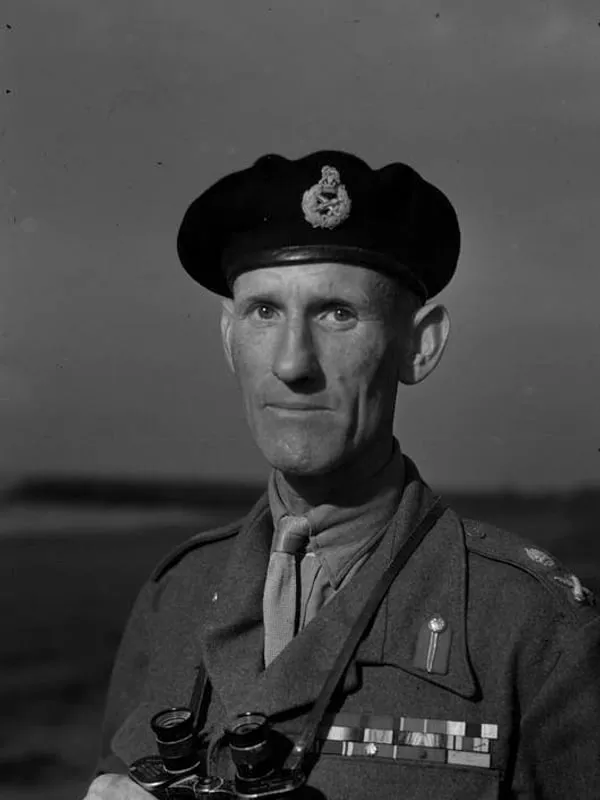
Richard McCreery
Chief of Staff, Middle East Command (1942–1943) and 18th Army Group (1943), commander of X Corps (1943–1944) and the Eighth Army (1944–1945)
- Born:
- 1 February 1898, Market Harborough (United Kingdom)
- Died:
- 18 October 1967, Templecombe (United Kingdom)
- Author:
- Natalia
- Photo:
- Tanner (kpt.), War Office official photographer, domena publiczna, Wikimedia Commons

Richard McCreery was the last commander of the British Eighth Army and the only cavalryman ever to lead it. For most of the war he stood in the shadow of better-known generals: as chief of staff to Harold Alexander he helped to plan the victories in Africa, but the glory went to others, and his X Corps fought at Salerno and on the Garigliano as part of the American Fifth Army. Only in the spring of 1945, when the Eighth Army under his command broke the front on the Senio and pushed through the Argenta Gap into the German rear, did it become clear that this shy officer with a limp was one of the ablest British commanders of land forces. The Polish II Corps fought under his orders in that last offensive.
Lancer at Arras
Richard Loudon McCreery, known in the army simply as Dick, was born on 1 February 1898, the eldest son of Walter McCreery, a Swiss-born American who had settled in England and in 1900 played polo for the United States at the Olympic Games in Paris. His mother, Emilia McAdam, came from the family of the Scottish engineer John Loudon McAdam, whose name gave us the word “macadam”. The boy was educated at Eton College, and in the spring of 1915, as soon as he had turned seventeen, he passed the entrance examination for the military college at Sandhurst.
In August 1915 he was commissioned as a second lieutenant in the 12th Royal Lancers and from January 1916 he served in France. For most of the time the cavalry on the Western Front sat in the trenches like infantry, waiting for a breakthrough that never came. The chance was supposed to arrive at the Battle of Arras in April 1917. On 11 April the regiment, pushed forward behind the advancing infantry, came under artillery and machine-gun fire. McCreery was shot in the thigh and the bullet severed an artery. Stopping the bleeding saved his life, but gangrene set in in his foot. He refused to have the leg amputated; he lost some of his toes and limped noticeably for the rest of his life. He had to learn to walk and to ride all over again.
He rejoined the regiment in September 1918, during the Hundred Days Offensive, when cavalry could once again operate on horseback. On 9 November, two days before the armistice, at the head of a mounted patrol he knocked out a German machine-gun post, took ten prisoners, cleared several villages and sent back a precise report on the enemy’s positions. For this he was awarded the Military Cross.
Horseman and staff officer
In the 1920s McCreery was one of the finest riders in the British Army, despite his damaged leg. Twice, in 1923 and 1928, he won the Grand Military Gold Cup steeplechase at Sandown Park, and he played in the Army polo team. He served as regimental adjutant, attended the Staff College at Camberley in 1928–1929, where Bernard Montgomery was among the instructors, and in 1935 took command of the 12th Lancers. In 1928 he married Lettice St. Maur, with whom he had five children. The interwar years also brought family tragedies: one of his brothers was killed by republicans in Ireland in 1921, and another took his own life.
In 1938 McCreery became chief of staff of the 1st Infantry Division, then commanded by Harold Alexander. His whole later career was bound up with that connection.
France 1940 and Africa
He went to France with the 1st Division, and in January 1940 he took over a light armoured brigade and then the 2nd Armoured Brigade of the 1st Armoured Division. The brigade fought alongside the French south of the Somme in the last phase of the French campaign, after the main British forces had already been evacuated from Dunkirk. At Abbeville McCreery met Charles de Gaulle, whose bearing during a counter-attack made a lasting impression on him. For his command of the brigade in this fighting he was awarded the Distinguished Service Order.
In December 1940, as a major-general aged forty-two, he took command of the newly formed 8th Armoured Division in England. It was short of equipment, but McCreery trained it so well that it caught his superiors’ attention at the autumn manoeuvres of 1941. He was praised above all by Alan Brooke, soon to be Chief of the Imperial General Staff, who from then on was his patron.
In March 1942 McCreery arrived in Cairo as adviser on armoured fighting vehicles to the Commander-in-Chief Middle East, General Claude Auchinleck. The partnership did not work, as the two men held different views on the use of armour. According to his biographer Richard Mead, in the summer Auchinleck removed him from his post, and McCreery’s career might have ended there. He was rescued by a change at the top: in August 1942 Auchinleck was replaced by Alexander, who at once took McCreery as Chief of General Staff, Middle East Command.
In that post McCreery took part in preparing the Second Battle of El Alamein. According to many accounts it was he, together with the Eighth Army’s chief of staff Francis de Guingand, who persuaded Montgomery to move the final blow, Operation Supercharge, away from the coast and further south, to a sector held more weakly, mainly by Italians. Alexander later gave him the credit for the idea; Montgomery did not. In February 1943 McCreery became chief of staff of the 18th Army Group, which Alexander took over in Tunisia. Towards the end of the Tunisian campaign, when the Eighth Army’s attacks had stalled at Enfidaville, he urged his chief to transfer some of its divisions to the British First Army, advancing on Tunis from the west. This was done, and on 13 May 1943 the Axis forces in Africa surrendered. Brooke believed that McCreery never received due recognition for this success.
X Corps: from Salerno to the Garigliano
In the summer of 1943 McCreery took over X Corps, which was preparing to land in Italy. The corps, made up of the 46th and 56th Infantry Divisions, came under the American Fifth Army of General Mark Clark. On 9 September it landed north of the River Sele in the Battle of Salerno. Over the following days the British fought for Battipaglia and the hills above the beaches until every battalion of the corps was in the front line and there were no reserves left. During the crisis of 13 September, when Clark’s headquarters was drawing up plans to evacuate one of the corps, McCreery firmly opposed any withdrawal from the beachhead. The beachhead held.
Three days later McCreery had to deal with a mutiny on the beachhead. Several hundred veterans of the 50th and 51st Divisions, sent as replacements to units that were not their own, refused their postings and demanded to be returned to their own formations. The general spoke to them in person, admitted that a mistake had been made and promised that after the fighting they would go back to their divisions. Some of the men obeyed him, but almost two hundred were court-martialled.
After the capture of Naples X Corps crossed the Volturno and in the autumn advanced along the Tyrrhenian coast, and in November and December it bled itself white in the mountains around Monte Camino on the Bernhardt Line. In January 1944 McCreery opened the Battle of Monte Cassino. On the night of 17–18 January his 5th and 56th Divisions crossed the Garigliano near its mouth and took a weak German infantry division by surprise. Field Marshal Albert Kesselring had to throw two reserve divisions from around Rome against them, which made the landing at Anzio easier. The 46th Division’s attack closer to the mouth of the Liri failed, and within a few weeks the corps lost some 4,000 men. The bridgehead won over the Garigliano nevertheless proved very valuable in the spring, during the decisive offensive.
In the summer of 1944, after the Allies entered Rome, X Corps passed under the Eighth Army and advanced through the mountainous central Apennines. In July King George VI, visiting the troops in Italy, knighted McCreery in the field near Arezzo.
Commander of the Eighth Army
In early October 1944, when General Oliver Leese left for South East Asia, McCreery took command of the Eighth Army. He took it over at a bad moment. After the capture of Rimini the army had indeed come down from the mountains onto the plain of the Romagna, but the autumn rains turned it into a swamp, and each of the dozens of rivers and canals running across the axis of advance became another line of defence. McCreery, unlike his predecessor, did not try to force his way along the Via Emilia. He fought limited attacks, from river to river, trying to spare the infantry, which was ever more scarce. On 9 November his troops took Forlì and in early December Ravenna, where a few weeks later he personally decorated the commander of the local partisans. In the winter the front came to a halt on the Senio and settled into stalemate. Meanwhile the army was losing divisions: some went to Greece, and early in 1945 the entire Canadian corps was moved to north-west Europe.
The plan for the last offensive, called Operation Buckland by the Eighth Army, was largely McCreery’s work. Instead of driving with his main forces straight at Bologna, he intended, once the front on the Senio and the Santerno had been broken, to swing north-west through Argenta – a narrow strip of dry land between the Comacchio lagoon and fields flooded by the Germans. For crossing the floods and canals the army received tracked amphibians. A successful passage of the gap would let it take the German Tenth Army from behind and cut its route to the Po.
The spring offensive in Italy began on 9 April 1945. After a heavy-bomber raid and several artillery barrages, the 8th Indian Division, the 2nd New Zealand Division and the Polish 3rd Carpathian Rifle Division crossed the Senio. The Polish II Corps of General Władysław Anders, which had fought as part of the Eighth Army since Monte Cassino, advanced along Route 9 towards Bologna and on 21 April was the first to enter the city. On McCreery’s orders the Poles then halted around Bologna and took no part in the pursuit. At Argenta the Germans threw in their last reserves, but by 19 April the gap had been forced and the British 6th Armoured Division drove deep into the German rear. On 23 April at Finale on the Panaro it met troops of the American Fifth Army under General Lucian Truscott. The pincers closed short of the Po: the divisions of General Heinrich von Vietinghoff lost almost all their heavy equipment on the south bank of the river. On 2 May the surrender signed at Caserta came into force.
The offensive lasted a little over three weeks and was one of the British Army’s most successful undertakings of the war. It was, however, overshadowed by events on the Western Front and in Germany, which is why it is remembered far less than the Eighth Army’s desert victories under Montgomery.
After the war and assessment
After the surrender the Eighth Army became the British occupation force in Austria, and until the spring of 1946 McCreery was its commander and the British representative on the Allied Commission for Austria, with his office in Schönbrunn Palace. In 1946–1948 he commanded the British Army of the Rhine in occupied Germany, and then represented the British Army on the United Nations Military Staff Committee in New York, which was to prepare a standing armed force for the United Nations; nothing came of it. In December 1949 he retired with the rank of general.
He spent the rest of his life at Stowell Hill in Somerset, devoting himself to horses, hunting and his garden. He took no part in public life, with one exception: during the Suez Crisis in 1956 he wrote a letter of protest to a wartime acquaintance, the minister Harold Macmillan, calling the intervention in Egypt dishonourable. He died on 18 October 1967; his memorial service was held in Westminster Abbey.
McCreery was modest to the point of shyness, disliked public speaking and did not seek publicity, which set him apart from Montgomery, whom he in any case regarded as an over-cautious commander. Macmillan wrote in his war diary that he was one of the ablest soldiers he had met in the Mediterranean. Historians, who turned to him only many years later, describe him as one of the best British armoured commanders and one of the most underrated generals of the war. Polish readers know him above all as Anders’s superior in the last battle of the II Corps.
Sources
Commanded in battles
(02)Mentioned in battles
(01)Often appears with
People who appear in the same events.