Austria
Alexander Löhr
Commander of the Austrian air force (1934–1938), of Air Fleet 4 (1939–1942), of the Twelfth Army and Army Group E (1942–1945), Commander-in-Chief South-East (1943, 1945)
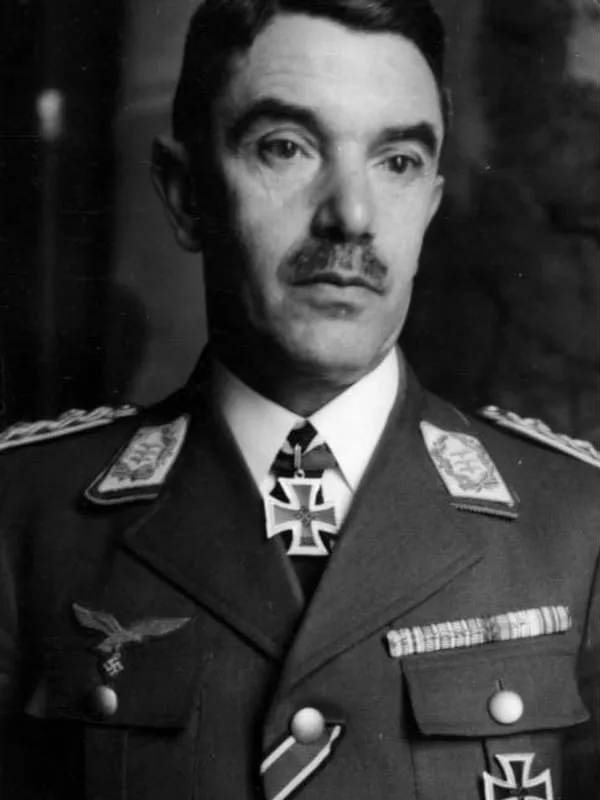
- Born:
- 20 May 1885, Turnu Severin (Romania)
- Died:
- 26 February 1947, Belgrade (Yugoslavia)
- Author:
- Łukasz
- Photo:
- Sturm, Wilhelm, CC BY-SA 3.0 DE, Wikimedia Commons

Alexander Löhr was an Austrian officer who built the air force of the First Austrian Republic from scratch and, after the Anschluss, became one of the most important commanders of the Luftwaffe. His Air Fleet 4 bombed Warsaw in 1939, and on Palm Sunday 1941 it destroyed Belgrade. Löhr then exchanged the air force for the army and for almost three years held command in the Balkans, where the war against the partisans meant shooting hostages, burning villages and killing prisoners. After the war he stood trial before a Yugoslav court and was shot in the city he had once ordered to be bombed.
Child of the Danube
Alexander Löhr was born on 20 May 1885 in Turnu Severin on the Danube, in the Kingdom of Romania. His father, who came from Mainz, was a ship’s captain with the Austrian Danube steamship company, and his mother was the daughter of a Russian army doctor from Odessa. The boy grew up among several languages, which later helped him in his service in the Balkans. He was educated in the military schools of Austria-Hungary, graduated from the Theresian Academy in Wiener Neustadt in 1906 as an infantry second lieutenant, and in 1910–1913 attended the war college in Vienna, the training ground of general staff officers.
In the First World War he fought first as a staff officer and commander on the Serbian and Eastern fronts, and from 1916 he worked in the newly created aviation department of the Austro-Hungarian war ministry. He experienced the collapse of the monarchy in 1918, as his biographer in the “Neue Deutsche Biographie” writes, as a shock without equal; he remained a monarchist for the rest of his life.
Creator of the Austrian air force
The Treaty of Saint-Germain forbade Austria to have a military air force, but Löhr, an officer of the new federal army, prepared its rebirth for years: first in plans and articles, then through a civil aviation company and the training of pilots under the cover of sport flying. In May 1934 he took command of a camouflaged “air defence” force, renamed the air force in 1935. In March 1938 Austria had two fighter regiments, nearly a hundred combat aircraft and seven airfields. After the Anschluss Löhr was taken into the Luftwaffe as a lieutenant general; he kept command of the air force in former Austria, and in the spring of 1939 he became General of the Air Force and commander of Air Fleet 4, with headquarters in Vienna.
Warsaw and Belgrade
In the September campaign Löhr’s Air Fleet 4 supported Army Group South. Among its formations was Wolfram von Richthofen’s dive-bomber group, which destroyed Wieluń on the first day of the war, and at the end of September his aircraft took part in the heaviest raids on Warsaw.
The gravest charge brought against him after the war, however, concerned Belgrade. After the coup in Yugoslavia of 27 March 1941, Adolf Hitler decided to destroy the country “militarily and as a state” and to punish its capital with an air raid. Löhr’s order of 31 March spoke openly of destroying Belgrade with a great air attack; according to some historians, at the last moment he gave the airmen specific military and government targets. On the morning of 6 April, without a declaration of war, the bombers of Air Fleet 4 struck the city, which the government had earlier declared open, and they returned the next day as well. Operation Strafgericht (“Punishment”) opened the war, cut the Yugoslav high command off from its armies and hastened the country’s surrender, which came on 17 April. The death toll is disputed: the occupation authorities gave about 2,300, other sources anything from 1,500 to more than ten thousand; the most commonly accepted figure is several thousand victims, the vast majority of them civilians.
Crete and the Eastern Front
Later in April Löhr put forward a plan to take Crete from the air, and the commander of the airborne forces, Kurt Student, won Hermann Göring and Hitler over to it. In May 1941 Löhr was promoted to colonel general. In Operation Merkur he held overall command, Student directed the airborne assault, and Richthofen’s aircraft struck at the British ships. The Battle of Crete ended with the capture of the island, but with such heavy losses among the paratroopers that Hitler never again agreed to a similar operation.
From June 1941 Air Fleet 4 fought on the southern wing of Operation Barbarossa, over Ukraine, the Crimea and the Don. According to his biographer, Löhr considered the war against the USSR a disaster from the start. In the winter of 1941–1942 his torpedo bombers attacked Soviet shipping on the Black Sea, cutting the supply lines of the troops on the Kerch Peninsula, and in May 1942 part of his forces helped repel the Kharkov offensive. In July 1942 he handed the air fleet over to Richthofen and moved to the army.
Master of the Balkans
Löhr took over the Twelfth Army and the post of Wehrmacht commander South-East, with headquarters in Salonika. On 1 January 1943 his army was turned into Army Group E, and until August of that year he was also Commander-in-Chief of the whole South-East, from Croatia to Crete. The war against the Yugoslav partisans came under him. As early as 1942 he extended Hitler’s order on shooting commandos to captured partisans, even those in uniform. At the beginning of 1943 he directed Operation Weiss, and in May and June Operation Schwarz, in which the Germans and their allies encircled the main forces of Josip Broz Tito on the Sutjeska. Löhr ordered the encircled forces destroyed without taking prisoners, including the wounded and medical staff; a report of the 1st Mountain Division recorded 498 prisoners, of whom 411 were shot.
At the same time, from March to August 1943, almost the entire Jewish community of Salonika, which before the war had numbered more than 50,000 people, was deported to Auschwitz; most of the deportees died in the gas chambers. The deportations were carried out by Adolf Eichmann’s men, but they took place in an area under Löhr’s command and with the participation of his military administration; German historians regard his shared responsibility for the deportations of Jews from Greece, especially from the islands, as proven.
After Italy’s surrender in September 1943, the troops of Army Group E disarmed the Italian garrisons in Greece. On Cephalonia an Italian division resisted, and after it capitulated the Germans, carrying out Hitler’s order, murdered thousands of prisoners, around 4,000 according to recent research; only after the capture of Corfu did Löhr forbid further executions. In the autumn his troops took the Dodecanese, including Kos and Leros, back from the British. In reprisal for actions by the Greek partisans, units under his command burned villages and murdered their inhabitants. After the destruction of Kalavryta in December 1943, Löhr forbade similarly drastic actions, but not because he considered them a crime: he judged that they drove the population into the arms of the partisans. Six months later SS men massacred the inhabitants of Distomo, women and children among them. On the staff of his army group, a young lieutenant named Kurt Waldheim (PL), later Secretary-General of the UN and President of Austria, served as an intelligence officer.
Retreat and captivity
When Romania changed sides in August 1944 and the Red Army reached the Danube, Army Group E, numbering several hundred thousand men including the island garrisons, had to leave Greece. In the autumn Löhr withdrew it through Macedonia, Kosovo and Bosnia, while Soviet troops and Tito’s partisans took Belgrade, threatening his line of retreat; the last units left mainland Greece at the beginning of November. At the end of March 1945 he replaced Field Marshal Maximilian von Weichs at the head of the whole South-East and received the Oak Leaves to the Knight’s Cross.
In May 1945 his troops fell back through Croatia towards Slovenia and Austria. On 8 May Löhr handed command of the Croatian forces to Ante Pavelić and tried to negotiate with the British in Carinthia for his troops to go into British captivity. When they refused, he ordered surrender to the Yugoslav army. In mid-May he himself fell into Yugoslav hands.
Trial and memory
The trial of Löhr and his subordinates before a Yugoslav military court in Belgrade took place at the turn of 1946 and 1947. He was charged with crimes committed in the Balkans, above all the raid on Belgrade without a declaration of war, and also the murder of hostages and prisoners and the burning of villages. Sentenced to death, he did not ask for clemency. He was shot in Belgrade on 26 February 1947.
In Austria he was remembered for decades mainly as the creator of the air force. In 1955 a plaque in his honour was put up in the garrison church in Vienna; protests against it flared up again in 1986, during the dispute over Waldheim’s wartime past, and it was finally removed in 2015. Historians now stress that his professional career cannot be separated from its criminal side: Löhr was an efficient organiser and a loyal executor of orders who in the Balkans waged war with no regard for the lives of civilians and prisoners.
Sources
Commanded in battles
(03)Mentioned in battles
(04)Often appears with
People who appear in the same events.
On the timeline
(19)1939
September
- 01
- Key eventGermany invades PolandAt dawn on 1 September 1939 the Wehrmacht attacked Poland from the north, west and south without declaring war. The Slovak army struck alongside the Germans.
- The bombing of WieluńOn the morning of 1 September 1939 Luftwaffe dive-bombers destroyed central Wieluń, a town with no troops or air defences. The first bombs hit its hospital.