Germany
Maximilian von Weichs
Commander of XIII Corps (1937–1939), the Second Army (1939–1942) and Army Group B (1942–1943), Commander-in-Chief South-East and commander of Army Group F (1943–1945)
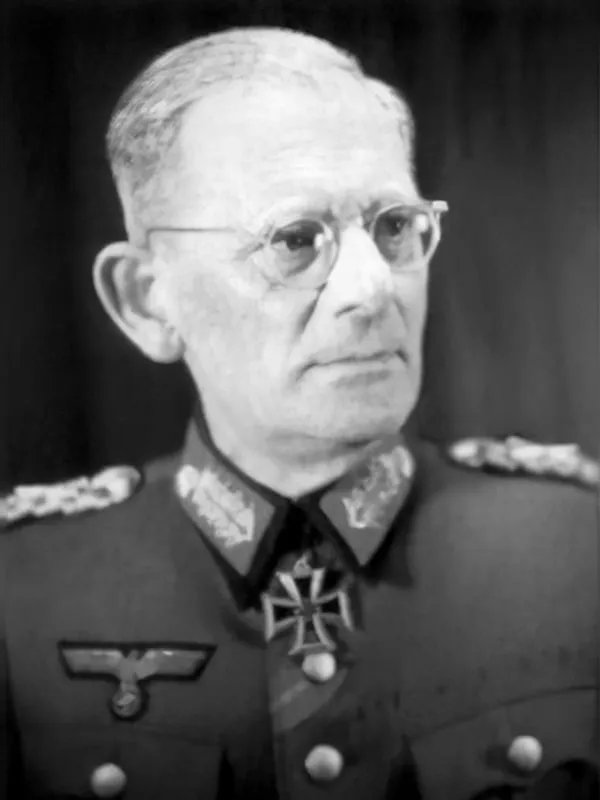
- Born:
- 12 November 1881, Dessau (Germany)
- Died:
- 27 September 1954, Rösberg Castle in Bornheim (West Germany)
- Author:
- Łukasz
- Photo:
- autor nieznany, domena publiczna, Wikimedia Commons

Maximilian von Weichs was a general whose name rarely made the headlines, although he held command in some of the most important places of the war. In September 1939 his corps took Łódź, in April 1941 he accepted the capitulation of Yugoslavia, and in the summer of 1942 he took over Army Group B, which marched on Stalingrad and was shattered there. From 1943 he was commander-in-chief of the German forces in the Balkans, where a merciless war against the partisans was being fought, and in the autumn of 1944 he brought his troops out of Greece and most of Yugoslavia. After the war he was charged with shared responsibility for the mass shooting of hostages, but because of illness he was never tried.
A Bavarian cavalryman
Maximilian Freiherr von und zu Weichs an der Glon, a descendant of an old Bavarian family, was born on 12 November 1881 in Dessau (PL), where his father, a retired cavalry captain, was master of the horse at the court of the dukes of Anhalt. He was a devout Catholic. After leaving school in Munich, in 1900 he joined the Bavarian 2nd Heavy Cavalry Regiment at Landshut. He had a model career in the Bavarian army, graduated from the war academy in Munich in 1910–1913 and was promoted to cavalry captain in 1914. Throughout the First World War he served on the Western Front as an orderly officer, an adjutant and, from 1915, a staff officer of an infantry division.
From cavalry to armour
Weichs, a Bavarian monarchist by conviction, entered the service of the Weimar Republic without hesitation. In 1920 he took part in suppressing the communist uprising in the Ruhr. He then went through the usual staff and line posts: he was a tactics instructor at the infantry school, commander of a cavalry regiment in Stuttgart and chief of staff of a cavalry division in Frankfurt an der Oder. In 1928 he married Margarethe von Niesewand.
In April 1933, after Hitler had come to power, he became a major general, and in the autumn commander of the 3rd Cavalry Division in Weimar. In 1935 it was converted under his direction into the 1st Panzer Division, one of the first in the German army; its manoeuvres made a good impression on the army’s commander-in-chief, Werner von Fritsch. By 1936 Weichs was a general of cavalry, and in October 1937 he took over XIII Corps in Nuremberg. His troops marched into the Sudetenland in 1938 and into Bohemia in March 1939, when Germany seized the rest of the country.
Łódź, France, Yugoslavia
In the September Campaign XIII Corps fought as part of Johannes Blaskowitz’s Eighth Army. On 9 September Weichs took Łódź without a fight; his divisions then fought in the Battle of the Bzura and in the siege of Warsaw, and after the capitulation part of the corps occupied the capital. On 20 October 1939 Weichs took over the Second Army, with which in 1940 he went through the campaign in France as part of Gerd von Rundstedt’s Army Group A. He received the Knight’s Cross and in July 1940 promotion to colonel general.
In April 1941 the Second Army attacked northern Yugoslavia from Austria and Hungary, taking Zagreb among other places (see invasion of Yugoslavia). On 15 April Weichs flew to captured Belgrade to prepare the terms of the capitulation, which was signed on 17 April (see capitulation of Yugoslavia). According to the findings of the Nuremberg prosecutors, as early as May 1941, when the first attacks on Germans began in occupied Serbia, Weichs announced that a hundred Serbs would be shot for every German soldier killed.
The Second Army in Russia
In the war against the USSR the Second Army served in Fedor von Bock’s Army Group Centre. Its infantry guarded the pockets at Białystok and Minsk, during the Battle of Smolensk it took Gomel, and in September, together with Heinz Guderian’s 2nd Panzer Group, it turned south into the rear of the South-Western Front and took part in the Battle of Kiev. In October it fought in Operation Typhoon near Bryansk, and in November it took Kursk.
Army Group B and Stalingrad
In the summer offensive of 1942 Weichs commanded the group of forces that on 28 June was the first to strike from the Kursk area towards Voronezh. On 13 July, after Bock’s dismissal, Hitler entrusted him with Army Group B, which in Operation Blue was to reach the Volga and cover the drive into the Caucasus from the north. Under his command were the Sixth Army of Friedrich Paulus, Hermann Hoth’s Fourth Panzer Army and the Hungarian, Italian and two Romanian armies, which covered the long flanks of the advance.
On 19 November 1942 the Soviet Operation Uranus broke through the Romanian front north and south of Stalingrad. That evening, on Weichs’s orders, Paulus halted the attack in the city and began to pull his armoured units out of it. On 22 November Paulus reported the encirclement of the Sixth Army, and the next day Weichs backed his request for permission to break out to the south-west. Hitler refused and chose to defend a “fortress” supplied by air. At the end of November he took the direction of the troops at Stalingrad away from Weichs and gave it to Erich von Manstein’s new Army Group Don. Army Group B, whose allied armies were smashed in the winter offensive, was dissolved in February 1943. On 1 February 1943, the day before the last units capitulated in Stalingrad, Weichs was nevertheless promoted to field marshal. In the summer he was transferred to the reserve.
The Balkans
As early as August 1943 Hitler appointed him Commander-in-Chief South-East and commander of Army Group F, with headquarters in Belgrade. He was in charge of the troops in occupied Yugoslavia, Greece and Albania. In September 1943, after Italy’s capitulation, his units disarmed the Italian divisions in the Balkans. His main task, however, was the fight against Josip Broz Tito’s partisans in Yugoslavia and against the Greek resistance. It was waged with the utmost brutality: hostages were shot in retaliation for attacks, villages were burnt, and the civilian population was treated as the enemy. As commander-in-chief Weichs bore a share of responsibility for this. According to the “Neue Deutsche Biographie” he was informed personally by Heinrich Himmler of the systematic murder of the Jews in the extermination camps.
In March 1944 Weichs directed the occupation of Hungary, which Hitler ordered in order to prevent his ally from leaving the war. In the autumn, when Romania and Bulgaria went over to the Allies and the Red Army reached the Danube, the German forces in the Balkans were in danger of being cut off. Weichs long delayed ordering the withdrawal from Greece, which according to historians gave Alexander Löhr’s Army Group E time to move out men and equipment. Then, presenting planned withdrawals in his reports to the high command as forced on him by the enemy, he brought his troops out of Greece and most of Yugoslavia. On 5 October he moved his headquarters from Belgrade to Vukovar, and on 20 October the Yugoslav capital fell in the Belgrade operation. The successful retreat from the Balkans is regarded as his greatest military achievement. In February 1945 he received the Oak Leaves, and on 25 March he was transferred to the reserve.
Trial and assessment
In January 1945 Guderian still proposed him as commander of the new Army Group Vistula, but Hitler chose Himmler, who was replaced in March by Gotthard Heinrici. On 2 May 1945 Weichs was taken prisoner by the Americans at Ettal in Bavaria. In May 1947 he was among the twelve defendants in the Hostages Trial, one of the Nuremberg trials before an American tribunal, which dealt with Wehrmacht crimes in Yugoslavia, Greece and Albania. The prosecution charged the generals with the deaths of hundreds of thousands of civilians killed in reprisal for attacks on Germans, with quotas of up to a hundred shot for every soldier killed. In January 1948 Weichs’s case was severed from the proceedings because of his illness; he was never tried and was set free. Eight of his co-defendants were convicted, among them Field Marshal Wilhelm List, who was sentenced to life imprisonment. Weichs died on 27 September 1954 at Rösberg Castle near Bonn.
In the Wehrmacht he was regarded as an exceptionally able, reliable and level-headed general. Hitler valued his expertise, although he distrusted his Catholicism, and Weichs was not afraid to argue with him on military matters. Yet he never distanced himself from the regime: he condemned the 20 July 1944 plot and served Hitler with commitment almost to the end of the war. He also bore a share of responsibility for the ruthless war and occupation in the USSR and in the Balkans.
Sources
Commanded in battles
(05)Mentioned in battles
(05)Often appears with
People who appear in the same events.